

Nvidia said Thursday it would invest $5 billion in Intel, giving its support to the struggling U.S. chipmaker just weeks after Washington engineered an unusual deal for the federal government to take a 10 percent stake in the company.
The purchase will make Nvidia one of Intel’s largest shareholders, with roughly 4 percent of the company once new shares are issued. Nvidia will pay $23.28 per share, slightly below Intel’s closing price of $24.90 on Wednesday but higher than the $20.47 paid by the U.S. government for its stake last month.
Nvidia’s move triggered a 30 percent jump in Intel shares in premarket trading. Shares of Nvidia rose more than 3 percent, while rival AMD dropped nearly 4 percent and Taiwan’s TSMC fell 2 percent.
Intel named a new CEO, Lip-Bu Tan, in March. He came under fire from U.S. lawmakers, including President Donald Trump, over his connections with China. That pressure led to an emergency deal in Washington in which Intel agreed to give the United States a 10 percent stake.
“This is Nvidia looking to diversify its U.S. investments and earn some goodwill with the U.S. government,” said Chris Beauchamp, chief market analyst at IG Group in London. “It doesn’t change Nvidia’s bigger problem with China, but it keeps it in favor with Washington.”
Analysts said the deal also adds to Intel’s growing reserves of capital. The company recently secured a $2 billion investment from SoftBank and $5.7 billion from the U.S. government.
Beyond the financial stake, Nvidia and Intel announced they will jointly develop processors for PCs and data centers. Intel will design custom central processors that will be packaged with Nvidia’s AI GPUs. The chips will communicate through Nvidia’s proprietary NVLink technology, which allows ultrafast data transfer and traces its roots to Nvidia’s 2019 acquisition of Israeli networking company Mellanox.
“Speedy links” are key in AI computing, where many processors must be tied together to crunch massive amounts of data. At present, Nvidia’s best-selling AI servers rely solely on Nvidia’s own chips. The pact would put Intel on equal footing, enabling it to profit from every Nvidia server sold.
“This historic collaboration tightly couples Nvidia’s AI and accelerated computing stack with Intel’s CPUs and the vast x86 ecosystem,” Nvidia CEO Jensen Huang said. “Together, we will expand our ecosystems and lay the foundation for the next era of computing.”
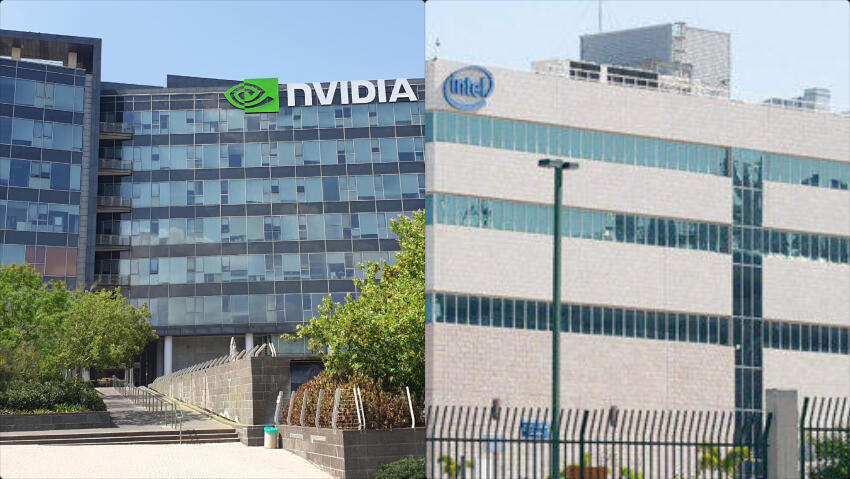
(Photo: Courtesy of Nvidia Israel, Herzl Yosef)
Intel also plans to use a custom graphics chip from Nvidia in its PC processors, potentially giving it an advantage over AMD in the consumer market.
The agreement poses a potential risk to Taiwan’s TSMC, which currently manufactures Nvidia’s flagship processors. Industry watchers say Intel’s contract manufacturing business could one day benefit if Nvidia shifts some production away from Taiwan.
“For Nvidia, the financial impact is small, but the political upside is big: this move aligns with U.S. policy and could help ease restrictions on selling advanced chips to China,” said Matt Britzman, senior equity analyst at Hargreaves Lansdown.
The two companies did not disclose the full financial details of their technical collaboration or a timeline for new products but said they intend to produce “multiple generations” together.
Both Intel and Nvidia maintain major research and development hubs in Israel. Nvidia is expected to expand its Israeli campus, scouting locations in northern cities such as Yokneam, Kiryat Tivon, Haifa and Nesher. Intel’s main R&D center is also in Haifa, alongside its large semiconductor plant in Kiryat Gat, which is undergoing expansion.