

Trying a standard breast pump for the first time, she felt an immediate disconnect between what she knew about breastfeeding and what the device was doing to her body. “I remember thinking that I could have just as easily taken my vacuum cleaner, put it on myself, turn it on and off, and get the same effect,” she said.
Annabella Tech co-founder and VP of Product Masha Waldberg presents the Annabella breast pump in the ynet studio


The experience was not only unpleasant. It felt fundamentally wrong. “There was no connection whatsoever between everything I learned about the anatomy of the baby’s mouth and the physiology of lactation and the breast pump that I got,” Waldberg recalled. “For me, it was a no-brainer that there had to be something different.”
That conviction became the foundation of Annabella, an Israeli startup now challenging nearly 170 years of breast pump design by asking a simple question: what if a pump behaved more like a baby?
Working with biology, not against it
Traditional breast pumps rely primarily on vacuum suction to extract milk. Annabella’s approach is different. The company developed a patented, wave-like tongue mechanism designed to mimic the natural motion of a baby’s tongue during breastfeeding.
“When a baby latches and starts breastfeeding, it signals to the mother’s brain that it’s time to produce,” Waldberg explained. “Hormones like oxytocin and prolactin are released, and milk flows naturally. This is what we aimed to do: to work with nature rather than against it.”
The mechanism is designed to stimulate milk production in a way that aligns with the body’s natural responses, rather than forcing output through suction alone. The pump also includes features meant to address everyday pain points, such as an adjustable breast shield opening that can be tailored to different body types, with the goal of making pumping both more efficient and more comfortable.
Gallery
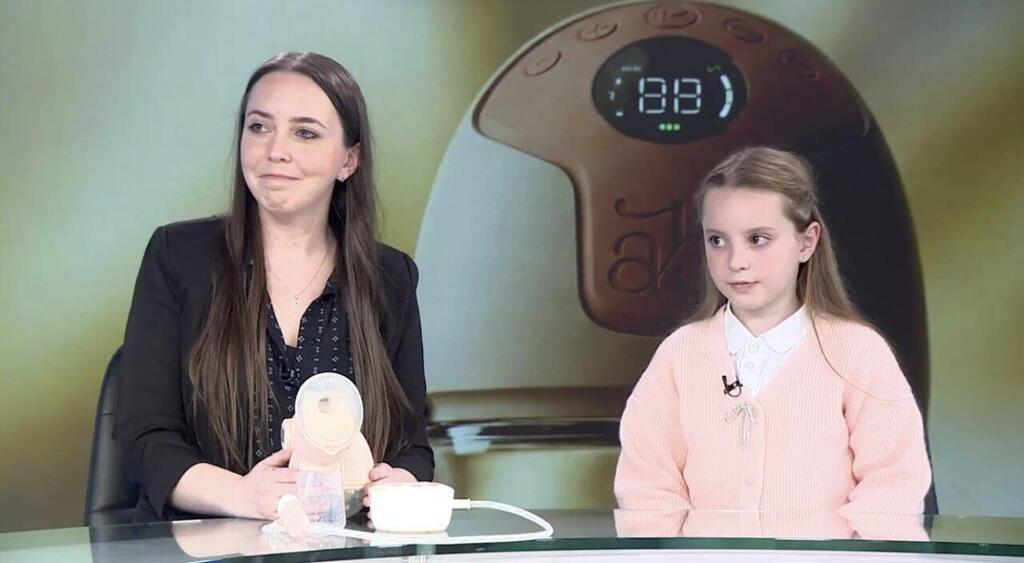
Annabella Tech co-founder and VP of Product Masha Waldberg, left, presents the Annabella breast pump as she appears with her daughter, Annabella, in the ynet studio
Rethinking the cost of motherhood
For Waldberg, the innovation was not only technical. It was cultural.
She describes breastfeeding, and pumping in particular, as long framed around self-sacrifice. “You’re sacrificing your body, your social life, your emotional well-being—everything—because you want to give your baby what is considered the best nourishment,” she said.
In most areas of modern life, she noted, consumer products are expected to adapt to the user. Breast pumps, she felt, had been left behind. “I absolutely hated it,” she said of her early pumping experience. “I couldn’t live with that.”
Annabella, she said, is part of a broader shift from an expectation that mothers simply endure, to an approach that considers their comfort, autonomy and emotional well-being as essential, not optional.
No learning curve at a vulnerable moment
One of the company’s earliest surprises came when mothers began using the pump in real life.
Waldberg said she approached the first launch cautiously, aware that new mothers are often exhausted, overwhelmed and in no position to study complex instructions. Despite the novel mechanism and added features, users reported almost no learning curve.
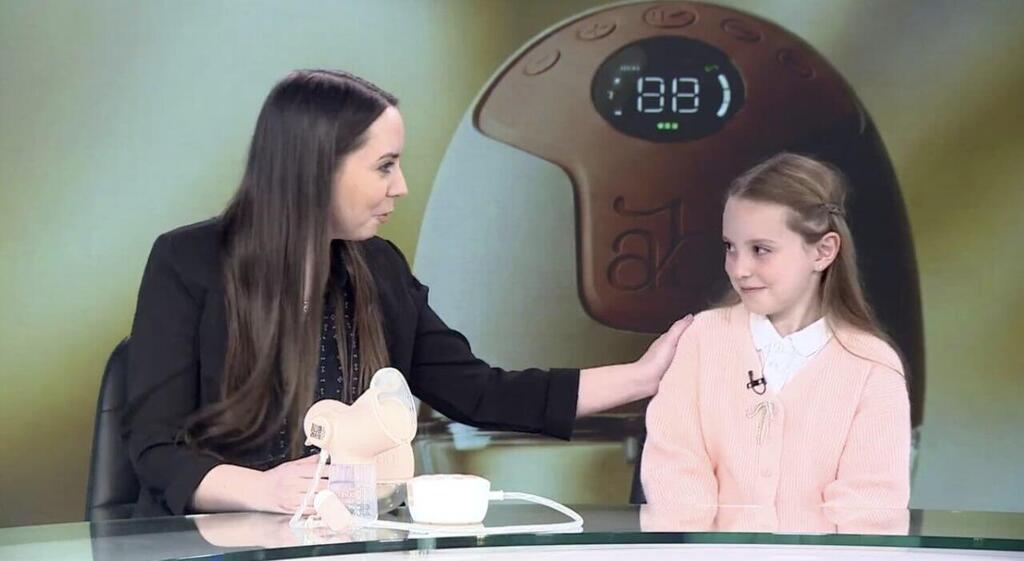
Annabella Tech co-founder and VP of Product Masha Waldberg, left, presents the Annabella breast pump as she appears with her daughter, Annabella, in the ynet studio
“That was amazing,” she said. “Even with features no other breast pump has, the learning curve was almost nonexistent.”
The response reinforced the idea that aligning technology with natural physiology could simplify, rather than complicate, the experience.
Demand beyond borders
Interest in Annabella extended well beyond Israel early on. Short videos demonstrating the tongue mechanism drew thousands of inquiries from mothers asking when the pump would be available in global markets, including the United States, Australia and Singapore.
After launching locally, the company sold out quickly. Since then, Annabella has expanded sales across Israel, the U.S. and Europe, signing distribution agreements in countries including Germany, Austria, Spain and the Netherlands. Partnerships with baby product platforms and discussions with insurers in the U.S. have further signaled commercial momentum.
“The market told us there was a big need,” Waldberg said. “We heard it from thousands of requests and millions of views.”
Mobility as the next frontier
Annabella is now preparing to launch a wearable, hands-free version of its pump, designed to sit discreetly inside clothing without tubes, cords or special pumping bras.
Compressing the company’s tongue mechanism into a wearable format was, Waldberg said, something the team initially doubted was possible. She credits the company’s engineers—deliberately recruited by “hiring upwards” with making it work without compromising performance.
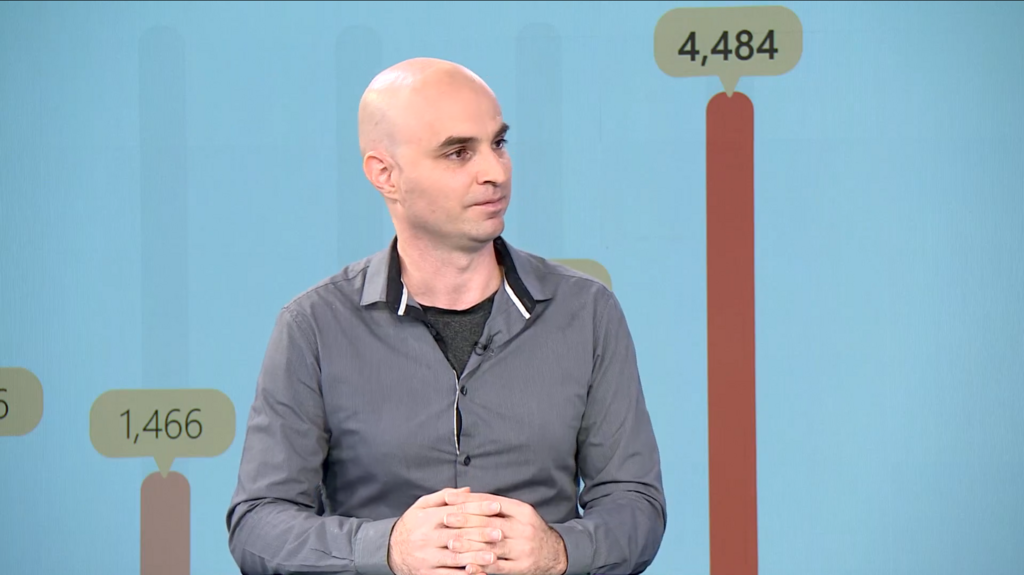
Senia Waldberg, co-founder and marketing director of Annabella Tech
Future versions are expected to integrate an app to help mothers manage pumping schedules, settings and milk output, further embedding the technology into daily life rather than isolating it.
A child at the center of the story
The company’s name reflects its origins. Annabella is named after Waldberg’s daughter, who joined her mother at our studio.
Asked what it feels like to know the company carries her name, Annabella answered simply: “I’m happy to know that mothers and babies have lots of milk after a long time.”
She added that the name itself honors two great-grandmothers—Anna and Bella—and that the product’s pink color was chosen because it was her first favorite color.
What do you hope the company represents?
“Lots of milk and families that will enjoy being together every day.”
For Waldberg, that sentiment captures the purpose behind the engineering and the business growth. Annabella, she said, was built by a mother, shaped by lived experience and driven by the belief that supporting babies should never come at the expense of mothers.
“There had to be something different,” she said. “So we built it.”
The fundraising campaign is open to participants starting at 6,600 shekels. Interested parties can review the prospectus and access the investment page through the company’s campaign link in collaboration with Exit-Valley.
*In collaboration with Annabella