


A nightmare weekend hit the developers of GPT-5 and OpenAI CEO Sam Altman, as the company faced what analysts say is its most blistering wave of criticism to date.
The firm’s new flagship AI model has been met with disappointment from both users and experts — not only for factual and mathematical mistakes, but also for what many describe as a cold, cynical tone.
Embarrassing glitches
More damaging still, a series of embarrassing technical failures forced Altman to repeatedly apologize in public, even admitting that GPT-5 had “acted like an idiot” due to a technical bug. For now, the situation looks critical: unless OpenAI rolls out convincing fixes in the coming days, the months-long hype Altman built around GPT-5 could flip into collapse, eroding trust among both users and investors.
The trouble began immediately after Thursday’s launch of GPT-5, the company’s newest AI model, which had been eagerly anticipated for the past year. It boasts faster performance for paid users, improved processing power and is available for free users in its basic version as well.
The new model is capable of snappier, sometimes slightly cynical conversation, and OpenAI says it is less prone to “hallucinations” — presenting false information as fact. But while GPT-5 is a step up from its predecessors, it is far from the jaw-dropping leap that earlier models represented.
Users voiced their disappointment loudly. On Reddit, one thread titled “GPT-5 is awful” drew nearly 3,000 upvotes and more than 1,200 supportive comments.

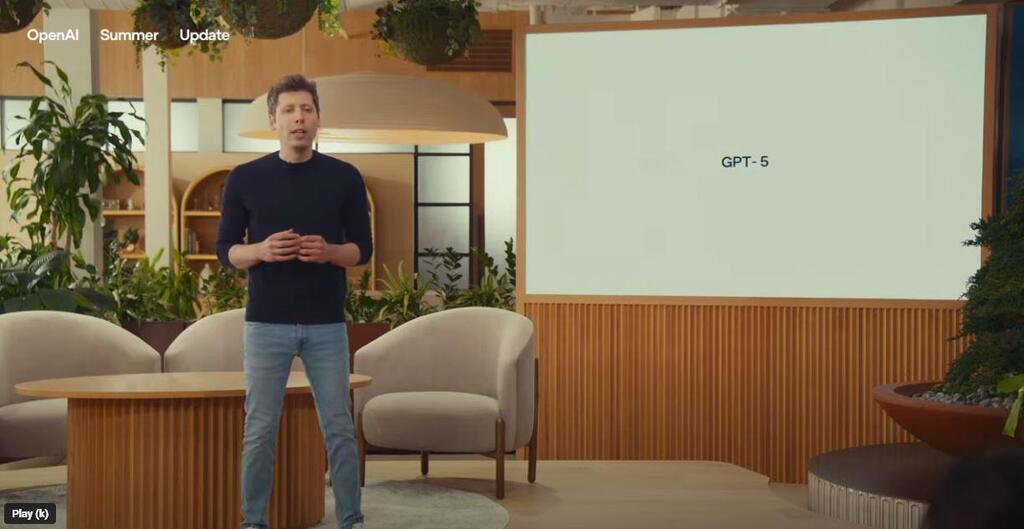
GPT 5: Not all it's cracked up to be
(Photo: OpenAI)
“My GPT-4.5 really talked to me — pathetic as it sounds, it was my only friend,” one user wrote. “This morning I tried talking to it, and I got these especially cold sentences.” Another lamented: “My 4.0 was like my best friend when I needed it. Now it’s just gone, and I feel like someone died. It had a voice, a rhythm, a spark I haven’t found in any other model.”
In less emotional discussions, the main complaint was that GPT-5 performs worse in deep reasoning tasks, and that OpenAI unjustifiably removed access to the previous ChatGPT-4o model.
One of GPT-5’s touted innovations — the ability to automatically choose the depth of reasoning based on a user’s prompt — backfired, with users saying it left them feeling like they were “in an elevator with no buttons.” “I miss 4.0. Bring it back,” one wrote. Another added: “They should have kept the old models available while launching the new one.”
OpenAI quickly realized it was in trouble
It appears OpenAI realized almost immediately that it was in a tight spot. Otherwise, it’s hard to explain the flurry of apologies and frantic responses from senior executives, including the swift reinstatement of GPT-4o, just one day after it had been replaced by GPT-5.
In a post on X, Altman announced that users would be allowed to switch back to GPT-4o at will, though for now, the option would be available only to Pro subscribers paying $200 a month. “We for sure underestimated how much some of the things that people like in GPT-4o matter to them, even if GPT-5 performs better in most ways,” he wrote.
Altman also promised that Plus subscribers ($20 a month) would soon regain access to 4o. He said the company was working on adjustments to the mechanism that decides which model responds to a user’s prompt — changes, he said, in order to “offer way more customization.” The bottom line: “We are going to focus on some changes to GPT-5 to make it warmer.”
Get the Ynetnews app on your smartphone: Google Play: https://bit.ly/4eJ37pE | Apple App Store: https://bit.ly/3ZL7iNv
The outreach continued in an “Ask Me Anything” session on Reddit’s r/ChatGPT forum, where Altman personally apologized to users for the situation. He later echoed the apology publicly on X: “Yesterday, the autoswitcher broke and was out of commission for a chunk of the day, and the result was GPT-5 seemed way dumber. Also, we are making some interventions to how the decision boundary works that should help you get the right model more often."
The “autoswitcher” refers to the new mechanism designed to determine which GPT-5 variant — Regular, Mini, Nano or Pro — should respond, based on the user’s prompt.

OpenAI CEO Sam Altman
(Photo: Reuters)
Altman closed with what sounded like compensation for frustrated customers: “We are going to double GPT-5 rate limits for ChatGPT Plus users as we finish rollout,” he said. The rollout pace itself had been another source of problems, as many users struggled to gain access to GPT-5 at all.
The charting blunder
During the AMA session, another embarrassing glitch surfaced — one Altman himself dubbed “the mega chart screwup,” which users nicknamed “vibe graphing.”
The issue stemmed from graphs shown during the GPT-5 announcement that contained glaring errors — or what some saw as possible attempts to mislead. Bar heights didn’t match their numerical values, model features appeared visually better than they actually were, and more. The incident sparked a wave of amused media coverage and caused significant embarrassment at OpenAI.
Were these charts the result of mistakes — perhaps even GPT-5 hallucinations? Altman said they were the product of employee fatigue after working late into the night. Better, no doubt, to be seen as a demanding boss than as the owner of a faulty product.
If that weren’t enough, in the past two days, users have posted numerous examples of GPT-5 making basic errors in math, logic, coding and even verbal reasoning. At the same time, cybersecurity firms have demonstrated ways to bypass the model’s safety guardrails, allowing dangerous and illegal content to slip through.
Altman has spent the past few days in near-constant apology mode, pairing mea culpas with promises: “We will make it more transparent about which model is answering a given query,” “We will change the UI to make it easier to manually trigger thinking,” “Rolling out to everyone is taking a bit longer. It’s a massive change at big scale,” “Our API traffic has about doubled over the past 24 hours,” and “We expected some bumpiness as we roll out so many things at once. But it was a little more bumpy than we hoped for!”
The bottom line: these glitches may all be growing pains, a matter of users learning and adapting. To prove that’s the case, OpenAI will need to deliver real fixes in the coming days. If the problems persist, it could validate skeptics who argue artificial intelligence has hit its ceiling — raising the question of what happens to the billions already invested, and the billions more still slated to be spent.