


At the annual conference that opened Tuesday night in San Francisco, Microsoft unveiled new artificial intelligence technologies and innovations, with a strong emphasis on cybersecurity aimed at preventing its latest products from becoming new attack surfaces for cybercriminals.
Microsoft has identified the potential not only in AI but also in protecting AI and is entering the field across the board. The company hopes this will convince customers who are still unsure whether AI systems are reliable enough for broad deployment to adopt them on Microsoft’s platforms, reinforced by the company’s AI-driven cybersecurity tools.
Among the standout announcements was the Security Dashboard for AI, the first dashboard of its kind to unify the security picture for all of an organization’s AI assets. The company also showcased advanced security capabilities, including upgraded security agents, such as a threat intelligence agent, a dynamic threat detection agent and more.
Microsoft also presented significant progress on the data front with its new Fabric IQ platform, which introduces an AI-powered smart data layer that links information, business context and operational decisions. This was presented alongside expanded capabilities in Teams Copilot and enhanced management and security tools in Copilot Studio.
Israeli development teams at the forefront
The conference also highlighted the extensive work of Microsoft Israel’s Research and Development teams, which developed several of the company’s core new products. This year saw a strong Israeli presence, with more than 150 Israeli representatives participating, including from Check Point, Zenity, Upwind, Eon, Cyera, JFrog, Vast Data, BigID, Atera, AudioCodes, BlinkOps, Qodo.ai, Semplicity, Genpact Israel, Volumez and ControlUp, along with a major partnership with cybersecurity firm Varonis.
As part of the event, several companies are expected to announce new collaborations with Microsoft, underscoring the depth of the company’s partnerships with Israel’s tech sector.

There was also a strong presence in the “code-to-runtime” security track. One major development, led by Israeli teams, is the new integration between Defender for Cloud and GitHub Advanced Security. The integration unifies a process that until now was fragmented: identifying vulnerabilities during development, assessing their impact in the cloud environment and rapidly fixing them through Copilot Autofix. This enables developers and security teams to work from a shared view of risk.
Israeli teams also led enhancements to Microsoft Defender and Agent 365 in securing the new generation of AI agents. The solution allows organizations to view all AI agents, models and applications running inside the company, determine which are unmanaged and identify those that may expose sensitive information. For organizations entering the world of agentic AI, this tool introduces order to an attack surface that is rapidly expanding.
Microsoft Israel’s teams are also behind several of the standout agents in Security Copilot: the Threat Intelligence Briefing Agent, the Dynamic Threat Detection Agent, the Phishing Triage Agent and the Threat Hunting Agent.
Anfother capability, Predictive Shielding, also developed in Israel, can anticipate an attacker’s next move, reinforce critical defense paths in real time and deploy targeted defensive actions. It is powered by analysis of more than 100 million trillion signals per day, processed through the company’s global cybersecurity intelligence center.
Microsoft wants to lead the era of AI agents
With the opening of the Microsoft Ignite conference, the company presented a significant entry into the full lifecycle of artificial intelligence, from infrastructure to user experience, with the central theme being the use of AI to “fulfill humanity’s aspirations.”
This year, the company placed strong emphasis on the arrival of AI agents into the world of work, unveiling a platform called Work IQ that enables Microsoft 365 Copilot and AI agents to understand how the user works, with whom and on what content.
It is an application layer built on user data, memory and reasoning, connected to the organization’s knowledge repository found in emails, files, meetings and chats, together with user preferences, habits, work patterns and the different contextual environments in which they operate (for example, the organizational setting).
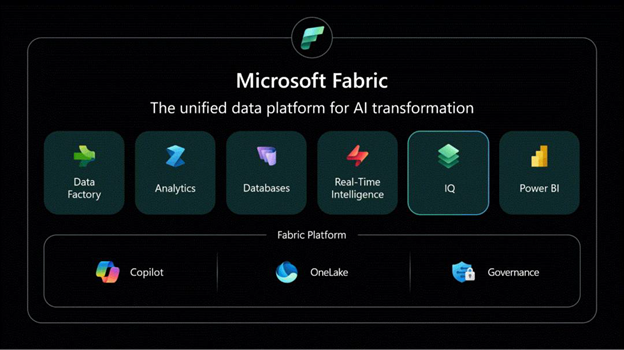
Microsoft Fabric
(Photo: Microsoft)
In parallel, products such as Fabric IQ and Foundry IQ help agents understand user actions, bridge the gap between raw data and its true business meaning, and identify the context required for decision making.
Key capabilities in the Fabric IQ platform include the Operation Agent, an autonomous system that monitors business activity, interprets shifts in context, evaluates options and independently carries out operational tasks.
Microsoft also introduced Microsoft Agent Factory, a program that unifies the IQ layers of agents and allows organizations to build agents efficiently. Through a single measurement framework, customers can begin developing IQ-powered agents using Microsoft Foundry and Copilot Studio and deploy them anywhere, including in Microsoft 365 Copilot, without the need for prior licensing or allocation.
Here too, two important agents that enable more efficient monitoring and security were developed by teams in Israel: Agent Evaluations, which enables the creation of automated tests for assessing agent performance, and Real-Time Monitoring, which includes real-time security capabilities during agent execution.
Microsoft predicts that by 2028, companies will be running some 1.3 billion AI agents. According to the company, most organizations are still not equipped with tools to monitor, secure or manage these agents, and if they fail to manage them, AI agents may turn into shadow IT that is underutilized and exposes the company to new attack vectors.