

Despite just three years of activity and a workforce of about 100 employees, the anonymous Ramat Gan-based company Q.ai, which Apple is acquiring in a deal estimated at more than $1.5 billion, has so far managed to maintain almost complete secrecy about the product it is developing.

“In a world full of noise,” the company hints on its minimalist official website, “we are creating a new kind of quiet.” On LinkedIn, it offers a slightly more revealing clue that only deepens the mystery: “In an era where human communication is everything, we have found a way to take it to the next level, enabling extremely high bandwidth, unprecedented privacy, accessibility, multilingualism and more. Biology can only take us so far. Q.ai will do the rest.”
Understanding whispers
According to leaked reports, the technology allows devices such as headphones and smartphones to “understand” what is being said near them, even when it is whispered, and to capture extremely basic sound in noisy environments. Patent applications filed by the company indicate that it focuses on decoding human speech without using voice, through computer vision sensors capable of detecting micro-movements of the facial skin, cheeks and jaw during internal speech or whispering, even when these movements are invisible to the human eye, and translating them into words or commands.

The patent application filed by Q.ai
( Photo: Q.AI)
Apple is willing to pay billions for this technology, which could dramatically boost the performance of its personal assistant Siri, the Apple Watch and the Vision Pro headset. It would allow users to operate these devices or communicate through them using lip movements alone, and possibly even through thought. Monitoring the vocal and facial muscles during “internal speech” or “silent reading” is a fascinating research field known as silent speech interfaces, or SSI. The primary technology used in this area is electromyography, or EMG, which measures the electrical signals that pass through muscles even when they are not visibly moving. This is an especially complex technological challenge, as the signals are very weak and vary greatly from person to person.
Sending commands through the brain
Q.ai’s breakthrough is likely an optical technology that replaces physical sensors and eliminates the need to attach them. Until now, all methods for monitoring subtle movements of facial skin and muscles relied on sensors attached directly to the body.
The most well-known project in the field was originally developed at MIT and became a commercial company in early 2025. The system, called AlterEgo, includes a wearable device placed on the jaw and neck. It detects neuromuscular signals sent from the brain to the speech muscles while a person is “talking to themselves” internally, allowing users to send commands to a computer, perform calculations and receive answers through headphones without uttering a sound or moving their face.
Unlike technologies that rely on facial movements alone, Q.ai’s system can also perfectly separate background noise from the user’s speech, enabling unprecedented noise reduction during phone calls.
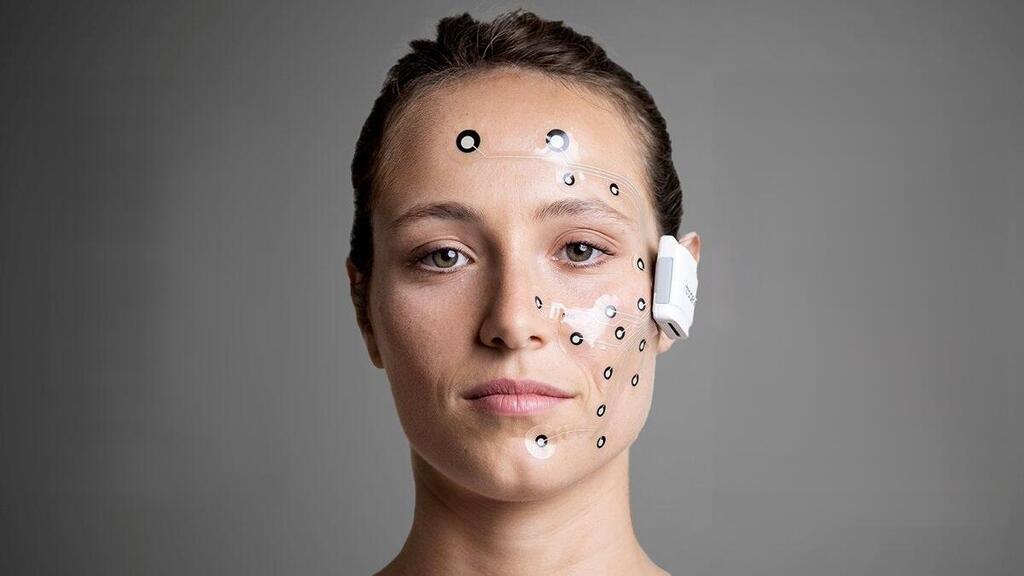
The development by Israeli company xTrodes
(Photo: xTrodes)
Another development comes from Israeli company xTrodes, which offers small, flexible adhesive patches placed on the facial and neck muscles that can monitor and decode subtle EMG signals. These are currently used to help diagnose sleep disorders or muscle problems, but in principle can also be used to translate “silent speech.”
NASA is also considered one of the pioneers in the field, with a system it developed to identify “sub-vocal” speech. The goal is to allow astronauts to communicate in extremely noisy environments or from inside specialized helmets where conventional microphones fail. The system includes sensors placed on the sides of the throat that detect words a person is “uttering” inside their head.

Meta CEO Mark Zuckerberg
(Photo: Nic Coury/AP)
Meta’s Reality Labs recently acquired CTRL-Labs, a company focused on monitoring muscle signals. Here too, the goal is to enable commands through thought or internal speech alone, using wearable sensors integrated, for example, into glasses, which translate muscle signals into digital actions.
Defense establishment interest
Unsurprisingly, the technology is especially relevant for military applications and is currently being seriously examined by Israel’s defense establishment. In an interview published today in ynet and Yedioth Ahronoth, Dr. Alona Barnea, head of the neurotechnology department at MAFAT, Israel’s equivalent of the U.S. Defense Advanced Research Projects Agency, explained: “The brain can ‘understand’ the movements we make with our mouth when we speak, and then I can essentially ‘talk’ to you without making any sound at all. “Think about the operational implications of this when there is a need for silent communication or activity in a noisy area. At the first stage, this can happen with electrodes attached to the facial muscles, an active project currently underway. In the future, we will not even need that. The brain alone will be enough.”
Tom Hulme, managing partner at Google Ventures, the venture capital arm of Google and one of Q.ai’s investors, confirmed the assessments on Tuesday night. “For decades, we were forced to speak the language of machines, learning to type, click and swipe,” he said. “We believe we are in the middle of a new technological revolution, a period in which the machine finally learns to understand us.”
“The technology developed by Q,” he added, “has the potential to reach billions of people and fundamentally change the way we connect with one another.”