

It weighs less than a cup of coffee, launches at the press of a button and can follow you at speeds of up to 60 km/h without you ever touching a remote control. We took Zero Zero Robotics' (ZZR) new camera drone for a test flight and came back with conclusions about the gadget that wants to turn you into a social media star — as well as one observation about its name.
For many Israelis, the name "Hover" immediately brings to mind vacuum cleaners and household cleaning products. But the new HOVERAir X1 Pro that landed on our desk is about as far from a carpet cleaner as it gets — even if it does suck in plenty of air to keep itself hovering steadily at eye level.
Raphael Kahan tests the HOVERAir X1 Pro drone
(Raphael Kahan)


The X1 Pro is the next generation of one of the most interesting concepts to emerge in the gadget market in recent years: a fully autonomous flying camera designed for people who don't know—and don't want to know—how to fly a professional drone, but still want the experience.
ZZR isn't the first company to explore this idea. DJI got there earlier with the simpler Neo drone. But the concept here is both simple and clever: instead of buying a complex professional drone that requires registration, training, joystick skills and the risk of crashing equipment worth thousands into a tree, this compact device simply takes off from the palm of your hand, identifies you using artificial intelligence and follows you while you run, ride a bike, or simply try to look photogenic on vacation.
Design and portability: a pocket-sized book with wings
The first thing that stands out about the X1 Pro is its design. It weighs just 192.5 grams (about 0.42 pounds), placing it comfortably below the weight threshold that triggers stricter aviation regulations in many countries, meaning it generally does not require registration or a drone pilot's license. Folded up, it's roughly the size of a small paperback book and slips easily into a backpack—or even the pocket of a roomy pair of cargo pants.
Its most important design feature is the protective cage. The propellers are fully enclosed within a rigid plastic frame. This engineering decision solves two critical problems at once. First, safety: you can launch it from your hand and catch it again without worrying about losing a finger. Second, durability: if the drone misjudges a turn and bumps into a branch or wall, the frame absorbs the impact, allowing it either to keep flying or simply fall to the ground without damaging the propellers.
My dog wasn't really happy with the noise of the HOVERAir X1 Pro
(Video: Raphael Kahan)
Performance and video quality: the AI eye
Technically, the Pro version represents a significant leap over the first generation. It features a camera capable of recording 4K video at 60 frames per second, as well as 2.7K vertical video tailored specifically for TikTok and Instagram Reels, eliminating the need to crop footage later in editing.
Image quality in bright daylight is excellent, with vibrant colors and impressive detail thanks to an upgraded sensor and an electronic image stabilization system paired with a two-axis mechanical gimbal. That said, don't expect professional cinema-quality footage—it still relies on a smartphone-sized image sensor at its core.
The biggest improvements are under the hood. While the previous generation struggled to keep up with fast cycling, the Pro can cruise at 42 km/h (about 26 mph) and reach a top tracking speed of 60 km/h (around 37 mph). If you're a mountain biker looking to record your trail ride from dynamic angles, it can keep pace.
Its visual tracking algorithm, called ShadowTrack, does an impressive job of locking onto the subject and maintaining track even when the user briefly disappears behind light obstacles, rides through wooded areas, or navigates more challenging terrain.
Official battery life is rated at around 16 minutes per charge, but in our testing we consistently saw about 10 to 11 minutes, depending on flight speed. On the plus side, our review kit included a charger and a second battery, making extended use much more convenient.
The less photogenic side: where does it fall short?
Despite the praise, the X1 Pro isn't without flaws, and there are several important shortcomings to consider before heading to the store.
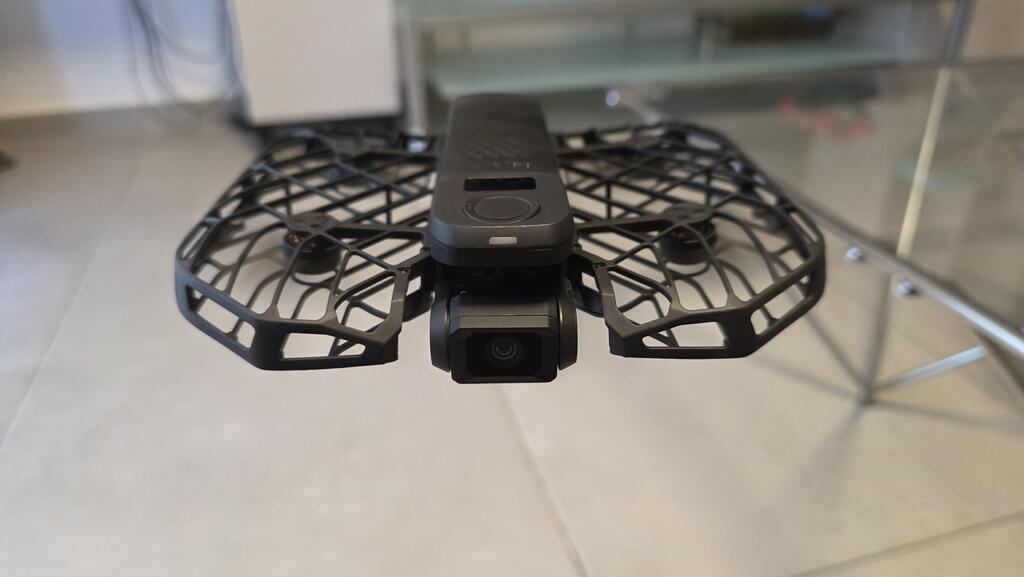
HOVERAir X1 Pro camera drone
(Photo: Raphael Kahan)
First, it's loud. The noise level is comparable to an especially agitated swarm of bees. If you're planning to film in quiet locations, expect plenty of attention—and not always the kind you want.
Audio is another weak point. Sound recorded directly through the drone's built-in microphones is largely unusable because of motor noise. To address this, the company allows users to record audio through a smartphone or its dedicated Beacon accessory, though that workaround requires additional synchronization afterward. In any case, we recommend using a separate external microphone.
Another limitation is obstacle avoidance. While the drone includes active rear proximity sensors, it lacks the full 360-degree obstacle avoidance systems found on more expensive drones. It assumes it is flying along a path you've already cleared. If you make a sharp turn into an area filled with thin branches or power lines, there's a reasonable chance it will end up on the ground.
The cost of accessories is another drawback. The basic package, which sells in Israel for around NIS 1,500 to NIS 1,800 (499 to 600 dollars)., includes only the drone and a single battery. If you want the smart controller with built-in joysticks and a small display—or even just the battery charging hub and an additional battery—you'll need to spend several hundred shekels more, pushing the total cost closer to the price range of significantly more capable professional drones.
Bottom line
Ultimately, the HOVERAir X1 Pro is an excellent gadget that largely delivers on its promise. It doesn't try to be the drone that captures cinematic landscapes from 100 meters in the air. Instead, it aims to be your personal camera operator—one that fits in your pocket or backpack and is always ready to fly.
For cyclists, runners, surfers, or content creators who want to elevate their videos without asking a friend to hold the camera, it's one of the most effective and enjoyable tools currently available. It's simple, durable and, above all, removes much of the effort from aerial filming—as long as you're willing to live with the motor noise and its far-from-budget price tag.