

"We founded Classiq to solve an almost embarrassing problem: Nobody knew how to communicate with a quantum computer. It was a gamble because quantum computers didn't really exist yet. In the two or three years after we established the company, the computers developed considerably, and today, despite what people might think, there are quite a few applications for quantum computing, even if the commercial breakthrough hasn't happened yet. You'd be surprised, but even Ichilov Hospital and the Bank of Israel use our technology."
That is how Nir Minerbi, co-founder and CEO of Israeli quantum computing startup Classiq, described the company's journey Thursday morning, a day after Intel announced it would acquire the business in a landmark deal.
Gallery
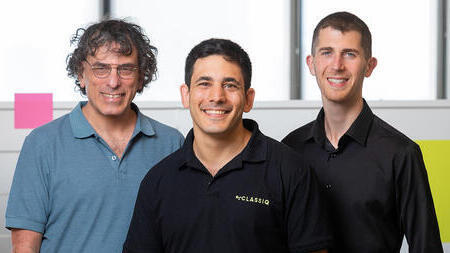
Classiq founders. From right: Nir Minerbi, Amir Naveh and Dr. Yehuda Naveh
(Photo: Eyal Toueg)
Following years of internal turmoil that had also prevented it from pursuing acquisitions, Intel announced Wednesday that it would pay $2.3 billion in cash and stock for the Israeli startup. The deal is the largest quantum computing acquisition in the world to date and is expected to further strengthen Israel's position in the emerging industry.
Israel already ranks among the world's five leading countries in both the number of quantum computing companies and the volume of private investment in the sector.
Minerbi, 35, founded Classiq six years ago alongside Amir Naveh, a friend from their shared military service in the IDF's elite Talpiot program, and Naveh's father, Yehuda Naveh, who previously led IBM's quantum computing program in Israel.
"Amir and I have been friends for 20 years. Ever since we left the army, we knew we wanted to build something together, but we also knew it wouldn't be cybersecurity," Minerbi said.
"At the time, Yehuda was leading IBM's quantum computing efforts in Israel, so we started flirting with the field. Google had just announced quantum supremacy in 2019. We put together a presentation for Entrée Capital, which is by far the strongest deep-tech investor in the world. After 35 minutes of meeting with us, they said, 'We're in.'"
But the years that followed were far from easy.
"I hate the term 'deep tech' because it's almost like an excuse: You don't have revenue, and you don't need customers. But you can only play that game for so long, so we decided to do the opposite," Minerbi explained. "It was important for us to build a customer base, and ultimately that's what Intel really liked: We also know how to do business."
Sold to Intel for $2.3 billion
(Photo: Shutterstock)
For Classiq, the acquisition represents something of a full-circle moment. In its early days, the company participated in Intel Ignite, the chipmaker's startup accelerator program.
"We worked with Intel over the years, and in the end, this became a very natural connection for two reasons. First, I'm originally from Haifa, and a Haifa native at heart, and Intel holds a special place in every Israeli's heart. Second, when you're building an entirely new world of computing, Intel is the obvious name that comes to mind," Minerbi said. "They have many hardware capabilities that can serve the quantum industry. What was missing was the software that would allow users to work with all these systems."
According to Minerbi, Intel's chief technology officer, a close associate of CEO Lip-Bu Tan, presented the acquisition to investors and analysts Wednesday and compared Classiq's potential role to that of CUDA for Nvidia or DOS for Microsoft: software that serves as a bridge between hardware and the end user.
'A once-in-a-century business opportunity'
The quantum revolution has supposedly been just around the corner for nearly 20 years. What's different this time?
"Quantum computing is an entirely new world of computing. It's a revolution people have been discussing since the 1980s because all the computers we know today share essentially the same DNA, while quantum computing is something completely different.
"What has changed in recent years is that the conversation has shifted from 'Will it happen?' to 'When will it happen?' That's because the challenge has moved from being a scientific problem to an engineering problem, and engineering problems can be solved. When it happens, it will be a once-in-a-century business opportunity. A company like Intel is less sensitive to the exact timing, whether the breakthrough happens in a year or two."
Before the sale, you seriously considered going public. Why did you ultimately decide to sell?
"We examined several alternatives recently, including the public market. There were opportunities both through a SPAC and through a traditional IPO. You could say we came close to going in that direction. There was also strategic interest from other companies.
"There's an unprecedented anomaly in the public market for quantum computing companies, and the closest comparison is the pharmaceutical industry. There's an enormous promise that allows companies with almost no revenue to trade publicly, but that also creates volatility that isn't for the fainthearted.
"Even if we had decided to go public, I'm not sure we would have done it now. We might have raised another private round instead."
Minerbi was referring to recent declines in quantum computing stocks, which have pushed the valuations of some of the sector's largest and leading companies down from levels in the tens of billions of dollars to around $10 billion or less.
Given Intel's mixed track record with acquisitions, what will make this deal successful?
"Intel is in an incredible position to serve the entire industry. And yes, Intel is developing its own quantum computer, and it's phenomenal. Ultimately, when you combine that with the software, the opportunity becomes enormous.
"Let's meet again in a year or two. There's a good chance Intel will be among the first companies people think of when they hear 'quantum computing.' I focus less on Intel's history and more on the people leading it today. They emphasize how important it is for us to continue operating like a startup within Intel. We have confidence in this partnership. Both sides have something to prove, but the burden is greater on us."
How large is Intel's quantum computing operation today, and where will Classiq fit into it?
"We will lead Intel's quantum strategy, and that leadership will come from Israel. It's still too early to say what each person's role will be, but Intel keeps emphasizing that it needs every one of our employees. Intel currently has only 70 employees working in quantum computing, so adding Classiq's 140 employees is a dramatic expansion.
"Until now, Intel's quantum activities have been focused on research and development rather than building a commercial business. With Classiq making the technology accessible to end users, Intel will have an opportunity to go from zero to one. We'll report to the CTO organization, but Intel keeps telling us that it wants us to preserve our startup culture and our Israeli identity."
Have you benefited from Israel's national quantum computing program, and what should the next government do to support the sector?
"Financially, the amount we received from the government was very small, but strategically it was important. Before founding Classiq, I had the impression that the Israel Innovation Authority was something like a welfare system for failing companies. But I learned that this really wasn't the case. They helped make both the massive fundraising rounds and the company's development possible. For every shekel the Innovation Authority invested, we raised 100 shekels from private investors."