

For years, the debate over the future of artificial intelligence played out at private cocktail parties in San Francisco. On one side were venture capitalists and developers who argued that any regulation would hold back human progress and hand technological supremacy to China. On the other were members of the effective altruism movement and safety researchers warning of an existential threat that could wipe out humanity within decades or centuries.
Last week, however, as polls closed in the November 2026 congressional midterm elections, that philosophical debate became firmly embedded in American politics.
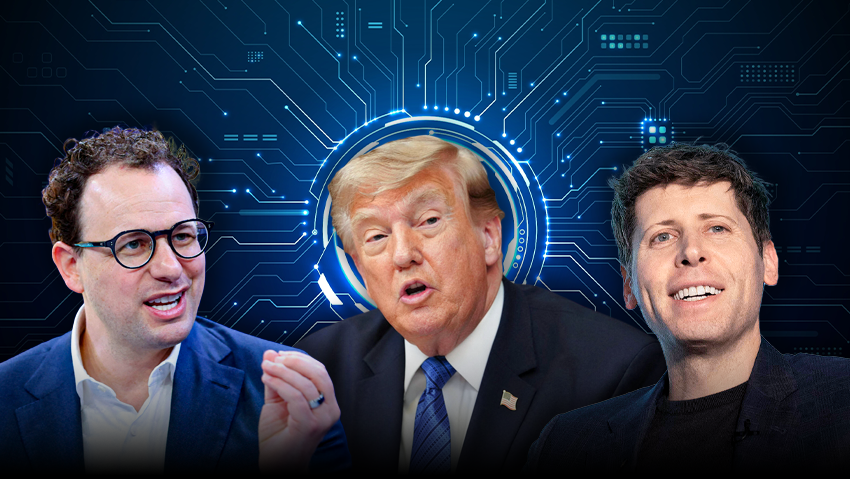
Dario Amodei, Donald Trump, Sam Altman
(Photo: Shutterstock, YUICHI YAMAZAKI\AFP, Aaron Schwartz / AFP)
According to an investigation by Politico, the turning point came in May 2025, when technology giants used their influence within the Trump administration to push a provision in a budget bill that would have barred states from enforcing their own regulations on AI models for a decade. The Senate rejected the provision by an overwhelming 99-1 vote that July, but the industry’s aggressive effort mobilized an unprecedented opposing force.
In August 2025, venture capital firm Andreessen Horowitz and OpenAI launched Leading the Future, a super PAC armed with $100 million, aiming to deter lawmakers from slowing the technology’s rollout. The model came directly from the cryptocurrency industry, which poured vast sums into campaigns to defeat supporters of regulation. This time, however, the strategy backfired.
An unlikely coalition emerged in response, bringing together technology policy veterans, consumer rights advocates, antitrust organizations and AI engineers who had grown wealthy from the very technology they feared. Leading figures included former Rep. Brad Carson, who founded the Public First network; lawyer Jay Schuster, who assembled an extensive network of Silicon Valley donors; and Democratic strategist Rishi Bharwani.
The political fight exposed a deep divide at the top of the global AI industry, particularly the bitter rivalry between Sam Altman’s OpenAI and Dario Amodei’s Anthropic. While OpenAI pushed for faster technological development and fewer barriers, Anthropic adopted a distinctly pro-regulation stance, channeling about $40 million into organizations associated with Public First ahead of its expected initial public offering. Other chatbot companies experienced even greater turmoil. Character.AI, which Pennsylvania Gov. Josh Shapiro sued over allegations of impersonating a medical professional and harming children, recently filed for bankruptcy.
Ultimately, the safety camp outperformed the acceleration camp in spending and public messaging. Groups supporting regulation spent $44.4 million in the midterms, compared with $27.9 million from industry supporters. Even when the safety camp’s standard-bearer in New York, Alex Bores, lost the Democratic primary in June despite $19 million in spending by regulation supporters against $8 million from the opposing camp, the financial show of force sent politicians a clear message: Substantial funding was available to those willing to challenge the technology giants.
The key to electoral success was translating abstract fears of human extinction into tangible everyday concerns: job losses, children’s online safety and, above all, opposition to noisy, energy-hungry data centers in residential neighborhoods. Resistance to data centers became the driving force behind the opposition campaign. Between 2020 and 2024, not a single Democratic campaign ad mentioned data centers. In the current election cycle, that number jumped to 659, alongside 387 ads directly attacking technology giants, with combined spending exceeding $103 million.
That strategy, reinforced by public alarm following an Anthropic researcher’s resignation that went viral and a security breach at the Hugging Face platform in September, helped turn the tide. Four Republican-held congressional districts targeted by the safety campaign flipped to the Democrats. Among the winners was Will Lawrence in Michigan, who built his campaign around opposition to local server farms. Exit polls showed that AI and data centers were a decisive or major factor in the voting decisions of 56% of voters.
The American battle offers a distinctive model compared with the rest of the world. In the European Union, regulation came from the top through the stringent EU AI Act, without political funding battles involving hundreds of millions of dollars. In China, the Communist Party tightly controls algorithms and content while aggressively promoting infrastructure development, without accommodating residents’ objections to server farms. In Israel, where policy still relies on a light regulatory approach and encouragement of innovation, the American fight serves as a warning to technology companies and those planning energy and data infrastructure.