

U.S. President Donald Trump called Nvidia CEO Jensen Huang during an industry summit on Monday, delivering an emphatic defense of artificial intelligence after Huang put the president on speakerphone before the audience.
Trump dismissed concerns over AI safety as a “hoax” and told Huang during the All-In Summit that the United States must outpace China in developing and deploying the technology.
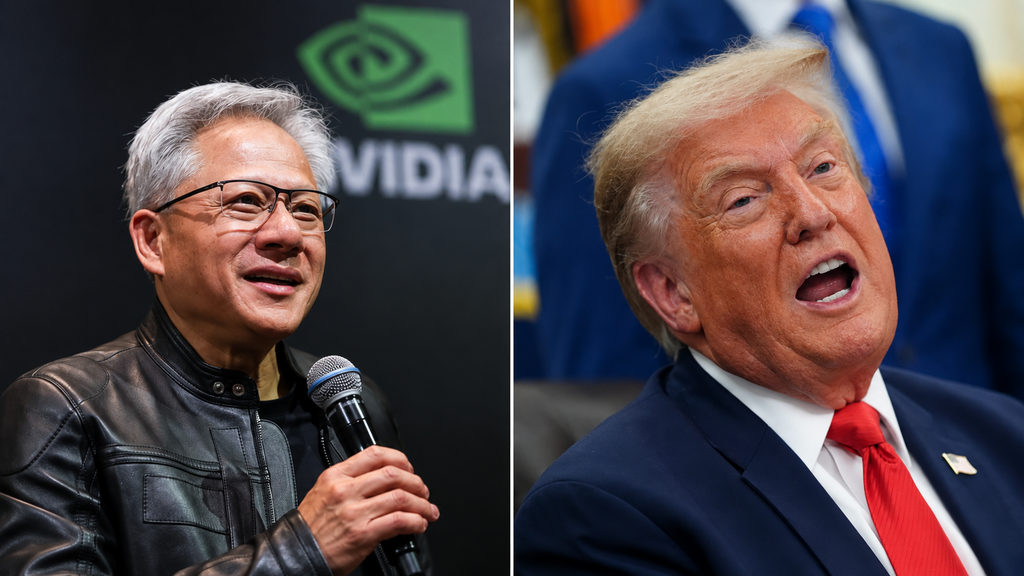
Jensen Haung, Donald Trump
(Photo: AP/ Julia Demaree Nikhinson, AFP)
“The robots will not be taking over. The AI will not be taking over the rest of the world. The whole thing is a hoax,” Trump said, suggesting that critics are “just playing right into the hands of a lot of people that don’t want to see it happen. That could be political people, that could also be China.”
Trump also defended the rapid expansion of data centers, which have faced growing political resistance in some parts of the country over their energy use, infrastructure demands and local impact.
“It’s the oil of the next 20, 25 years, it’s bigger than the internet and AI, you know, much more so,” he said, while adding that people “have to be a little careful” and do things “prudently.”
A video of the conversation was posted on X and later shared by the Trump War Room account, which is linked to a pro-Trump political action committee. The exchange also appeared in a podcast Huang was recording at the time.
Nvidia said it had no comment on the conversation or on whether Huang and Trump were expected to meet again soon.
Trump’s remarks to the head of one of the world’s dominant manufacturers of AI chips came as some of the industry’s most prominent figures were calling for tighter safeguards around the technology.
Anthropic CEO Dario Amodei wrote in an essay over the weekend that AI development required stronger protections. His argument was quickly endorsed by Tesla CEO Elon Musk and OpenAI CEO Sam Altman, among others.
The debate intensified after several researchers at leading AI companies left their jobs last week and publicly raised concerns about the pace of development, with some warning that advanced AI could pose an existential risk to humanity.
Former President Barack Obama also called on Democrats last week to develop a clearer policy agenda around AI.
Trump, however, has consistently pushed back against calls to slow the technology’s development. In a series of social media posts Monday, he described AI concerns as a “SICK conspiracy” and a “hoax.”
During his call with Huang, Trump said he assumed the Nvidia chief agreed with his approach. Huang said he did.
“We’re going to make sure that everybody wins in the AI race in America. Every industry, every company, every state, every people,” he told Trump during their call.
Huang, who helped persuade Trump last year not to deploy National Guard troops to San Francisco, serves on the president’s council of science and technology advisers.
He has also lobbied lawmakers to allow Nvidia to sell its products more broadly around the world, a position that has drawn concern from members of Congress who argue that expanded sales could benefit China and weaken U.S. technological leadership.
The call came as the political fight over AI safety was also intensifying on Capitol Hill.
House Speaker Mike Johnson, R-La., who had faced pressure from House Democrats to bring lawmakers back early from recess to consider AI safety legislation, said Monday that industry leaders should take the lead in setting safeguards.
Johnson also said Trump planned to convene a meeting with AI executives.
A source familiar with the discussions told NBC News that such a meeting was “in the works,” although no firm date had been set.