


June 2025 was a scorching month—not just because of the heat wave. While Israel was preoccupied with the war against Iran, it appears foreign networks were working overtime to undermine the country’s stability.
A report by media watchdog FakeReporter reveals the digital battlefield waged—and still being waged—beneath our noses, offering a behind-the-scenes look at modern influence warfare executed by the Islamic Republic against Israel.
Gallery

Iranian Supreme Leader Ayatollah Ali Khamenei, Prime Minister Benjamin Netanyahu
(Photos: Iranian Leader's Press Office - Handout/Getty Images, Haim Goldberg/Flash90, IDF)
The report monitored eight different influence networks on X, Facebook, TikTok and Telegram between June 13 and 18, and paints a grim—but unsurprising—picture: demoralization, intimidation and repeated attempts to deepen social divisions. As often happens during crises, social platforms become fertile ground for narrative campaigns aimed at eroding public trust, and these campaigns are alarmingly aligned with real-world developments.
The narratives uncovered are not overly sophisticated, but their strength lies in their simplicity and emotional appeal. To demoralize and intimidate, the message is clear: Iran is a powerful, existential threat and Israel is in jeopardy. Videos allegedly showing missile strikes in Israel—many of them fake—were circulated in June to sow fear.
Platforms like Zchutenu and Azaka T'kifa (Attack Alert) were central distribution hubs. The Iranian-backed Hebrew-language channel Kol David on X amplified these messages too, even spreading baseless claims about downed Israeli F‑35 jets
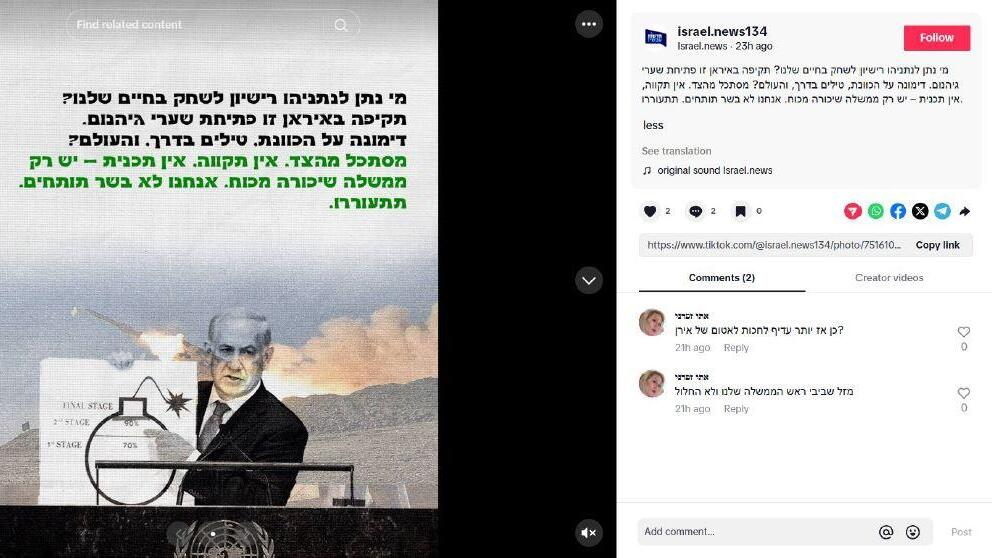
Another recurring theme contended that senior leadership, especially the prime minister, had abandoned the country in its hour of need—leaving the public to fend for itself and risking catastrophic war. Derogatory terms like “Netnazi” (a portmanteau of Netanyahu and Nazi) appeared on Zchutenu, alongside doctored videos showing the prime minister boarding a flight to safety.
Accounts like Dma’ot HaMilchama (Tears of War), Sara Aviram (20,000+ followers), Neged Mehagrim Bilti Hukyim (Against Illegal Immigrants) and Miriam Kozak actively spread these messages with deepfakes and edited clips. TikTok channel News Israel (1,400+ followers), positioning itself as a truth-teller, amplified demoralizing content and attacked the prime minister's handling of the Iran war.
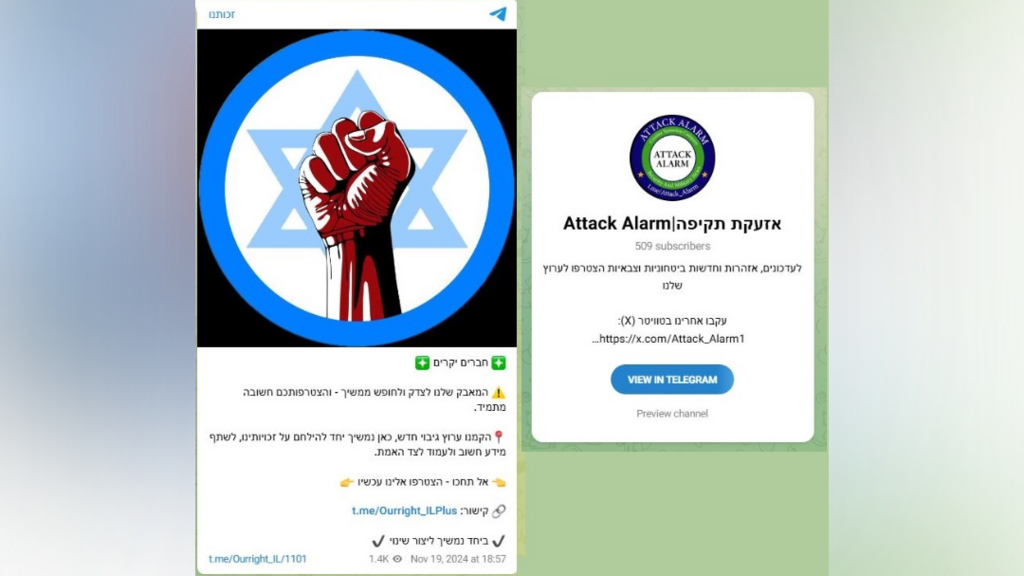
Telegram groups found to be foreign influence networks
(Photo: Screenshot)
Attempts to exploit existing divides in Israeli society were also evident. Posts falsely accused supporters of specific parties of being “Iranian agents,” claiming that missiles only target their neighborhoods. Dma’ot HaMilchama and Sara Aviram fanned the flames of hatred, leveraging public grief to drive social division.
Powerful tactics included rapid dissemination of fabricated content depicting attacks or heavy damage in Israel. In some cases, even legitimate Israeli media outlets fell prey to these manipulations.
Psychological research underscores that fake news and propaganda during wartime pose a significant threat to citizens’ mental resilience and public trust. In crises, audiences become more vulnerable—and narrative attacks on leadership and institutions can destabilize internal cohesion.
The report notes that, following the ceasefire announcement, most of these networks “returned to routine,” focusing mainly on anti‑Netanyahu and government content in the context of the Iran war—alongside the fighting in Gaza and hostage-related discussions. Iranian-affiliated profiles, however, maintained a propaganda-driven narrative claiming victory in the operation.
Disinformation as a strategic weapon
This is not a marginal issue, but a clear manifestation of a global trend documented in numerous studies: while social networks enhance civic engagement, they also fuel disinformation, manipulate public opinion and exacerbate polarization. False information—spreading faster than truth—complicates voter decision-making. Constant exposure to dividing rhetoric erodes trust in democratic institutions and weakens satisfaction with democratic governance.
Influence campaign by foreign and Iranian networks
(Photo: FakeReporter)
The lack of adequate regulation enables hostile actors—including foreign states—to aggressively infiltrate public discourse, intentionally undermining national resilience. Although platforms make some efforts to remove harmful content, there is a pressing need for balanced oversight that protects national security while respecting free speech.
Social media is a double-edged sword. It offers unprecedented opportunities for civic participation and access to information—but it is also a breeding ground for disinformation, division and instability. The impact on democracy and national security is far-reaching.
Get the Ynetnews app on your smartphone: Google Play: https://bit.ly/4eJ37pE | Apple App Store: https://bit.ly/3ZL7iNv
Addressing these threats requires deep understanding of digital dynamics, as well as regulatory and educational tools to strengthen public and national resilience. If citizens of a democratic state can’t differentiate fact from fiction, they become digital “cannon fodder” in this influence war—and tragically, that threat is not fake.
Behind the scenes of the influence war
FakeReporter told Ynet that the influence of foreign propaganda is not measured merely by likes or views, but by its ability to trigger underground shifts in perception.
Many of these channels have only hundreds or thousands of views—far less than mainstream Israeli media. Have you investigated their effect on public sentiment?
“Influence isn’t measured by popularity alone. These networks are crafted meticulously to seem authentic and kept dormant until activation. Fake profiles, like good wine, deepen, gain credibility and become more valuable over time—built to be activated at the right moment. Moreover, sentiment can be shaped by influencing journalists, influencers and even minor political activists—sometimes yielding greater impact than mass public reach. Therefore, actors target people by ideology to shift opinions. They also work to recruit agents—some unwittingly—so numbers or reach aren’t necessary.”

Foreign social media posts aimed at undermining the sense of achievement in the war and affecting resilience
(Photo: FakeReporter)
Why not simply demand platforms remove them?
“Our organization, with limited resources, can identify these networks—why can’t the state or tech firms? Why are they still online? The answer: no regulation and no accountability from social platforms. Frameworks like Israel’s National Cyber Directorate are only just beginning to detect and dismantle such networks. Their work is valuable—but insufficient without serious pressure on platforms.”
FakeReporter called on the government to adopt a holistic strategy including legislation, enforcement, public education and community engagement for a deeper and broader response. Just as anti-smoking campaigns took years of regulatory effort, a sustained approach is needed for harmful online behavior. Civil society organizations can help raise awareness and serve public interests.
Do you have any estimates on the scope of networks that have not yet been identified?
"It is difficult to estimate how many networks there are that have not been identified, but at any given moment, there are several networks operating across social platforms. However, the more the public is aware and knows how to think critically about the problem, the more effectively we can combat the phenomenon.
"We call this the 'influence trap' - the more influence a network wants to have, the more people it needs to be exposed and in contact with. And the more exposed it is, the higher the risk of being caught. If enough people know how to identify and know that action can be taken against these foreign networks, we can thwart more malicious activity."
FakeReporter also published a public guide titled “How Not to Become an Iranian Agent,” detailing behavioral patterns and tips to help users identify suspicious profiles and networks. Public vigilance, they say, is the first line of defense in this war.