
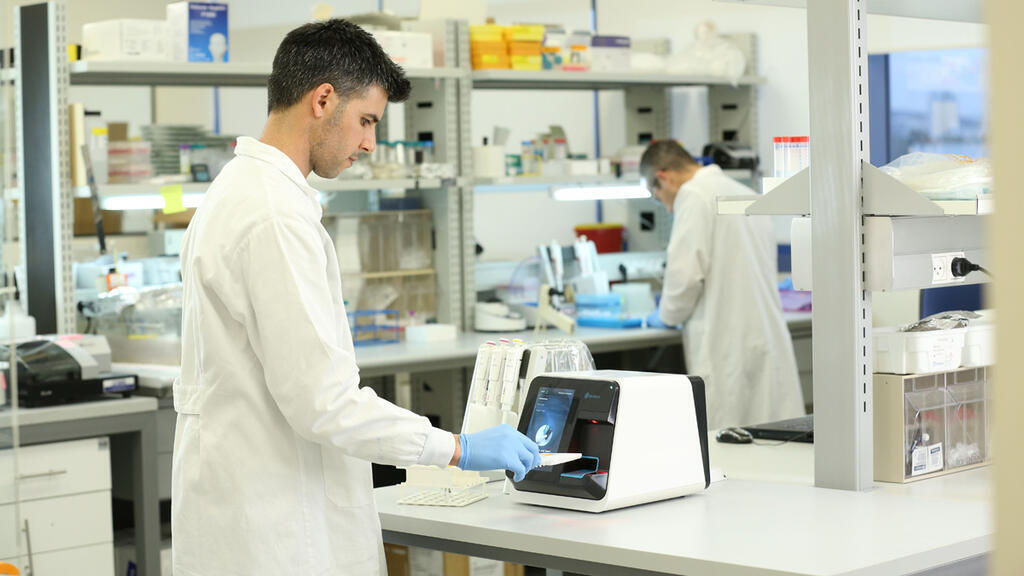
Few medical decisions seem so simple, yet create so much uncertainty: Is the infection bacterial, and therefore potentially in need of antibiotics, or viral, meaning antibiotics will not help? For years, physicians have tried to answer that question using symptoms, blood tests and tests that directly search for the virus or bacteria. Israeli company MeMed chose to look in a different direction: instead of searching for the invader, read the body’s response to it. The result is MeMed BV, a blood test that can help physicians distinguish between bacterial and viral infections in about 15 minutes.
The story began at the Technion – Israel Institute of Technology, where Eran Eden and Kfir Oved met as students. Eden moved between computer science and biology and later completed a PhD in systems biology at the Weizmann Institute of Science; Oved studied medicine and immunology at the Technion. The two had already worked together on problems involving the immune system, but they were looking for a major medical challenge where the combination of biology, medicine and data analysis could produce a practical solution. One of the most pressing was unnecessary antibiotic use: when it is unclear whether an illness is bacterial or viral, doctors sometimes have little choice but to prescribe antibiotics “just in case.”
MeMed BV, a blood test that can help physicians distinguish between bacterial and viral infections
(Video: MeMed)


That led in 2009 to the idea that would become MeMed. The key was understanding that the immune system does not respond in the same way to every infection. Instead of trying to detect a bacterium in the throat, lungs or elsewhere in the body, it is possible to measure the “fingerprint” that the body’s fight against it leaves in the blood.
After years of research and screening large numbers of biomarkers, the company focused on three proteins whose levels are altered differently by the immune system during bacterial and viral infections: TRAIL, IP-10 and CRP. An algorithm combines the three into a single score designed to give physicians another piece of information when determining whether an infection is bacterial or viral.
This represents a fundamental departure from conventional diagnostics. A test that searches for a pathogen needs to know what it is looking for and sometimes must also reach the specific location where that pathogen is present. MeMed BV asks a different question: How is the body responding right now? This allows it to work across a broad range of viruses and bacteria without depending on the identification of one particular pathogen.
The test is not intended to replace a physician, a culture or clinical judgment, but rather to add a new layer of information. “At its core, MeMed is about decoding the signals of the immune response to help physicians make more informed decisions,” Eden said in a company statement when the technology received European approval in 2020.
Getting there was a long process. The first generation of the test required a laboratory and took about two hours. The company later developed MeMed Key, a compact platform that allows the test to be performed in approximately 15 minutes. The test received FDA clearance in the United States, which was subsequently expanded to include direct use with whole blood. It is also approved in Israel and Europe, and in March 2026 received regulatory approval in Canada. According to the company, more than 100,000 patient tests had been performed using the technology by June 2025.
In recent years, the next crucial stage has been determining whether this additional information actually changes treatment decisions. A randomized U.S. trial found that when the test indicated a viral infection, antibiotic prescribing fell from 25% to 12%. In cases classified as bacterial, antibiotic prescribing increased from 41% to 78%, without an increase in emergency-room revisits or hospitalizations.
In Britain, the NHS is currently funding a hospital trial involving children who arrive with fever, examining whether the test can accelerate the diagnosis of dangerous conditions such as sepsis and meningitis while reducing unnecessary treatment.

Eran Eden
(Photo: MeMed)
At the same time, MeMed is working to make the technology even more accessible. In March 2026, the FDA granted Breakthrough Device designation to MeMed BV Flex, an investigational version designed to make the same distinction using just a few drops of blood from a finger prick, with results in approximately 15 minutes. If it receives full regulatory clearance, it could bring the test to clinics and urgent-care settings that do not operate advanced laboratories.
The implications extend far beyond reducing the time patients wait for a result. Overuse of antibiotics is one of the major drivers of antimicrobial resistance, a problem that has become one of the greatest threats to modern medicine. MeMed is trying to confront it not by developing a new antibiotic, but by intervening one step earlier: giving physicians a better reason to know when antibiotics are actually needed.
In this case, the breakthrough is not about finding the enemy—it is about learning to listen more closely to the body fighting it.