

ChatGPT continues to dominate the global AI market, but rivals are gaining ground, according to a new report by venture capital firm Andreessen Horowitz (a16z). The report, based on Similarweb traffic data and Sensor Tower app usage data, tracked monthly visits to AI websites and monthly active users of AI apps.
ChatGPT led by a wide margin across both platforms. Google’s Gemini came in second, with its website drawing about 12% of ChatGPT’s traffic. On mobile, the gap narrowed: Gemini reached roughly half the active users of ChatGPT.
Gemini’s growth trajectory, however, is steep. Website visits rose from 284 million in February to 700 million in July, compared with 5.72 billion for ChatGPT. Google placed three other tools in the top 50 websites: AI Studio (No. 10), NotebookLM (No. 13), and Google Labs (No. 39).
China-based DeepSeek ranked third in website traffic, followed by Elon Musk’s Grok. Although Grok had no mobile app at the end of 2024, it has since gained 20 million active users and jumped to No. 23 in the mobile rankings. The launch of Grok 4 in July spurred a 40% surge in app users, according to the report.
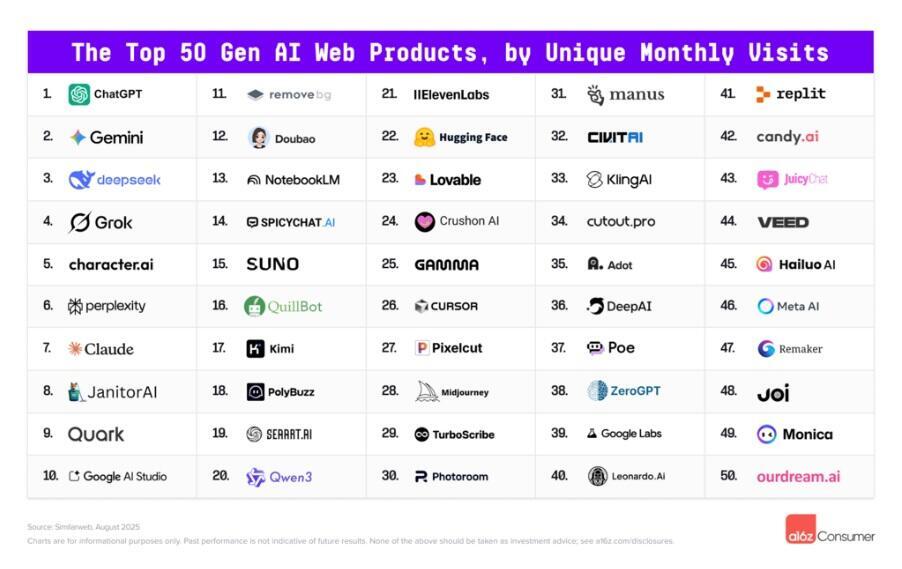
50 most popular AI websites according to Andreessen Horowitz
(Photo: Andreessen Horowitz)
Meta continues to lag behind. Its Meta AI ranked just No. 46 among websites and failed to break into the top 50 apps. Meanwhile, both Claude and DeepSeek saw sharp declines on mobile. DeepSeek’s active users dropped 22% from its peak, while website traffic plummeted 40% since February. By contrast, Claude and Perplexity grew on desktop, with Perplexity seeing the biggest leap on mobile, climbing from No. 50 in March to No. 10 in the latest rankings.
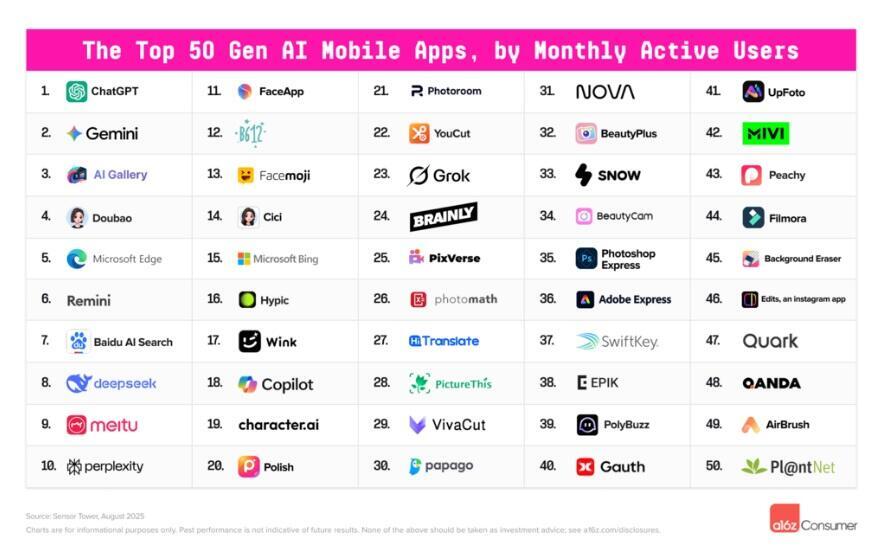
50 most popular apps
(Photo: Andreessen Horowitz)
China is rising in mobile AI
Three companies serving mainly Chinese users broke into the top 20 websites, with more than 75% of their traffic coming from China: Quark from Alibaba (No. 9 web, No. 47 mobile), Doubao from ByteDance, TikTok’s parent company (No. 12 web, No. 4 mobile), and Kimi from Moonshot AI (No. 17 web).
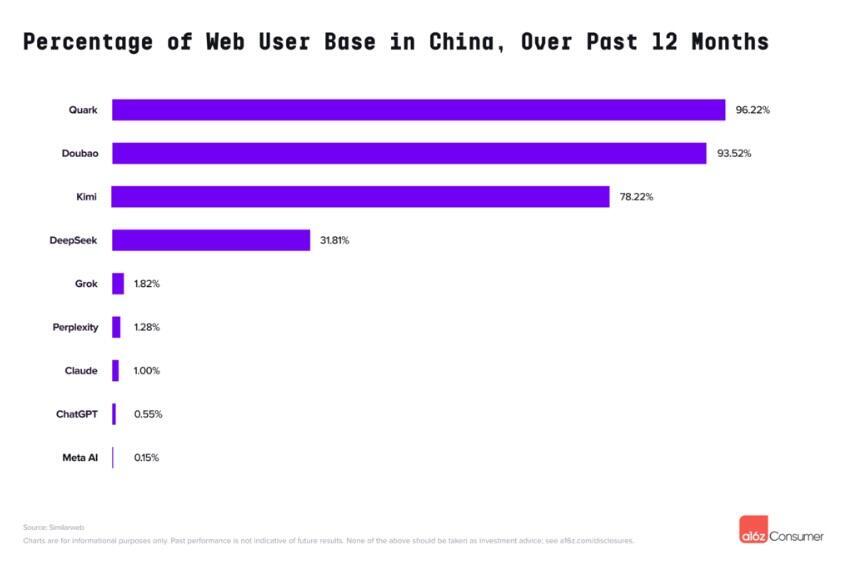
AI tool traffic in China
(Photo: Andreessen Horowitz)
China’s ascent is particularly visible in mobile AI. Of the top 50 apps ranked globally, 22 were developed in China, though only three are used primarily by Chinese users. Many of these focus on images and video, where Chinese firms hold an edge thanks to a strong research base and looser copyright restrictions.
Web coding tools are also climbing in popularity. Bolt, which entered the rankings at No. 48 in March, fell just outside the top 50 this time (No. 52). Taking its place were Lovable, which leaped to No. 23 from No. 55, and Replit at No. 41.