

Israel’s national plan to accelerate artificial intelligence development - a move designed to establish global leadership and strengthen the country’s technological sovereignty - was published last week by the Prime Minister's Office with with relatively little media attention.
The plan, formulated under the National AI Initiative at the PMO, sets out several ambitious goals, including the establishment of sovereign infrastructure and the unprecedented procurement of 100,000 processing units (GPUs) for government and national use.
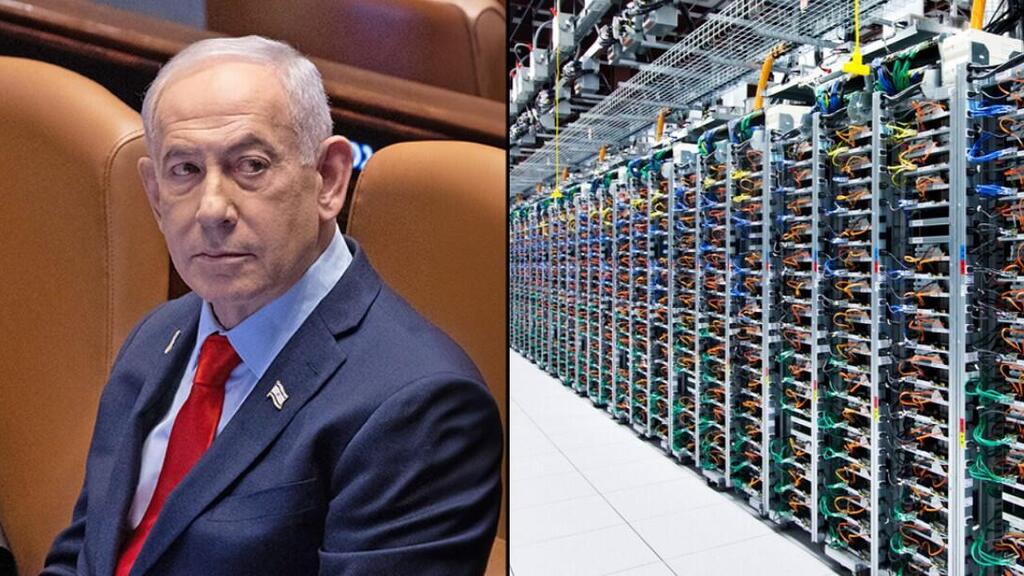
Prime Minister Benjamin Netanyahu; a data center
(Photos: Alexander Kolomoisky, Shutterstock)
Behind the celebratory announcements, however, lie significant budgetary challenges and longstanding political gaps. ynet spoke with Professor Nadav Cohen, a computer science and AI researcher at Tel Aviv University and co-founder of Imubit, to better understand the plan’s implications.
'A very ambitious and extremely costly goal'
Asked about the economic significance of acquiring 100,000 processing units, Cohen said: “One hundred thousand compute units is a very ambitious goal that could easily cost tens of billions of dollars. If we are talking, for example, about advanced Nvidia servers like the H100, the costs are enormous. In addition, computing units and servers become obsolete very quickly — within two to four years they already require upgrading.
“The very discussion of this at a national level is positive, but for a country like Israel, the aspiration to be fully independent across all layers of the technological stack is overly ambitious. In practice, almost no country in the world is fully independent. The idea that all computing components, models and chips will be ‘made in Israel’ is simply aiming too high.”
'Focus on physical AI'
Cohen said the state should focus its efforts on physical AI and edge systems.
“One of the key areas is Physical AI, particularly edge units — the components that ultimately operate in the real, physical world. This does not necessarily mean humanoid robots or robotic dogs; most of the economically viable applications are industrial, such as software that drives manufacturing lines or mechanical arms.
“Israel has a significant advantage in edge systems for several reasons. First, we have extensive defense experience with systems operating in the field in critical and complex environments. Second, in the physical world the cost of error is very high, so reliability and safety are crucial. Israeli academia has a strong foundation in the mathematical and algorithmic understanding needed to provide guarantees for such systems. It is better to be very strong in a few areas than to try to do everything.”
An unprecedented global technology race
Israel’s initiative comes amid an unprecedented global race among countries to develop AI systems that can serve national needs.
In the United States, the model relies heavily on private commercial infrastructure from companies such as Nvidia, Oracle, Amazon, Microsoft and Google, which are investing billions in hardware and data centers, while the government mainly acts as a regulator and funds national laboratories.
 Professor Nadav Cohen Photo: Aric Hoek
In Europe, the approach is more centralized and government-led, with the European Union advancing a project deploying advanced computing infrastructure across six sites to ensure digital sovereignty vis-à-vis the U.S. market. In China, by contrast, Beijing tightly controls the sector and is pouring hundreds of billions of dollars into sovereign computing infrastructure to reduce dependence on Western chips.
Israel’s stated goal — building a 100,000-GPU computing system for state use — is an attempt to create a public alternative to the computing power currently controlled almost entirely by commercial cloud giants such as Amazon Web Services and Google Cloud.
In global market terms, establishing such a large-scale computing and data center network based on advanced AI GPUs is, as Cohen emphasized, an enormous financial undertaking, estimated at $20 billion – $30 billion and potentially more, due to extreme demand and global shortages of advanced silicon components.
Alongside AI infrastructure, the plan also includes a push to establish a national quantum computer based on Israeli technology. The national quantum computing project effectively began in 2021, with discussions led by the National Infrastructure Forum for Research and Development and the Directorate of Defense Research and Development (DDR&D), and was formally launched in February 2022 under then-Prime Minister Naftali Bennett, with a dedicated budget of about 200 million shekels.
Since then, the broader national plan was not significantly advanced under the current Netanyahu-led government, and its renewed approval effectively restarts the earlier initiative in an attempt to catch up with global developments.
Internationally, the cost of building a single industrial-scale quantum computer is estimated at $20–100 million, due to the need for extreme cooling systems near absolute zero and complete isolation from environmental noise. “I would not connect the two fields at this stage. Artificial intelligence is here and now, while meaningful contributions of quantum computing to AI are much further in the future,” Cohen said.
A major national effort
The approved plan is expected to focus national efforts on human capital development, workforce transition planning, and targeted investment in AI-based cybersecurity, physical AI and deepfake defense — areas where Israel holds a relative advantage due to its security ecosystem.
Ultimately, Israel’s ambition to become a global AI powerhouse, similar to its success in cybersecurity, will be measured not by declarations but by execution — budgets, infrastructure and implementation.
“A large part of the power of such a national plan lies in its focus,” Cohen said. “Trying to achieve independence across models and chips could drain all national energy and still not be enough. The focus must be clear — acknowledge where we will not be independent, and lead where we can.”
What do you think is the least emphasized component of government programs right now, that requires urgent attention?
“In a sense, academia is the 8200 of the AI world. The local cybersecurity industry likely would not have reached its current level without military technological units, but in artificial intelligence, academia is the engine. AI development is a knowledge-intensive industry requiring long training and a very strong mathematical foundation.
“With all due respect to graduates of elite military technological units, in AI the leaders are often PhDs and professors, as is the case in the U.S. and China. A graduate of a program like Talpiot would be far stronger if they also held an advanced academic degree. We must understand that academia is the well from which we draw in this field.”