

Someone had to say it: A new Harvard Business Review analysis finds that AI tools are not reducing workloads but making them more intense and compressed.
From Silicon Valley tech workers to offices in Tel Aviv, managerial expectations are soaring and employees say they are juggling 10 projects at once.
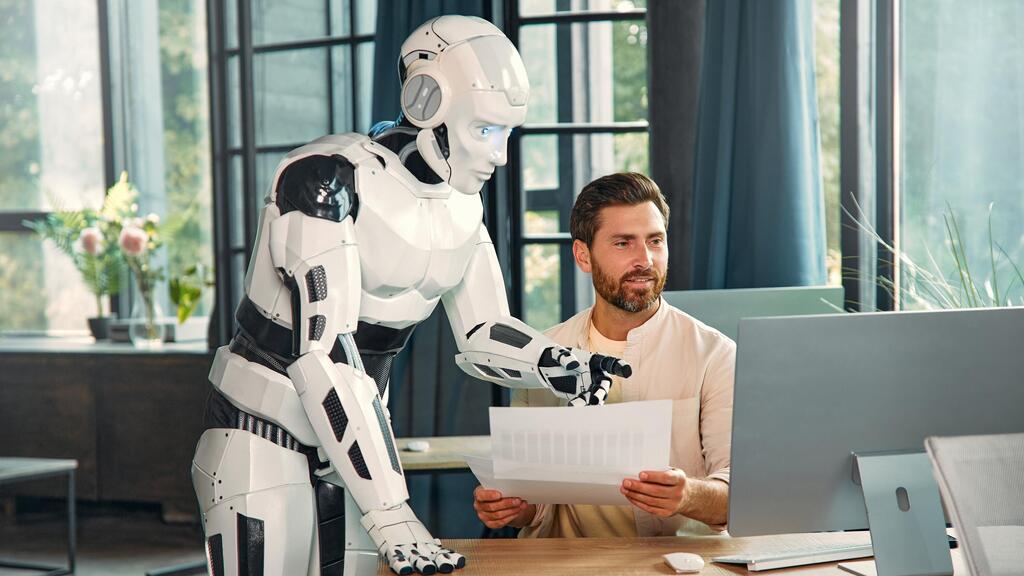
Instead of helping, AI adds to the load
For years, artificial intelligence was billed as a personal assistant that would free workers from routine tasks and let them leave the office earlier. The reality in 2026 looks very different.
The HBR analysis, based on monitoring employees at technology companies, paints a troubling picture: AI is not shortening the workday, it is packing more tasks into it.
The phenomenon, now described as “work intensification,” stems from AI’s ability to accelerate individual tasks. But instead of freeing up time for rest or creative thinking, that time is quickly filled with new assignments generated by the technology itself.
Workers report being required to perform “prompt engineering,” conduct rigorous fact-checking to prevent model “hallucinations,” and manage multiple AI agents operating simultaneously.
In the United States, discussion of the HBR report has been heated. On tech forums such as Hacker News, employees wrote that management expectations have tripled since the introduction of AI tools, while real productivity has risen only marginally. “It feels like we’re selling the same work hours, but at three times the pace,” one user wrote.

High-tech workers, illustration
(Photo: Shutterstock)
In China, the trend is even more extreme
While debate in the US centers on knowledge worker burnout, the situation in China is more severe. The notorious “996” work culture — 9 a.m. to 9 p.m., six days a week — has tightened with the adoption of AI. Companies are deploying the technology to gain a competitive edge, accompanied by close digital monitoring of every minute of the workday.
In Europe, regulators are attempting to slow the trend. Recent International Monetary Fund reports suggest that privacy laws and labor agreements may temper the pace of AI adoption while protecting worker welfare. However, European economists warn that without significant productivity gains, the continent could struggle to compete with the computing power of the US and China.
In Israel, the local market is embracing AI at record speed. But programmers are now expected not only to write code but to manage entire systems of automation tools. Comparisons with earlier low-code platforms show a key difference: while those tools were designed to simplify processes for nonexperts, AI requires even greater expertise to supervise and validate its outputs.
This is not the first time technology has promised leisure and delivered more work. In the 19th century, the Industrial Revolution and mechanical looms were expected to ease the burden on textile workers but instead led to longer factory shifts. The arrival of personal computers in the 1980s and the internet in the 1990s did not shorten the workweek either; they simply made workers available around the clock.
AI appears to be the next phase in that evolution. It does not replace humans but turns them into managers of fleets of machines requiring constant oversight.
The central challenge of 2026 may not be how to implement more AI, but how to manage humanity alongside it. Unless organizations redefine what “output” means in the AI era, workers risk being trapped in an endless cycle of generating and checking content without creating real value. As HBR put it: “The problem is not the technology, but the management.”