


Behind nearly every ad that appears online is an automated auction for the user's attention, conducted in a fraction of a second. In one of the major legal battles against Google, a federal court in Virginia ordered the company in September to open parts of this machinery to its competitors.
The company avoided the most drastic outcome sought by the Justice Department — the breakup of its advertising technology empire — but will be required to change its practices, share information and allow monitors access to its systems for six years.

U.S. District Judge Leonie Brinkema, appointed by President Bill Clinton, issued a 106-page ruling in the case. The document was made public two weeks after she rejected the government's demand that Google be forced to sell its AdX advertising exchange. Rather than ordering a breakup, Brinkema opted for restrictions on the company's conduct designed, in her words, to "pry open" markets harmed by Google's practices and prevent the company from returning to unlawful conduct.
How does Google's advertising empire work?
The system, which operates largely out of sight of internet users, determines which ads appear on their screens and how much the websites displaying them get paid. Google has a presence at nearly every stage: a tool for buying advertising space, the DFP ad server through which websites and publishers manage their ad inventory and the AdX exchange that connects buyers and sellers. It operates the exchange while also holding key positions on both sides of transactions. According to Google, its systems handle approximately 55 million requests per second.
These practices were central to the lawsuit filed by the Justice Department and several U.S. states in 2023. In April 2025, Brinkema ruled that Google had illegally maintained monopolies in the publisher ad server and ad exchange markets and had tied DFP to AdX in ways that blocked competitors.
According to the ruling, these practices harmed publishers, competition and consumers of online information. News websites, for example, often depend on advertising revenue to finance their operations. When one company controls key parts of the systems that manage ad sales, it can also influence the conditions under which website owners compete for revenue.
Under the ruling, Google will be required to connect AdX and DFP to Prebid, an open-source system that allows websites to receive bids from multiple advertising exchanges. AdX will also have to provide real-time bids to competing ad servers. Websites using Google's ad server will no longer be required to use its exchange, and publishers will be able to export their historical data. The latter provision is intended to remove a major obstacle to switching providers: the fear of losing years of business data.

Google's shopping cart
(Photo: Google)
Google's ad-buying tool, AdWords, now known as Google Ads, will also face restrictions. It will be prohibited from favoring Google's systems because of their common ownership and from submitting bids directly to DFP. The company has also committed to disclosing more information about how its auctions operate, a process long considered a "black box," and providing technical support and data to competitors and customers.
The Justice Department sought 15 years of oversight, while Google requested six. Brinkema adopted the shorter period, with the possibility of an extension if the requirements are not fully implemented. The court also rejected Google's request to limit the changes to the United States. Because its products operate uniformly across different regions, the restrictions are expected to apply worldwide and could also affect publishers in Israel.
The biggest concession Google received from the court was permission to retain AdX. The Justice Department argued that the company could not be trusted to operate the exchange after years of violations and sought to force its sale. Brinkema determined that a structural separation was neither realistic nor necessary and that opening AdX bids to competing servers could restore competition that had been lacking in the market.
Even after the ruling was released, the battle over its implementation continued. In early October, Google and the Justice Department submitted proposed versions of the final order, but disagreements remained over some of its provisions. This means that even after the court decided which restrictions to impose on the company, the two sides are still arguing over exactly how they should be implemented.
Beyond advertising: Google's search engine also faces scrutiny
This is the second time in recent years that a federal judge has found Google guilty of operating an illegal monopoly but declined to break up a major part of its business. In a separate case involving its search engine, the government's demand that Google sell its Chrome browser was rejected, although the company was ordered to share information with competitors.
The legal battle over Google's search engine began in 2020, when the U.S. Justice Department accused the company of exploiting its power to maintain its dominance in the market. At the center of the lawsuit were agreements under which Google paid enormous sums to ensure its search engine was set as the default on devices and browsers. In August 2024, a federal court ruled that Google had acted unlawfully to maintain its monopoly in the search market.
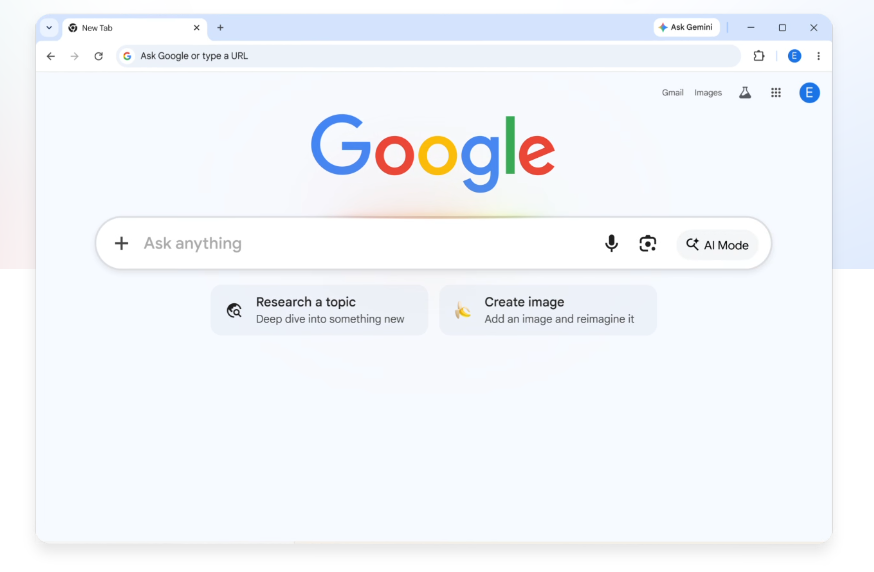
AI Mode in Google Chrome
(Photo: Google)
In September 2025, the court decided not to force Google to sell Chrome but imposed restrictions on exclusivity agreements and, as noted, required the company to share certain types of information with competitors. The decision did not end the case: Google and the U.S. government filed appeals challenging different aspects of the proceedings, leaving the future of those restrictions subject to further legal battles.
For Google, the issue is critical. Its search engine is not only one of the company's most recognizable products but also a major source of advertising revenue. Any change in how users access it, or in competitors' ability to obtain information previously controlled by Google, could affect competition across the entire market.
Google's app store also faces legal trouble
Google's legal challenges extend beyond search and advertising. Its Google Play app store is also under legal pressure over allegations that the company exploited its control of the Android operating system to restrict competition and dictate terms to app developers.
In the United States, Google fought a lengthy legal battle with Epic Games, the developer of "Fortnite," that resulted in a finding that its conduct in the Android app store market had harmed competition. As a result, Google was required to make changes to the store's operations, including expanding options for developers and competing app stores. At the same time, the two companies reached agreements as part of their legal dispute.
Legal proceedings are also continuing outside the United States. In October 2026, Google began defending itself against a class-action lawsuit in Britain seeking approximately 1 billion pounds ($1.3 billion) over allegations that it charged excessive fees on purchases and payments made through its app store. Google denies the allegations, arguing that Android offers users and developers choice and competition with other platforms.

Google's app store
(Photo: Android Authority)
Can Google's power be curbed without breaking up the company?
These three legal battles concern different markets, but they raise a similar question: What should be done when a single company controls essential infrastructure relied upon by billions of users and businesses?
So far, in the major U.S. cases involving search and advertising technology, courts have preferred to require Google to change its practices rather than force it to divest key assets. For regulators, the approach represents an attempt to open markets to competition without disrupting systems that serve businesses and users around the world. But whether these restrictions will be enough remains an open question.
And while these legal battles continue, Google is already deeply involved in the next major transformation: the shift from traditional search to AI-powered answer engines and artificial intelligence services. Here, too, the advantages Google has accumulated through its search engine, Chrome and Android — which allow it to reach billions of users — could prove significant.
The question is whether the restrictions now being imposed on Google will succeed in opening markets to competition or whether the tech giant will maintain its dominance in the next era of the internet.