

It looked like conclusive proof, in the familiar style of classic “before” and “after” satellite images: a photo of an “American radar system completely destroyed,” published last month in Iran’s Tehran Times to create a narrative of victory and deterrence.
In reality, it was a fake: a year-old satellite image from Bahrain that had been edited using Google’s Gemini. Independent intelligence experts quickly exposed it after comparing it with older satellite images and identifying the same elements, in the same positions, appearing in both photos.
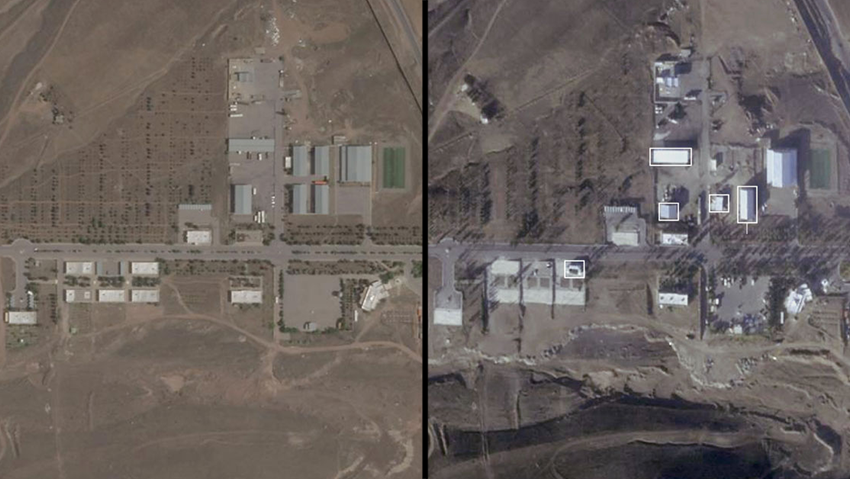
Similar forgery technology was used by the Iranians to “erase” the real signs of destruction caused by Israeli and American aircraft at their air force bases, as well as at oil refining facilities in the Abadan area. They took real commercial satellite images from the region and used artificial intelligence models to remove the actual damage. In the images distributed to the world, the sites appeared intact, with no bomb craters or burn marks.
Manipulating spy satellites
Wired magazine, which reported the story of the radar that was not bombed, argues that the Iranians are not the only ones who have exploited the basic trust most of us tend to place in satellite images for deception. One of the more complex operations in the current campaign combined open deception with deliberate manipulation of Iranian spy satellites.
To lull Iran into a false sense of security before the first massive strike on its nuclear and ballistic missile facilities, the United States and Israel conducted a sophisticated deception campaign. While U.S. President Donald Trump’s public statements created the false impression that “progress was being made in negotiations” and that an attack was not imminent, changes were being made on the ground to mislead Iranian analysts reviewing satellite images.
At Israeli air force bases and U.S. Central Command facilities in the region, decoys were deployed, including inflatable aircraft and camouflage nets, while armored vehicles were moved in staged maneuvers toward secondary targets. The goal was to make the Iranians believe the forces were engaged in routine training or defensive preparations only.
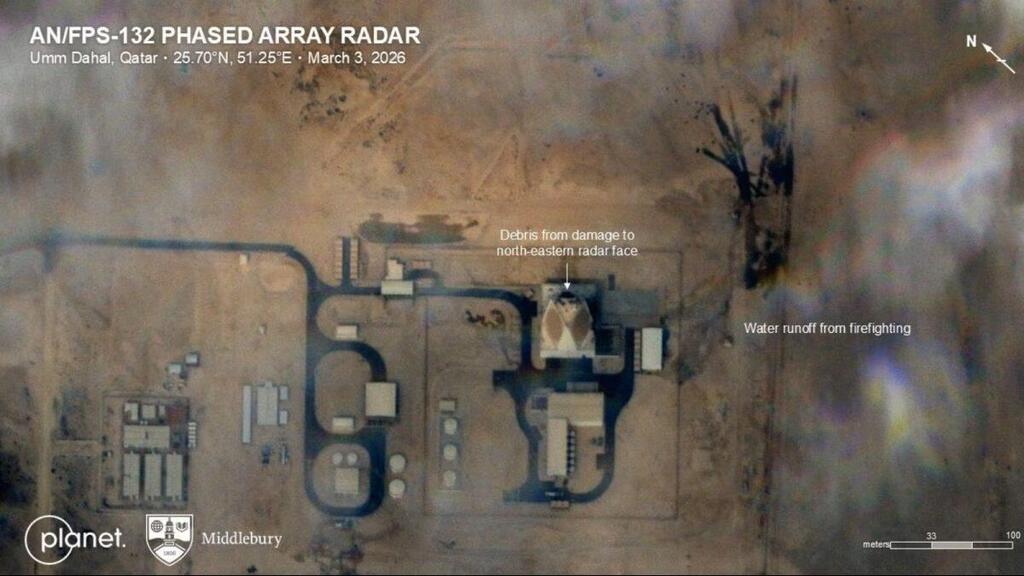
Satellite image of an American radar system in Qatar
(Photo: Planet Labs)
The rules of the game have changed
For decades, the satellite image was considered the final word in military intelligence — an “eye in the sky” that does not lie, providing decisive proof of what is happening on the ground. But the war between the United States and Israel on one side and Iran on the other has completely changed the rules of the game.
Government and private imaging satellites are no longer used only to expose the enemy. They have become a central tool in unprecedented deception operations and tactical forgeries. The satellite infrastructure, on which journalists, analysts and governments often rely to understand and analyze the conflict, is itself becoming contested.
When satellite data becomes unreliable, control over it becomes a central question. Advanced technology and the falling cost of space launches have led to the “democratization of space,” giving private companies the theoretical ability to develop and launch satellites of various types.
Until the early 2000s, satellite imaging capabilities, for example, were still largely reserved for superpowers. Today, in principle, anyone can purchase satellite imagery. The number of civilian companies with the capabilities required for high-quality satellite intelligence can now be counted on one hand, among them the American companies Maxar and Planet Labs, Europe’s Airbus, China’s CGST and Israel’s ISI, or ImageSat International. All now sell satellite imaging services at once-unimaginable resolutions for a range of needs, including agriculture, industry, mapping, urban planning, weather forecasting and more.
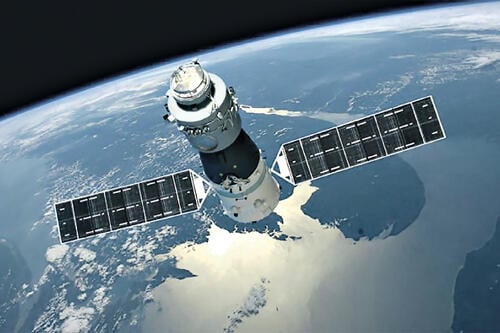
A satellite
(Photo: PR)
The Middle East’s prestigious space sector
Satellite infrastructure in the Gulf is mostly managed by states and under close government supervision, but not exclusively. The commercial satellite communications sector in the Middle East is estimated at more than $4 billion. These are satellites positioned relatively high above Earth, used mainly for missions such as broadcasting, communications and weather forecasting.
The United Arab Emirates has Space42 for secure communications and Earth observation. Saudi Arabia’s Arabsat specializes in broadcasting and bandwidth, while Qatar’s Es’hailSat supports regional connectivity.
Commercial companies, by contrast, focus on much smaller and cheaper satellites that orbit Earth at low altitude. They naturally operate differently from state-owned systems: governments receive priority, but major media outlets and other organizations are also paying subscribers.
In practice, there is no international body with the authority to determine what private satellite companies may or may not do in conflict zones. But because the U.S. government is one of the largest customers for many of them, they are likely to think twice before angering Washington.
California-based Planet Labs, for example, announced last March that it would temporarily tighten access restrictions on its imagery from the Middle East to prevent Iran and its partners from conducting real-time surveillance of forces deployed around them. It is also clear that Israel’s ISI is subject to strict regulatory restrictions.
But these companies must now be considered alongside Chinese firms such as MizarVision, an open-source geospatial intelligence provider based in Shanghai, which has seen growing demand in recent months for its satellite images. And that is before accounting for Russia’s capabilities, and the unclear question of whether, and to what extent, Moscow is assisting Tehran.
The Iranian doctrine
Iran is well aware of the power satellites give its rivals and has developed an entire doctrine around the issue. Over the past decade, it has built an active satellite network, both military, managed directly by the Islamic Revolutionary Guard Corps’ aerospace arm, and civilian, overseen by the Iranian Space Agency.
The most advanced observation satellite in Iranian use is Khayyam, a Russian-made imaging satellite launched for Iran in 2022. It is operated from ground stations in Iran, whose condition following the U.S.-Israeli attack remains unclear, and is used for strategic monitoring of U.S. and Israeli bases, ports and infrastructure in the region.
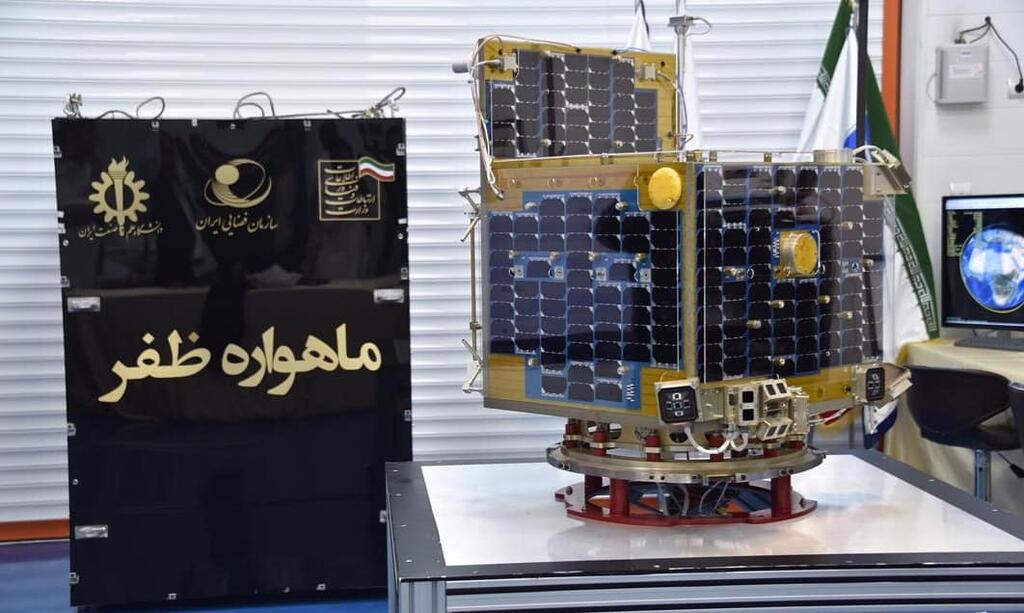
Iranian satellite
(Photo: Social media)
Iran also has a series of small spy satellites called Noor, developed and launched independently by the Revolutionary Guards, as well as a satellite called Kowsar, used for mapping and capable of producing high-quality images.
At the same time, Iran specializes in deceiving satellites, particularly because American and Israeli spy satellites constantly monitor its launch sites. The Iranians know that satellites can detect the movement of missile launchers, the deployment of logistics forces and troop gatherings ahead of an attack.
To disrupt detection, the Revolutionary Guards established “ghost launch sites” in remote desert areas of Iran. They positioned missile launchers made of fiberglass and wood, and used special pigments and conductive materials that reflected satellite radar waves in exactly the same way a real ballistic missile would.
For analysts reviewing the satellite images, these sites appeared to be active missile batteries. According to reports in the American press, in more than one case Israeli and U.S. fighter jets struck such fake “launch sites,” while the real launchers were hidden in underground tunnels, known as “missile cities.”
A psychological ‘victory image’
But the most troubling development in this campaign is taking place in the public sphere. Because satellite images enjoy relatively high credibility, both sides have learned to use them manipulatively. During the fighting, fake satellite images circulated on social media, supposedly linked to well-known commercial companies, showing the total destruction of strategic facilities, including airports and bases in Israel or oil facilities in Iran.
The forgeries were created using technologies known as GANs, which take old satellite images and “plant” bomb craters, rising smoke and destroyed buildings that never existed. The goal, of course, is to quickly influence global energy markets and create a psychological “victory image” before the real damage on the ground becomes clear.
Space and security experts agree that in the current era, the fact that “you saw it from space” is no longer proof that something exists. The side that wins the next campaign will be the one that knows not only how to look from above, but how to respond quickly to attempts to mislead it from below.