

Passengers aboard last week’s flydubai flight to Israel, which was targeted in a terror incident involving an attempted hijacking and effort to crash the aircraft, could be entitled to compensation of around $250,000 each, aviation law experts estimate, even if they suffered no direct physical injury and the plane ultimately landed safely.
The emerging legal battle is expected to focus not only on the amount of compensation, but also on where a potential mass claim against the Emirati airline would be heard.
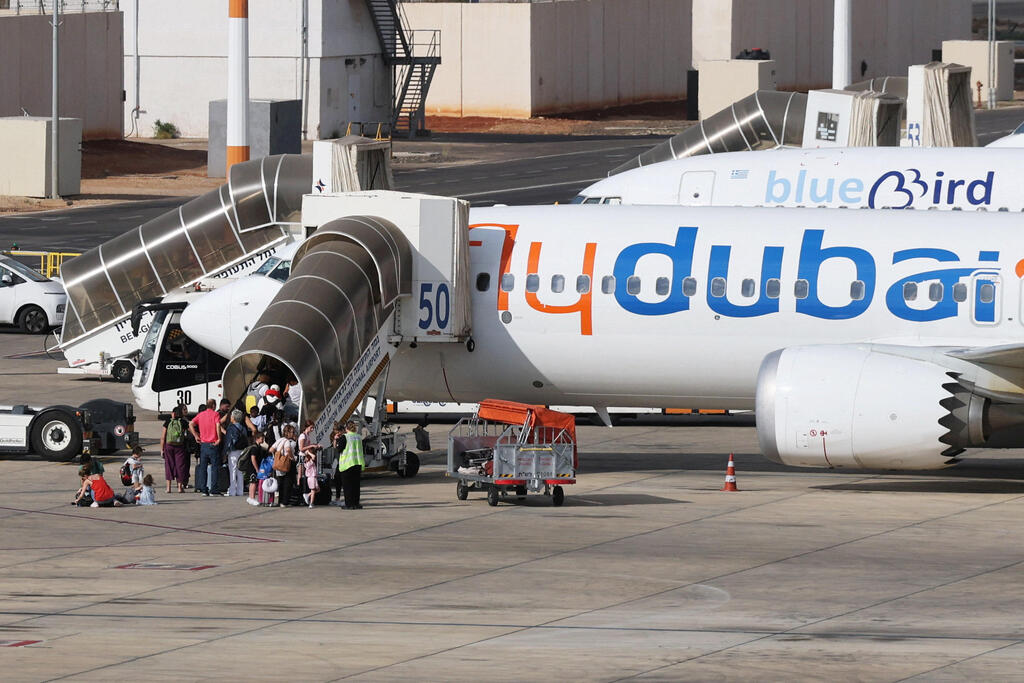
Attorney Deborah Sturman of the U.S. law firm Motley Rice, which has extensive experience in international aviation litigation and air disasters, estimates based on comparable cases that each passenger could receive compensation in the range of $250,000 even without a physical injury.
Experts say other effects may become apparent over time, including hearing problems, anxiety attacks and post-traumatic stress disorder. Motley Rice is examining potential claims under the Montreal Convention, including whether proceedings could be brought in the United States rather than Israel.
Israeli aviation law expert attorney Ehud Pei said the terror incident, which according to reports involved 174 Israeli passengers, including dozens of minors, could provide grounds for substantial compensation claims for both physical and psychological harm already suffered or that may develop later.
“This was a traumatic event that by its nature could leave long-term consequences,” Pei said.
Airline liability
Liability in such cases is governed by the Montreal Convention, which Israel adopted and which entered into force in the country in 2011. The convention regulates airline liability on international flights.
Under the convention, an airline may be held liable when a passenger is injured, provided that the accident causing the injury occurred on board the aircraft or during embarkation or disembarkation.
Israeli case law has held that an airline may be required to compensate passengers for physical and psychological harm caused by a terror incident aboard a flight. Israeli courts have also ruled that an act of terror may qualify as an “accident,” and that the concept of bodily injury can include purely psychological harm.
The Entebbe precedent
A key Israeli precedent dates to a 1984 Supreme Court ruling in a lawsuit against Air France, known as the Dadon precedent and still considered relevant today.
The case involved passengers aboard the 1976 Air France flight from Ben Gurion Airport to Paris that was hijacked and diverted to Entebbe, Uganda.
The Supreme Court adopted a broad interpretation, finding that the hijacking qualified as an “accident” and that psychological harm could be compensable even without an accompanying physical injury.

Relatives embrace, kiss and tearfully welcome loved ones freed in the Entebbe rescue operation
(Photo: State Archives)
“The hijacking of the Air France aircraft to Entebbe is considered an event within the framework of ‘air carriage’ ... and the damage caused to passengers as a result, even if purely psychological, constitutes ‘other bodily injury’ resulting from an ‘accident’ that occurred ‘on board the aircraft,’” the ruling stated.
The passengers’ claim in that case was ultimately rejected because it was filed after the two-year limitation period set by the convention. But the underlying principle that a hijacking may be considered an accident and psychological injury may be compensable remained in force.
That precedent was also cited by an Israeli district court in 2022 in the Iberia v. Fleischer case, in which the court found that compensation could be awarded for emotional distress caused by delayed baggage.
Pei cautioned, however, that compensation is not automatic. Passengers would still have to establish that the incident occurred, demonstrate the extent of their damage and prove a causal connection between the two.
How much could passengers receive?
Compensation under the Montreal Convention is not fixed in advance but is calculated through liability tiers based on Special Drawing Rights, or SDRs.
For damage resulting from an accident, the air carrier’s liability is nearly absolute up to 151,880 SDRs, equivalent to about 630,000 shekels according to the figures cited in the legal assessment.
If a passenger proves damages above that amount, additional compensation may be sought. In that situation, the airline may avoid further liability only if it proves that the damage was not caused by its negligence or other wrongful act or omission.
The convention also allows a carrier to escape liability in certain circumstances if it can demonstrate that it and its employees or agents took all necessary measures to prevent the damage, or that it was impossible for them to do so.
It may also seek to avoid liability by proving that the damage resulted solely from the negligence or wrongful act of a third party.
The legal questions now facing the flydubai passengers therefore extend beyond the trauma of the flight itself: what injuries can be established, how much compensation each passenger could receive, and whether the claims will ultimately be heard in Israel or the United States.