

Waiting for a flight at the airport can be exhausting and frustrating, especially for families with young children and older passengers. When the flight is ultimately canceled, the disappointment is even greater.
That has been the reality at Ben Gurion Airport in recent days, at the height of the summer travel season, with nearly 100,000 passengers and more than 500 flights passing through the airport each day.
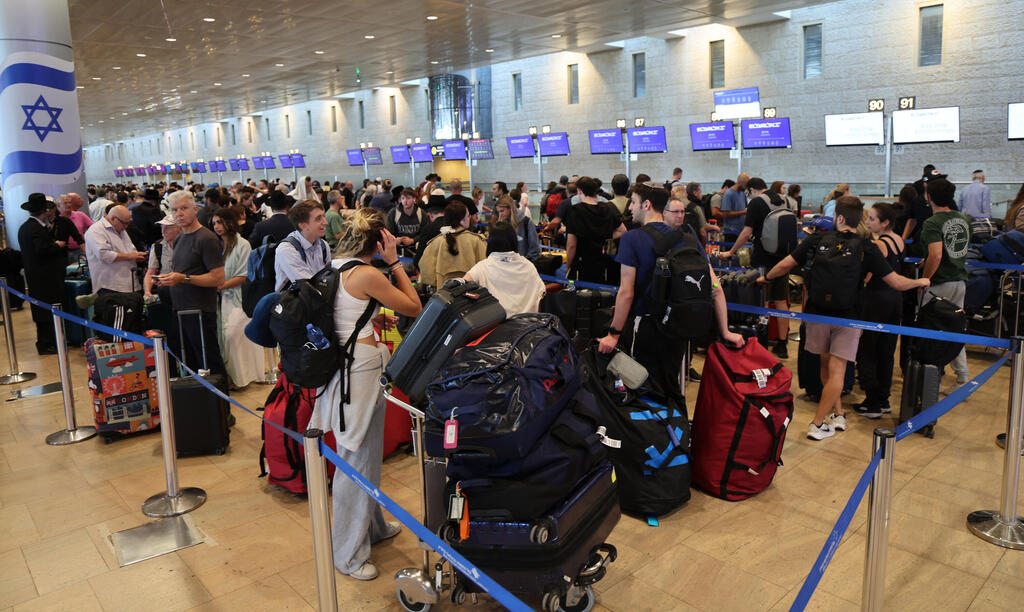
Summer at Ben Gurion airport
(Photo: Yariv Katz)
An unusual combination of circumstances during one of the busiest periods of the year has turned Israelis’ journeys abroad into a prolonged ordeal. Many passengers have reported hours of tense waiting aboard aircraft and inside terminals, repeated changes to departure times and last-minute cancellations affecting both international and domestic routes.
An analysis by the TLVFLIGHT system of 3,499 flights operated from Ben Gurion Airport between July 20 and July 27 reveals the scale of the congestion. Only 1,089 flights, about 31% of the total, departed at their originally scheduled time.
However, another 709 flights took off between 30 minutes and one hour late, 479 were delayed by one to two hours and 363 departed two hours late or more. In addition, 83 flights were canceled entirely during the week.
The average delay at Ben Gurion Airport over the past week was 40 minutes. The most problematic and congested hour was 2 p.m., when the average delay reached 83 minutes. Blue Bird Airways, which flies mainly to Greece, recorded the longest average delay at 99 minutes. It was followed by Cyprus-based TUS Airways with an average delay of 82 minutes and Lufthansa with 79 minutes.
The current aviation chaos stems from a combination of local and European factors. Ben Gurion Airport is currently hosting 33 refueling aircraft from the U.S. military fleet. The planes occupy parking spaces and are also engaged in frequent takeoffs and landings.
The Israel Airports Authority said their planned departure on July 21 was postponed because of the security escalation, continuing to place heavy pressure on the airport’s flight schedule.
The congestion has been compounded by a serious failure affecting radar systems and air traffic control equipment in Athens and in the Sitia and Kavros regions of Greece. The malfunction triggered a chain of delays across the Mediterranean and directly affected already busy airports including Paris, Madrid, Berlin and Zagreb.
For passengers, the result has been hours of discomfort and uncertainty. Yael, who was scheduled to fly with her family from Heraklion, Crete, to Tel Aviv on an Arkia flight at 6 p.m., said passengers were forced to remain aboard the aircraft for more than 90 minutes before takeoff.
Passengers on a Wizz Air flight to Rome last Friday experienced a similar delay. Tamar, who was scheduled to depart at 10:55 a.m., said that only after all passengers had taken their seats did the captain announce that unusually heavy congestion over Greece required the aircraft to change its route. The decision delayed takeoff by nearly an hour.
Even greater disruption affected Arkia passengers scheduled to fly to several destinations on Friday afternoon. Their flights were repeatedly postponed until passengers found themselves caught in a particularly difficult situation: Ben Gurion Airport closed for several hours that evening for routine runway maintenance, a closure scheduled in advance and known to all airlines.
The accumulated delays forced passengers, including families with young children, to wait inside the terminal until the airport reopened at 11 p.m. Passengers complained that no company representative was present to assist them or explain the situation. Arkia ultimately decided, beyond its legal obligations, to compensate each passenger with a $250 voucher for use on the airline’s flights.
Domestic flights were also disrupted. Passengers scheduled to fly from Eilat to Tel Aviv on an Israir flight at 6:15 p.m. two days earlier received notice of a delay the previous day. When they arrived at Ramon Airport, however, they were informed of another postponement, with departure moved to 10 p.m., nearly four hours after the original time.
Israir said it is required to notify passengers of any delay and inform them of the benefits available under the law. The airline said passengers on Sunday’s flight from Eilat were notified before arriving at Ramon Airport and that the delay was about two and a half hours.
Blue Bird Deputy CEO Amit Sagi said a significant portion of the recent delays had been caused by exceptional congestion in Greek airspace and at Greek airports, which account for a major share of the airline’s summer operations. “These conditions affect takeoff and landing times and sometimes cause delays to the aircraft’s subsequent flights as well,” he said. “In every case of a delay, we work to update passengers and provide assistance. We are aware of the inconvenience caused and apologize.”
Arkia said the delays were being driven by congestion in the airspace and at Ben Gurion Airport, ground-services staffing shortages and isolated operational disruptions. The airline added that every technical issue must be fully addressed without compromising safety, and that a delay to one flight can disrupt the wider schedule during peak travel periods.
“We are working around the clock to minimize the impact, keep passengers informed and restore the schedule as quickly as possible,” Arkia said. “We regret the inconvenience and continue working to improve service and the passenger experience.”