

It all began in my youth, when I stumbled upon an old National Geographic article. One photo—a man hanging from a rope ladder in front of a massive cliff, wrapped in a cloud of bees—stayed with me. I knew that one day, when I was older, I’d make it there myself.
As a tour and photography guide, I organized my first expedition in search of the honey hunters four years ago. It felt like building the Tower of Babel: they had no internet, no phones, no English—just us, the jungle, the cliffs and the hope that it would all somehow come together. There, among the trees, the mud and the long silences, I realized that this encounter was far greater than me.

For more than 2,000 years, men of the Gurung and Magar tribes in Nepal have descended bamboo rope ladders along the cliffs of the Himalayas to harvest one of the rarest and most dangerous substances in the world— “mad honey.” I, who had been on my way to catch a flight in tailored clothes and high heels, suddenly found myself deep in a muddy jungle, wading through puddles, breathless and covered in leeches, on my way to witness this ancient craft up close.
Hunting honey
(Video: Limor Zadok)


Himalayan honey: pleasure, pain and a vanishing tradition
Himalayan honeybees, the largest in the world, grow to the size of a thumb. Their sting is sharp and searing. Only twice a year, in May and November, the men of the tribe set out on a grueling journey along cliffs that rise hundreds of meters. Amid swarms of bees, they cut down massive honeycombs that hang from the rock face like giant shelf mushrooms.
We joined Naok, a 75-year-old veteran honey hunter who has been doing this for fifty years. “The younger generation no longer comes,” he told us. “Everyone wants easy jobs in the cities. The tradition is fading away.”
Naok strapped a wicker basket and a 70-meter rope ladder to his back and set off to prepare the next cliff. We tried to keep up: our heart rates spiked, our shoes slipped, and leeches climbed our legs. What had started as a calm jeep ride quickly turned into a survival challenge.
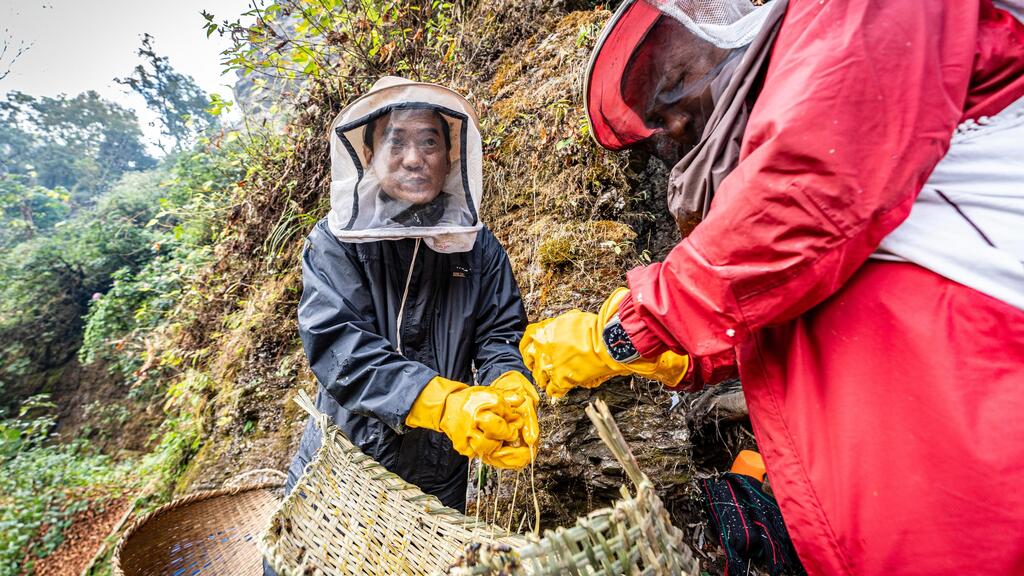
'The tradition is fading away'
(Photo: Limor Zadok)
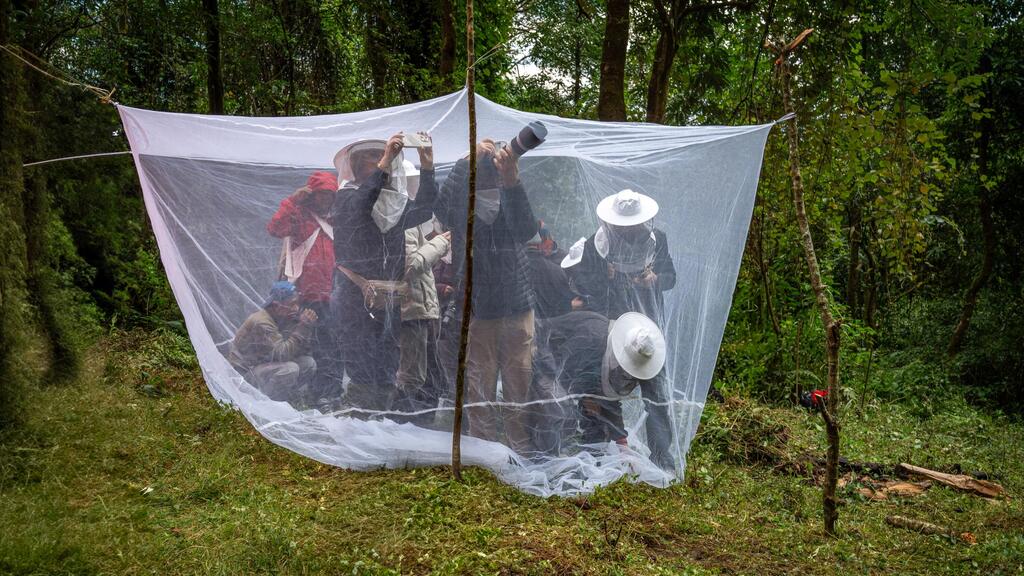
Tourists came to shoot photos
(Photo: Limor Zadok)
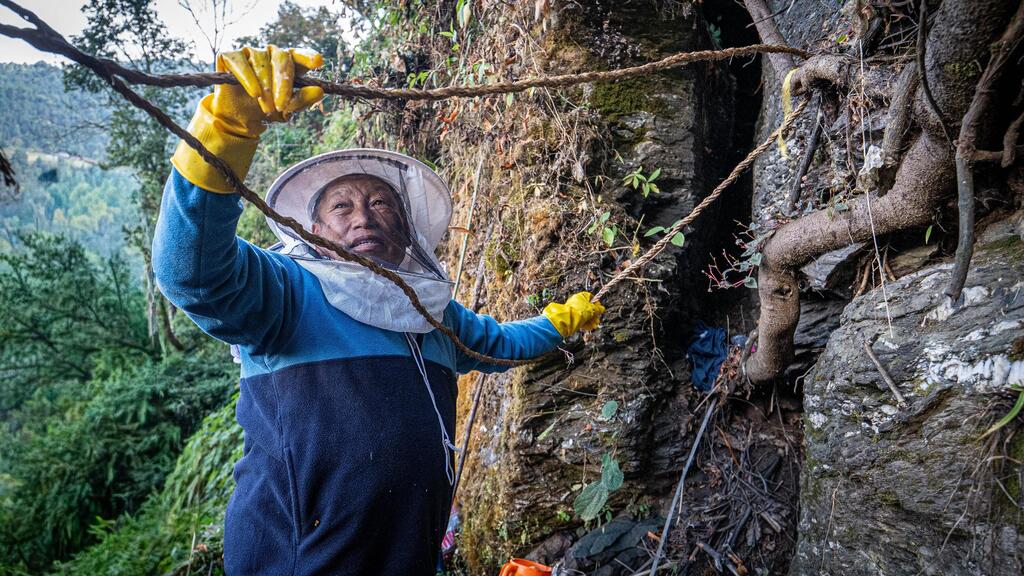
Grueling work in harsh conditions
(Photo: Limor Zadok)

'Mad Honey' comb
(Photo: Limor Zadok)
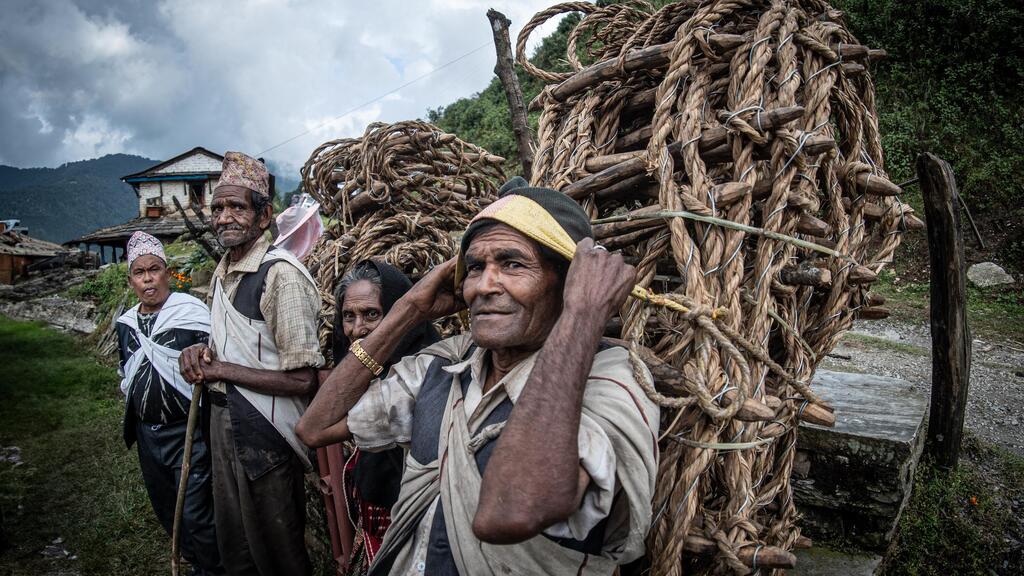
'The younger generation no longer comes'
(Photo: Limor Zadok)
An ancient ritual
Deep in the jungle, just before the honey harvest began, we met the village shaman. He lit incense and candles, poured milk at the base of the trees and laid out offerings of rice, flowers and tea leaves—presented to the spirits of the cliff, the forest and the bees. There were no drums, no performances, only a silence so profound it felt as if the forest itself had paused to breathe. For the tribe, this is a vow. A conversation between man and mountain, between hunter and ancient soul.
He whispered in a barely audible voice: “We are not thieves. We come with humility, asking for sustenance. Please show us mercy and keep us safe, so the honeycomb may fall peacefully and no one will be harmed.”
The honey hunters built a wooden support wall on the rock ledge, anchoring several rope ladders that stretched a total of about 300 meters. The work was carried out with skilled hands and not a word wasted. As always, everything depended on the wind, on luck and on the mercy of the bees.
When the harvest was done, a steep climb awaited us in the fading twilight. We reached the jeeps just as the last light vanished, only to find the road suddenly blocked—an enormous tree had fallen, cutting off the only jeep path to the village. We had no choice: night had fallen, and we had to hike up through mud and darkness. Our phones became flashlights.
The suitcases were sent after us on the backs of mules. But when they reached the top and we tried to approach them, the animals—spooked by unfamiliar sounds—bolted into the night. We were left standing in the mud, phone batteries nearly dead, trying to decide whether to laugh or panic. Only at the guesthouse, under a single bulb drawing swarms of insects, did we discover the dozens of leeches clinging to our legs and burst out laughing in equal parts horror and disbelief.
Since then, for every trip that followed, I’ve learned to ask travelers to bring trekking poles, flashlights, leech-proof gaiters, cotton balls and vinegar.
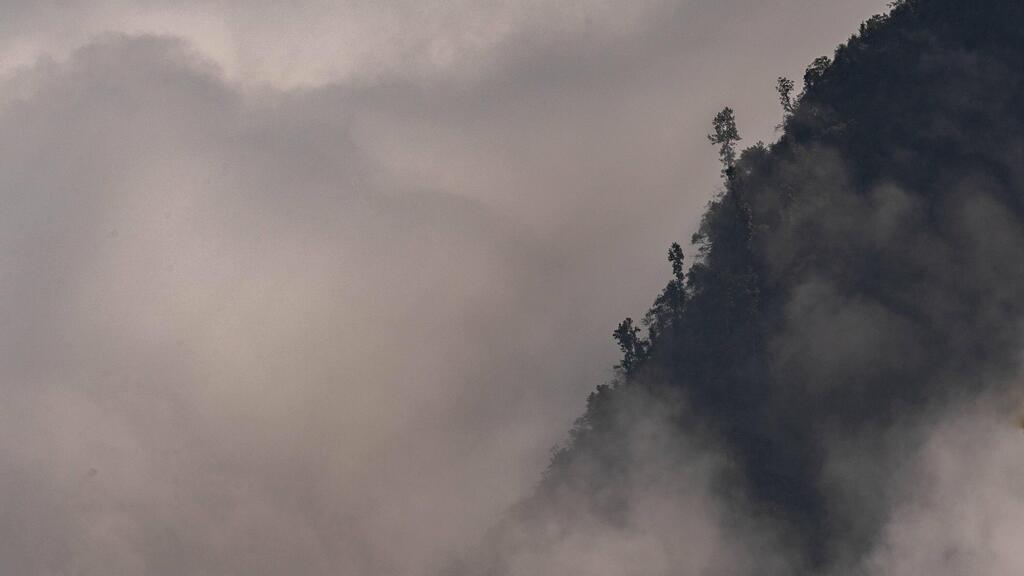
Challenging conditions
(Photo: Limor Zadok)
Swarms of bees
Before dawn, we set out for the cliff. The tribesmen lit a smoky fire using bamboo leaves to drive the bees away from the combs. Giant combs, up to two meters wide and black with hundreds of thousands of bees, emptied in an instant and turned golden with honey. Disoriented by the smoke, the bees landed on us, filling the air with a loud, chaotic buzz.
Despite our mesh hats, some of us were stung—a quick lesson in pain. On future trips, I made sure to set up a mesh shelter we could duck into as soon as the smoke began to rise along the cliff face.
Then the real work began: Naok, suspended between sky and earth on a rope ladder, gripped a sickle attached to a bamboo pole. Each comb was nearly two meters wide. He struck again and again until the honeycomb detached and slid down into a massive basket below.
We stood at the base of the cliff, surrounded by enormous bees. My mesh hat saved me during one particularly intense attack—the bees seemed especially drawn to my curly blonde hair. It was the first time I realized that the right gear could be a matter of survival.

(Photo: Limor Zadok)
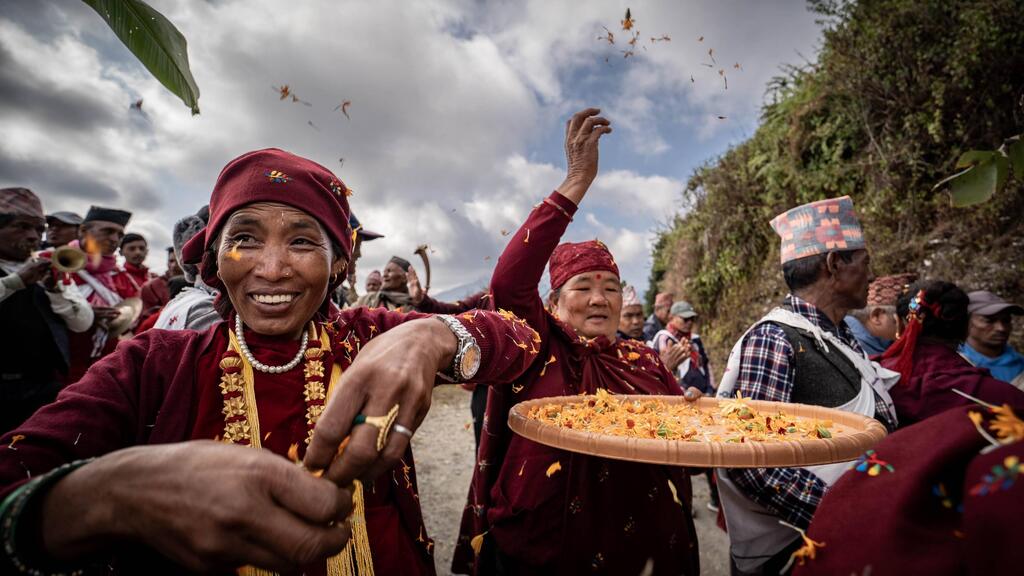
A celebration for the locals
(Photo: Limor Zadok)
The honey that dripped from the combs was thick and golden-yellow— “mad honey,” with psychoactive properties derived from the toxic rhododendron flowers. Half a teaspoon produces a feeling of lightness and dizziness; a full spoonful can lead to paralysis or even death. Locals use it as a traditional medicine, and it sells for several times the price of regular honey.
I tasted half a teaspoon. The world felt softer, warmer. Maybe it was the honey. Maybe it was the exhaustion. Maybe both. On future expeditions, I returned during the second harvest season, in November, when the bees produce honey from wild rose blossoms. This honey is not toxic, and its taste is sweet and distinctive.
A visit in Naok’s home
After hours of harvesting, Naok climbed down from the ladder, his face swollen from stings, this time “only” three. He told us that on his first climb, he endured more than fifty. He invited us to his home to meet his wife. “She’s sad,” he said. “The boys have left the village. They don’t want dangerous work. They’re chasing easy money in Kathmandu.”
Their home was made of mud, with no electricity or running water. A single window lit the room. Rice sacks hung from the ceiling. Outside were small terraces, a buffalo in a nearby shed, and hot tea with a single drop of honey—precious as gold. On the wall hung a calendar where Naok had written down the season’s cliff schedule: a handful of days, dozens of combs, hundreds of stings. An entire tradition carried on one man’s shoulders.
When I wanted to return to the village to give Naok and his wife the photos I had taken of them, I expected a reunion—a smile, tea, maybe another drop of honey. Instead, I was told that both had passed away. I stood before the empty house, holding photos that hadn’t become keepsakes—only memories.
On my next two trips, we joined Pasang, a 62-year-old honey hunter who has been in the craft since he was 15. The first expedition with him was a disaster: five of the six honeycombs broke apart and vanished into the abyss. A season’s worth of income for an entire village—gone. On the second journey, he managed to harvest every comb—steady, precise, almost entranced.
When we returned to the village, hearts full and clothes still carrying the scent of smoke and forest, I understood again why I keep coming back. This journey isn’t just a story about honey. It’s a story about people preserving an ancient tradition, about the bond between humans and the mountain and about the courage to brush up against life at its highest, most dangerous, and most alive point.
We left the village with a sense of gratitude—for that one distant day when everything was mud, pain, fear, laughter—and honey.
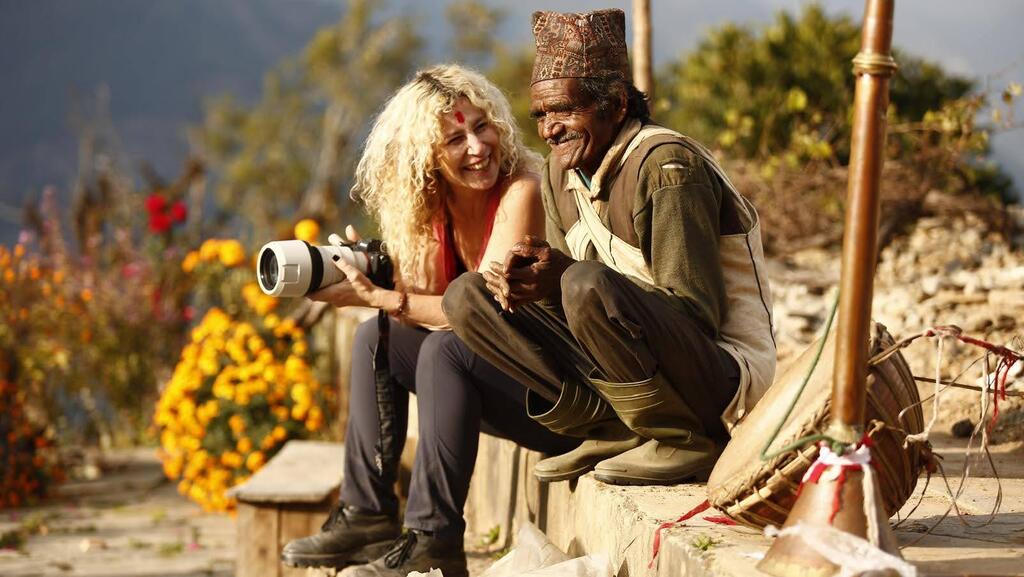
(Photo: Einat Shaked Maor)