

A routine overnight flight from Washington to Vienna turned into a medical emergency over the weekend when a passenger collapsed aboard the aircraft. A man sitting nearby rushed to help him, and two doctors traveling on the same flight soon joined the effort. Within minutes, the four discovered they had something unexpected in common: The patient and all three people helping him were Israelis, traveling to Tel Aviv. The incident ended safely, led to a shared breakfast at Vienna Airport and eventually became a viral social media post that moved readers across Israel.
"Flying home to vote. Connecting flight, Washington, D.C., Vienna, Tel Aviv," Dr. Dana Gefen Doron, a rehabilitation physician, wrote at the beginning of a Facebook post recounting the incident.

"During the first leg of the flight, an announcement comes over the PA system. The Austrian flight attendant asks if there's a doctor on board. I get up to see what's happening. 'Thank God, we need you,' the flight attendant tells me, pulling me forward. The cabin is already dark. It's an overnight flight. Ahead of me, I see two flight attendants carrying an unconscious passenger in their arms. Another passenger gets up to help them."
Gefen Doron went on to describe how they moved the passenger to an area where he could receive treatment. "They're struggling to maneuver through the narrow aisle between the other passengers and lay the unconscious man on the floor at the flight attendants' station in the middle of the plane. I find myself wondering why only one passenger got up to help two women carry an unconscious man who was practically slipping out of their arms. But never mind, there's no time to dwell on that thought."
The passenger who stepped in to help was Regev Ben-David, an Israeli historian who completed his doctorate at Tel Aviv University. Several months ago, he moved with his wife and their three children to Maryland, where he began a three-year postdoctoral fellowship.
Speaking to ynet, Ben-David said he boarded a flight to Israel on Friday to attend an academic conference, never imagining he would find himself assisting in a medical emergency along the way.
Where were you when the incident began? What exactly happened?
"I was asleep, or trying to sleep. I heard a woman shouting, 'Help, help.' I got up, went over and saw a woman sitting in her seat with a man lying at her feet, stretched across the seats."
The plane was dark, and most passengers were asleep. Ben-David, who was sitting about one row away from where the incident began, got out of his seat, switched on the lights and tried to assess the man's condition. He asked whether the passenger could hear him, whether he could open his eyes and what his name was. He initially spoke to him in English, but when the man responded and introduced himself, Ben-David realized he was Israeli.
After checking whether the passenger could move, Ben-David tried to help him reach the front of the aircraft. "I carried him toward the front of the plane," he recalled. But the man was struggling to walk even with support. At that point, another passenger helped Ben-David lift him and move him to an area near an emergency exit, where the crew had prepared a place for him to lie down.
Meanwhile, two doctors who were among the passengers arrived to help. One was Gefen Doron, and the other was a psychiatrist. The flight attendants, who appeared frightened according to Ben-David, quickly brought the medical equipment available on board, including devices for measuring blood pressure and oxygen levels. The doctors began examining the passenger while Ben-David remained nearby and helped whenever asked.
You have no professional medical training. Weren't you worried about getting involved?
"Now that I hear myself telling you this, I think maybe it was a little irresponsible," Ben-David admitted. "But it was something I just instinctively felt I had to do."
He said he had received basic first-aid training during his military service but had no professional medical qualifications. Nevertheless, the moment he heard the calls for help, he acted immediately, without stopping to consider the possible consequences.
In her post, Gefen Doron described meeting the second doctor and Ben-David as the three worked together to handle the emergency.
"Another woman comes over and introduces herself. 'I'm a psychiatrist.' I reply in English that I'm a rehabilitation physician. We exchange a joke in English that the patient will have to make do with us, and that it's a shame there isn't an emergency medicine specialist on board."
She also described Ben-David's willingness to help, even after he made clear that he had no medical training.
"The only guy on the plane who helped the crew tells us he has no medical training, but makes it clear in English that he's at our disposal until we tell him he's no longer needed: 'Where do you want me? How can I help?' I ask him to position himself by the patient's feet and help pass along the resuscitation equipment."
‘Are you Israelis?’ she asked in Hebrew
But as the emergency unfolded, a surprising detail gradually emerged: The passenger receiving treatment, both doctors and Ben-David were all Israelis.
Gefen Doron described asking the passenger's wife for his name. When she heard the answer, she recognized it as an Israeli name. She switched to Hebrew and asked whether the couple were Israelis. The woman said yes, adding that she had previously worked as a medic with Magen David Adom, Israel's national emergency medical service.
But the discoveries didn't end there. "On the other side of the unconscious man, down by his feet, the guy who helped us says, 'Oh, wow, I'm Israeli too.' Then the psychiatrist looks at us and says, 'I'm from Israel too,' and gives up on English," Gefen Doron wrote.
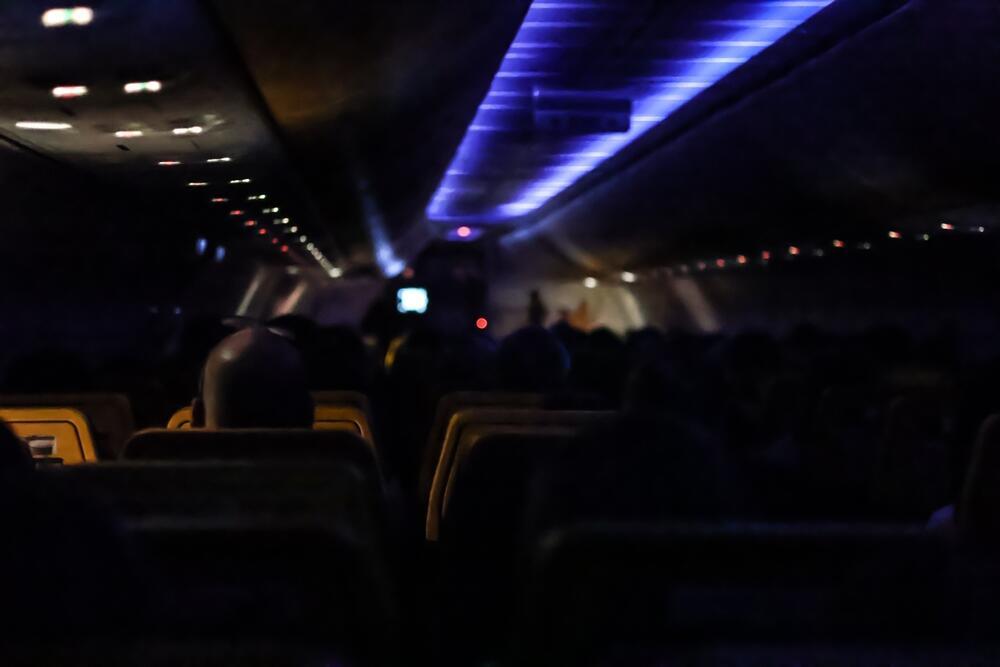
Calls for help rang out in the middle of the night as most passengers slept in the darkened cabin
(Photo: LadyLensArt / shutterstock)
According to her, the discovery also surprised the Austrian flight attendants. "The Austrian flight attendants look at us in amazement and say, 'So you are all Israelis? We are so lucky.' And then you can practically hear their sigh of relief that Israelis are handling the situation."
"It was amazing," Ben-David recalled. He said the phrase that stayed with him was one flight attendant's observation: "All speak the language."
He explained that having everyone speak Hebrew made it easier both to communicate with the patient and to coordinate the treatment. Despite the stressful circumstances, there was even room for humor. Gefen Doron described an exchange that eventually turned to the upcoming Israeli election.
"The passenger is fine. When he recovered, he asked me, 'Do you want to know who I'm voting for, so you can decide whether it's worth treating me?' I asked him if he wanted a slap from the doctor and made it clear that I didn't care who he was voting for."
‘Like four friends who had known each other for years’
Although the medical emergency had ended, the chance encounter between the Israelis did not end there. After landing in Vienna, and before their connecting flight to Tel Aviv, Ben-David, Gefen Doron and the couple decided to sit down together for breakfast. "I felt we had a lot in common," Ben-David said of the meeting.
Despite the unusual circumstances in which they had met, the atmosphere was surprisingly relaxed. He described it as feeling like four friends who had known each other for years rather than strangers who had met only a few hours earlier.
But for Ben-David, the night had been anything but restful. "I couldn't get back to sleep after the adrenaline from the whole incident," he said. "I got back to Israel and slept for 16 hours."
Gefen Doron also reflected on the unexpected connection and offered her own observation about Israeli behavior. "A whole plane full of people, but only Israelis got up to help, without knowing the person who needed help was Israeli, without even knowing who he was," she wrote, describing her impression of the incident. Ben-David, however, noted that another passenger had helped him lift the man during the evacuation.
"We all had coffee together in Vienna and continued as new friends on the flight to Tel Aviv," Gefen Doron wrote.
"Then we board the second plane, this time one full of Israelis. Everyone has brought too much hand luggage. People are fighting over seats. Children are yelling at their parents that they don't want schnitzel in pita bread and are demanding Bamba," she continued, referring to the popular Israeli peanut snack.
"If someone faints here, I have no doubt everyone will rush over to help. How good it is to be home."
‘It gives people a sense of optimism’
Gefen Doron's Facebook post began attracting shares and reactions, but Ben-David had no idea she had written about him. Only when he woke up the following morning and discovered that his sister had tagged him in the post did he realize that the incident he had experienced aboard the plane had become a widely shared story.
"It's funny," Ben-David said. "I had no idea Dana was writing this post. When I got back, I told the story to people I met. I told my wife, who's still in the United States, and my parents and friends."
He said he had never considered sharing the story beyond his immediate circle. "Then my sister tagged me in the post, which had reached her through someone else's share. I watched it take off, and I could see that it really answered a need people have right now, during these very emotionally charged days, for another glimpse of optimism, hope and solidarity. And I'm happy to be part of that."