

Could Neanderthals imagine, reinterpret—and even create art? A remarkable archaeological find in Spain may offer a tantalizing clue.
During a press conference in Segovia, researchers unveiled what they said was the oldest known complete human fingerprint ever discovered—unequivocally identified as belonging to a young male Neanderthal. The print, in red pigment, was found in July 2022 at the San Lázaro rock shelter near Segovia.
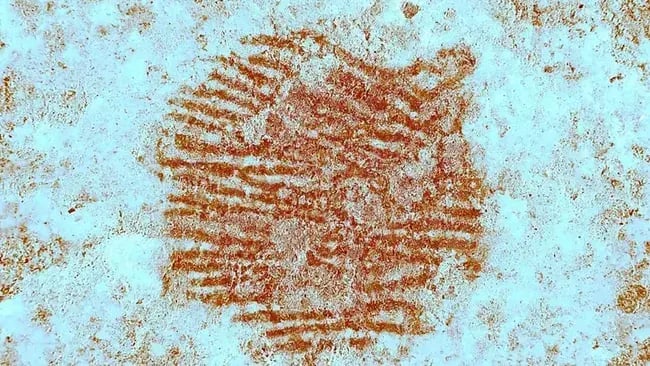
It was imprinted on a granite pebble the researchers nicknamed "Perico." The stone drew attention not only for its ochre markings—a natural clay-based pigment used by Neanderthals—but also for natural grooves that resembled a human face, a phenomenon known as pareidolia.
"Where the nose should have been, a perfect fingerprint had been imprinted. It was amazing," said geologist Andrés Díaz-Herrero, who took part in the study.
According to findings published in Archaeological and Anthropological Sciences, the stone dates back roughly 43,000 years. The team used a combination of scanning electron microscopy, 3D imaging and multispectral analysis to confirm that the red pigment was indeed ochre—previously used by Neanderthals to decorate objects and their bodies.
Fingerprint analysis, conducted by Spain’s national police forensic division, identified it as the right index finger of a young adult male between 18 and 25 years old.
Researchers believe the choice of stone, and the deliberate placement of pigment to highlight a specific feature, point to symbolic thinking and cognitive complexity. “Three fundamental cognitive processes are involved in creating art: the mental conception of an image, deliberate communication, and the attribution of meaning,” they wrote.
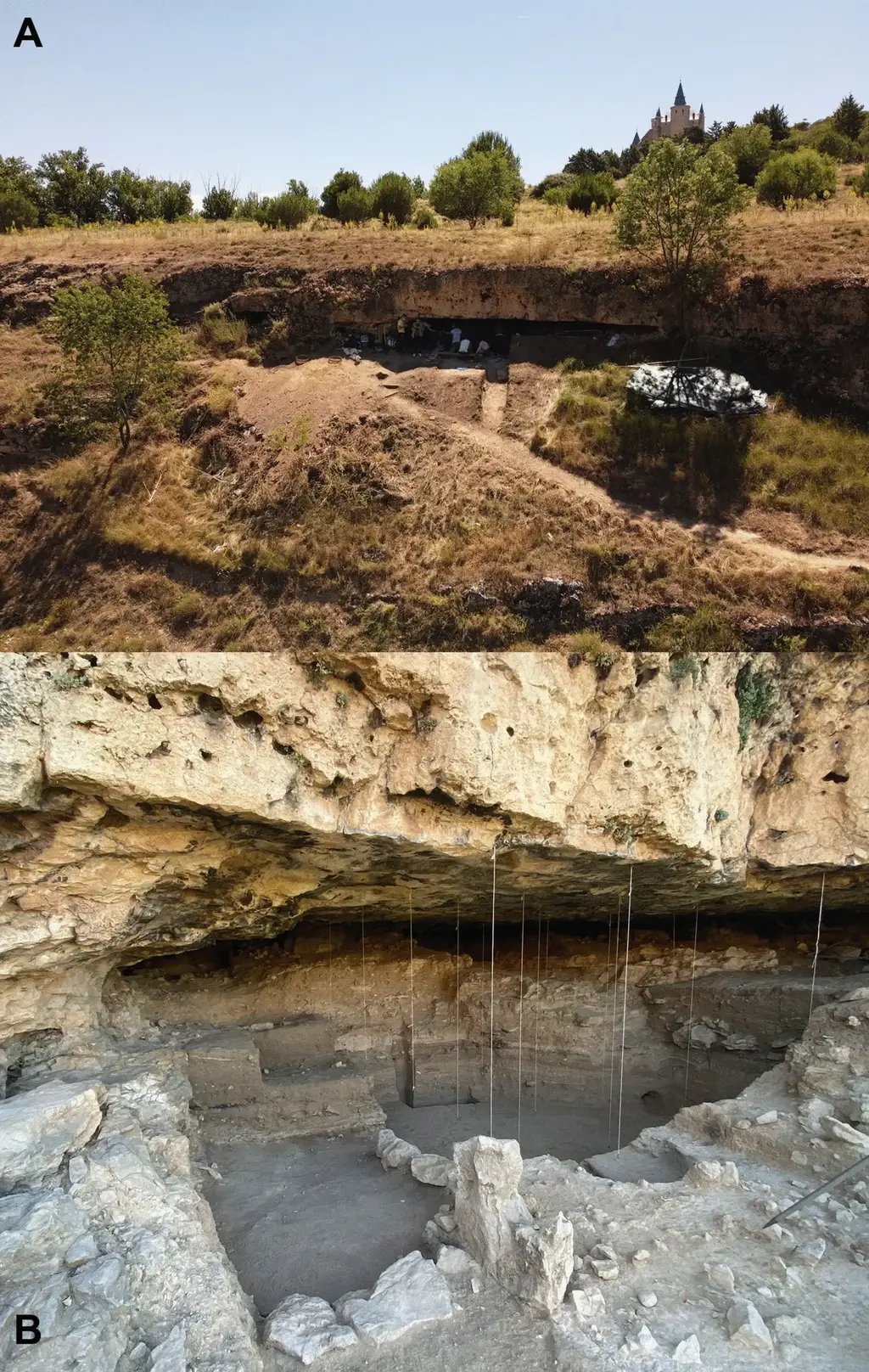
Cave where the fingerprint was found
(Photo: via the study)
Get the Ynetnews app on your smartphone: Google Play: https://bit.ly/4eJ37pE | Apple App Store: https://bit.ly/3ZL7iNv
Not all experts are convinced. Roberto Ontañón, director of the Museum of Prehistory and Archaeology of Cantabria, praised the study’s quality but challenged the interpretation. “The symbolic value seems implausible or nearly impossible,” he said, suggesting it could be a viewer's reaction to a random pattern rather than the deliberate work of an “artist.”
Javier Baena, an archaeologist at the Autonomous University of Madrid, also expressed skepticism. “The problem arises when one wants to dress it with a character of unicum (the oldest, the most singular) and the argument is forced in support of a purpose that strays from the strictly scientific,” he said.
Despite the debate, the discovery adds to the growing picture of Neanderthals as a sophisticated human group that did more than survive—they may have also thought, symbolized, and even created.
The pebble, named "Perico" in homage to Spanish cyclist Pedro Delgado—winner of the 1988 Tour de France—continues to draw interest.
The San Lázaro site remains a key location for studying the final Neanderthal communities in Europe, who disappeared about 30,000 years ago.