

Abu Dhabi has instructed hotels in the emirate to extend the stays of tourists who cannot leave because of the closure of airspace, announcing that local authorities will cover the costs.
The decision comes as about 500 Israelis are stranded in the United Arab Emirates amid a widening regional escalation. Yossi Shelley, Israel’s ambassador to the UAE, updated local authorities on the number of Israelis currently in the country who are unable to return home.
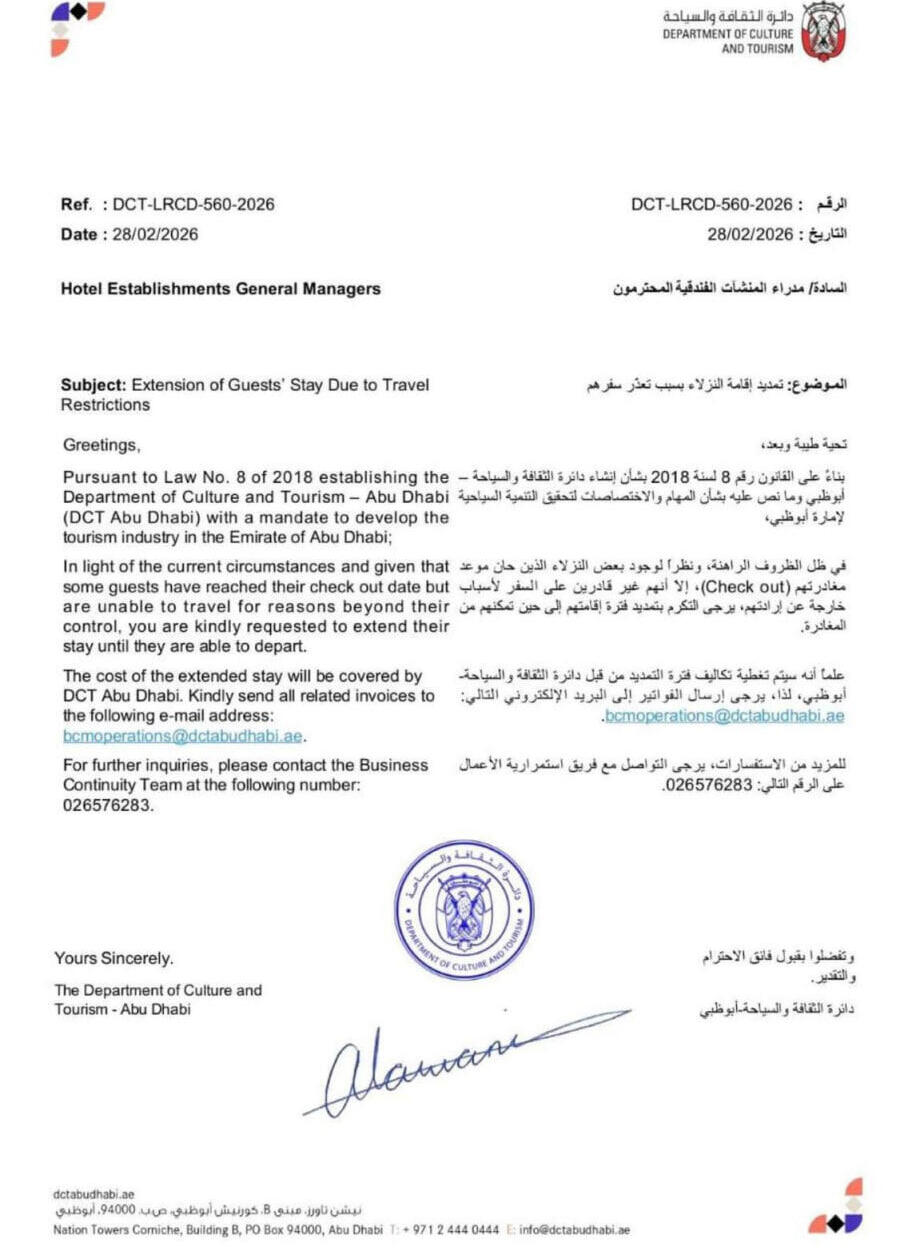
Against that backdrop, Abu Dhabi’s Department of Culture and Tourism issued an official directive to hotel managers ordering them to extend the stays of guests who have reached their checkout date but cannot fly out “for reasons beyond their control.” According to the document, the cost of the extended stays will be funded by the Abu Dhabi authority, and hotels have been asked to submit invoices to the relevant bodies. The move applies only to the emirate of Abu Dhabi and is not a federal decision covering the entire UAE.
The measure follows an expansion of the war between Israel and the United States and Iran into the Gulf. Tehran has attacked targets in the UAE, prompting the closure of airspace and the suspension of civilian air traffic.
Earlier Sunday, an Israeli woman and her son were lightly injured by a blast after a drone struck a building in Abu Dhabi housing Israeli envoys. Authorities said fragments from an intercepted drone hit a tower complex that includes the Israeli Embassy and other foreign missions, damaging the facade of the Etihad Towers complex.
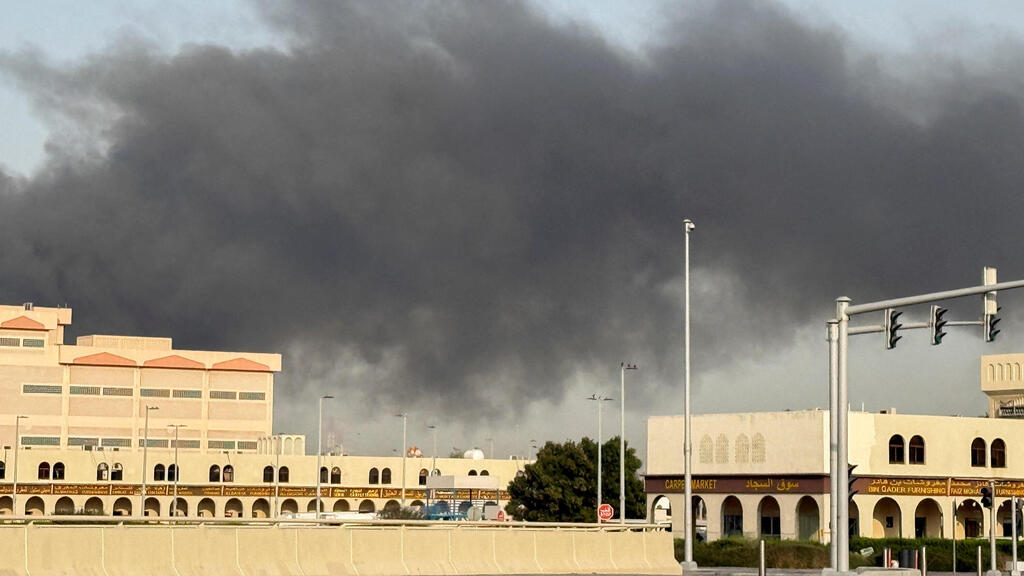
Smoke rises from Zayed Port in Abu Dhabi, United Arab Emirates
(Photo: REUTERS/Abdelhadi Ramahi)
In Israel, meanwhile, the Tourism Ministry has shifted to emergency operations under the direction of Tourism Minister Haim Katz, following the launch of Operation Roaring Lion. The ministry is providing accommodations for residents evacuated from their homes because of missile strikes and assisting tourists currently in Israel who wish to leave the country.
As of Sunday morning, about 37,400 tourists were in Israel. Since the start of the operation, roughly 700 have departed. The ministry said it is prepared to help tourists seeking to leave by arranging transportation to land border crossings and is maintaining continuous contact with the Israel Incoming Tour Operators Association, which is coordinating tour groups remaining in the country.
At the same time, the ministry is responsible for housing residents evacuated due to missile attacks nationwide. So far, more than 280 people have been placed in hotels under a framework prepared in advance with a broad inventory of rooms for emergencies, in cooperation with the Israel Hotel Association.
Director General Michael Izhakov has also ordered reinforcement of the ministry’s 24/7 virtual information office. Since the start of the operation, about 500 inquiries have been handled, many requiring direct responses from ministry staff.
The ministry said it remains in ongoing contact with hoteliers, travel agents, tour guides and other tourism operators and is receiving updated assessments of needs on the ground.
Israel’s land border crossings are currently operating on the following schedules: the Menachem Begin Crossing at Taba is open around the clock; the Yitzhak Rabin Crossing in the Arava is open from 6:30 a.m. to 8 p.m.; the Allenby Bridge terminal is open from 9 a.m. to 5 p.m., with tourist processing available until 2:30 p.m.; and the Jordan River Crossing near Beit She’an is open from 8:30 a.m. to 5 p.m., with arrivals permitted until 3:30 p.m.
Authorities advised travelers to pay border fees in advance to reduce waiting times and to arrive at crossings at least two hours before closing. Information is subject to last-minute changes, and travelers are urged to check for updates before departing for border terminals. Emergency information for tourists, including access to the virtual office, is available at: https://www.gov.il/he/pages/emergency-information-for-tourists