

Simcha Goldstein booked a stay through Booking.com at NAPOLI MOOD Il Golfo Apartments, a four-star apartment and guest-room complex in Naples. After his reservation had already been confirmed, he received a message from the property asking him to cancel it.
“You can cancel it, I don't accept citizens from countries guilty of genocide," the message said.
But despite the explicit wording and the refusal based on his citizenship, Booking.com did not remove the property from its platform and instead issued a warning.
Documentation shows that the message was sent through Booking.com’s messaging system after Goldstein requested to check in at the property. His check-in request was denied, and the message sent to him explicitly linked the decision to his country of citizenship.

Following the incident, Booking.com was asked to remove the property from its platform. In a letter sent by Shai Glick, CEO of the B’Tsalmo organization, he argued that the case constituted serious discrimination based on nationality and a violation of Booking.com’s nondiscrimination policy.
The letter called on the company to remove the property from the site, take action against its management and assist Goldstein following the refusal to host him.
Booking.com, however, has so far chosen not to remove the property.
In a response to ynet, the company said: “When a property chooses to join Booking.com, it commits, as part of its agreement with the company, not to engage in discrimination and not to allow discriminatory conduct at the property. In the present case, Booking.com issued a warning to the property, and if similar behavior is repeated, the company will consider taking further action.”
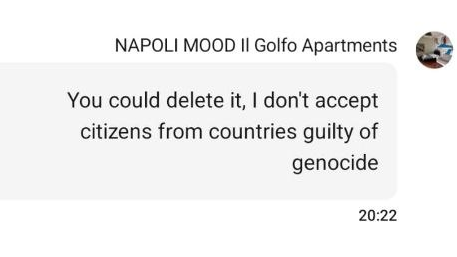
The message received by the Israeli tourist
In its response, Booking.com did not say that the property had been suspended or removed from the site, nor did it detail any additional steps taken following the incident beyond the warning.
Thus, at least for now, the sanction imposed over the documented conduct amounted only to a warning.
The property had not responded to ynet’s request for comment by the time of publication.
The case joins a series of incidents reported in recent months in Italy amid hostility toward Israelis and Jews. In July, ynet reported that an anonymous form circulated on social media in the country calling on users to report the arrival of Jews and Israelis at hotels and vacation apartments, as well as their presence at businesses, with the aim of “mapping Zionist tourism.”
The document was removed following intervention by Italy’s commissioner for combating antisemitism, while senior members of the Jewish community warned at the time of a “real manhunt” and a “new yellow badge.”
At the same time, protests and calls targeting Israeli tourists were also reported, including in Sardinia, along with attempts to flag their arrival at vacation destinations across the country.