

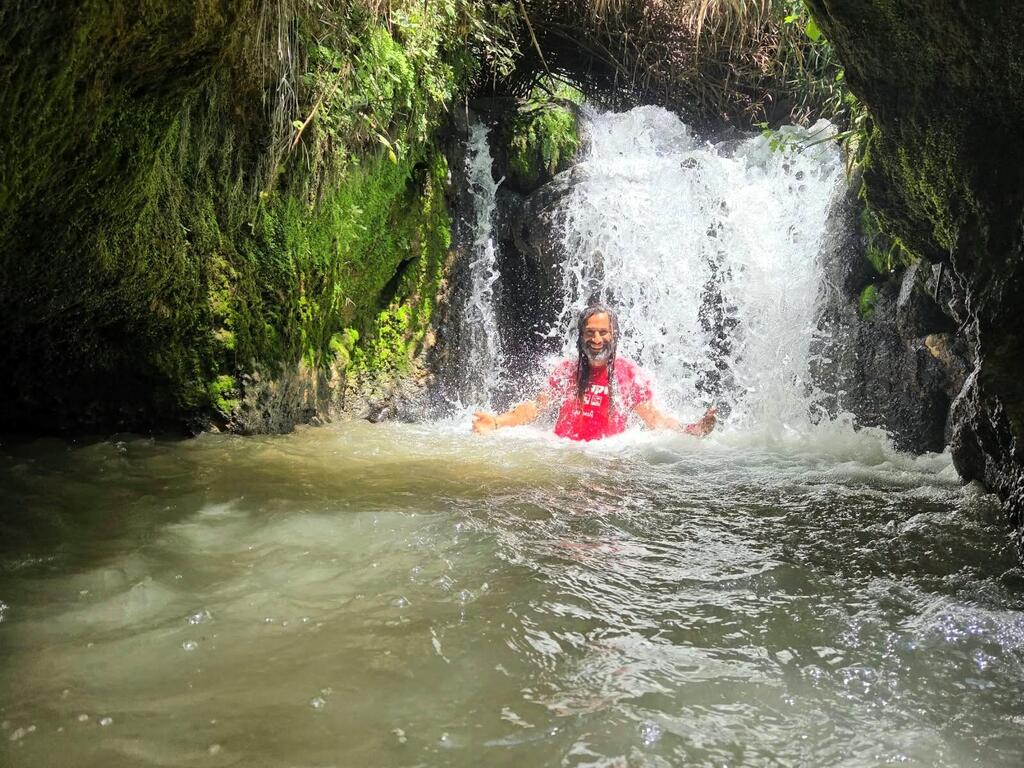
Just minutes on foot from residents’ homes lies a surprising urban stream, with a rushing waterfall, smaller cascades and hidden corners that even some local residents do not know about. Kobi Peled, the travel blogger known online as “Kuku Trip,” went for a dip in Nahal HaZahav, or the Gold Stream, in Kiryat Shmona and discovered a watery gem, including a beautiful waterfall that reminded him of a nature reserve in Europe. The echoes of explosions from across the border in Lebanon can occasionally be heard in the background, but for him, that is no reason to stay away: “We don’t have many streams like this in Israel.”
Nahal HaZahav originates at Ein HaZahav, or the Gold Spring, near Kiryat Shmona’s northern traffic circle on Route 90. From there, the water crosses residential neighborhoods, at times flowing right alongside people’s yards, passes through HaZahav Park and continues east toward the Jordan River’s western canal.
Bedouins called the spring Ein Dahab, meaning “Gold Spring.” After Kiryat Shmona was established in 1949, water from the spring was pumped for drinking by residents of the city and nearby mountain communities. Water use increased over the years until the stream nearly dried up completely. Following a prolonged campaign by Kiryat Shmona residents and environmental activists, authorities reopened the water flow in 2011. Clear water returned to the stream, along with vegetation and wildlife.
Kuku parked at the corner of HaYarden Street and Rabbi Yosef Messas Street and immediately headed down to the rushing waterfall. Only the residential buildings behind the vegetation reminded him that he was still in the heart of the city.
“If you look at the waterfall on its own, it feels like a place in the middle of some incredible nature reserve, somewhere you would make a special trip to visit,” he said. “But it’s maybe 200 meters, as the crow flies, from the houses and a five-minute walk from the car. When you stand below it and look up, for a moment it feels like Europe.”
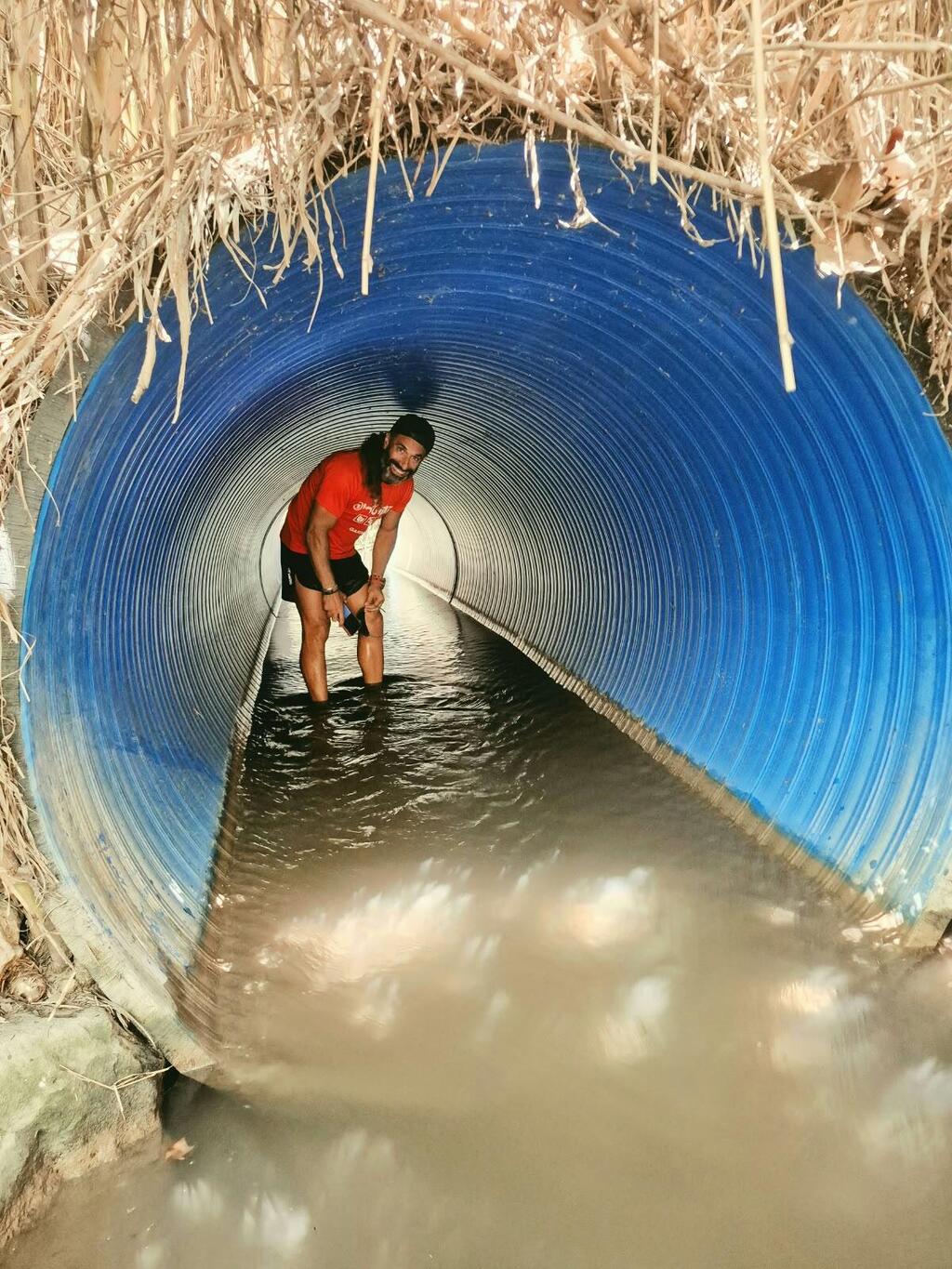
'I said, ‘Let’s get into the stream and go with the flow’'
(Photo: Courtesy of Kuku Trip)
Kuku had heard about the stream long ago but thought it was too small and short. “I like to run and I’m always looking for routes, and there isn’t really a long trail there. In the end, I managed to put together a nice circular route of about three kilometers: You walk along the stream and come back by road. It’s short, but it has lots of lovely little spots.”
“The highlight is this crazy waterfall,” he added. “The flow there is very strong, and it hasn’t let up for several weeks. You can get under the waterfall, and I did. I even tried jumping a little, carefully, although it’s not exactly the safest thing to do. You stand there and have to hold on tight against the current.”
Despite the crowds at northern Israel’s streams during Rosh Hashanah, he found very few visitors here. “We came from the Jordan River area, which was packed with people, and at Nahal HaZahav there were only seven people altogether — two families. It’s crazy.”
He said visitors should not rush straight to the waterfall. “I actually really enjoyed walking along the stream. You simply walk alongside the water, and when you see it turn, you follow it. There are several magical spots and little waterfalls. It’s somewhat reminiscent of the Rehaniya waterfalls: a small chain of low cascades, running water and green vegetation. Everything outside is yellow now, and suddenly you walk in there and feel as though you’ve arrived in spring.”
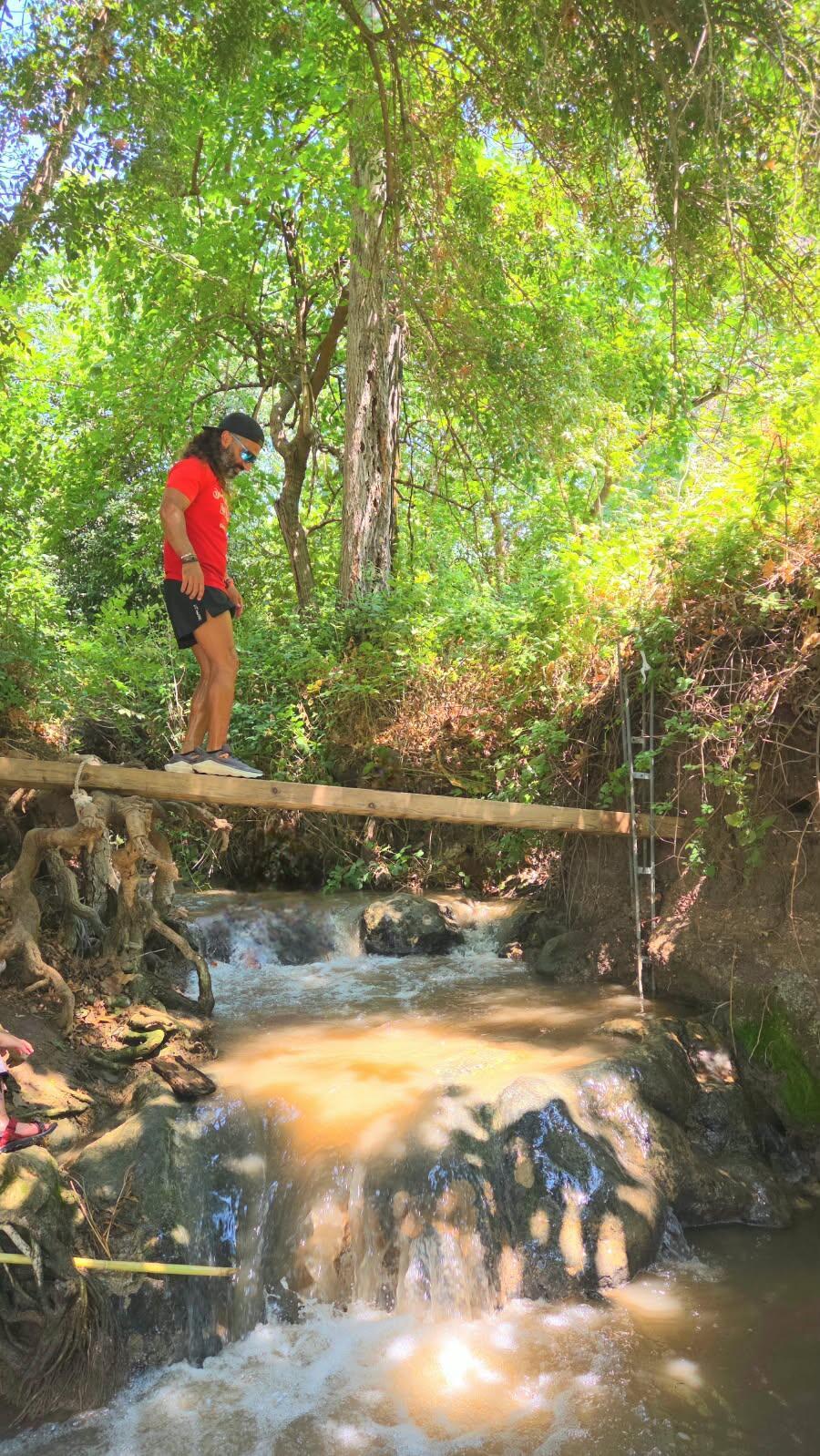
Beautiful spots along Nahal HaZahav
(Photo: Courtesy of Kuku Trip)
Kuku said he occasionally strayed from the path and found completely empty spots. “You sit in the stream with no one around, then look to the right and left and see the houses behind the bushes. Anyone who lives there gets this incredible experience right next to home.”
He improvised his “run and dip” route as he went. “I saw that people had marked lots of different points along the way, and I got confused by it. In the end I said, ‘Let’s just get into the stream and go with the flow.’ You simply stay close to the water. There are two main branches — one coming from the waterfall and another that turns off to the side. When you reach a point where the bushes block the way, you turn back and continue along the other branch until you reach the waterfall.”
HaZahav Park covers about 100 dunams, or 25 acres, in the heart of Kiryat Shmona. It begins as an urban park with lawns, picnic tables, playground equipment and sports facilities, but the farther visitors venture inside, the more the city seems to disappear. Paths and small bridges cross Nahal Ein HaZahav and vanish into dense vegetation, where streams, small pools and waterfalls emerge among the trees.
Alongside the natural surroundings, the park also contains traces of the area’s past. At its northern end stands the mosque of the former Arab village of Khalisa, while the remains of an old flour mill lie to the south.
“You can stop and sit by the bridge, but that’s not the highlight,” Kuku said. “The interesting places are the waterfall at the end and the area with the little waterfalls and beautiful flow, which almost no one reaches. For most of the way, the water is about ankle-deep, while in the pool beneath the waterfall it comes up to around an adult’s navel. I recommend coming with shoes or sandals suitable for water — not flip-flops.”
“A lot of people from Kiryat Shmona responded to me. Some said they had never even heard of the place. Others wrote, ‘We remember it from childhood, but we’ve never seen it flowing like this. We have to go back.’”
The reactions he received after posting footage of the site also surprised him.
“A lot of people from Kiryat Shmona responded to me. Some said they had never even heard of the place. Others wrote, ‘We remember it from childhood, but we’ve never seen it flowing like this. We have to go back.’ There were also people who said it had been their hangout when they were teenagers. If you photograph only the waterfall, there’s no way to guess it’s in the middle of a city. It absolutely blew my mind.”
For those looking to continue their day trip, Kuku recommends driving seven minutes to the Kurdish Spring at the end of David Shimoni Street in the city. This, too, is a small and relatively little-known urban nature spot.
“You can drive almost directly up to this completely clear spring. The water is shallow, around knee-deep, but it’s crystal clear. You can lie in the water, or walk through the stream for about half a kilometer. There’s no shade or designated picnic area, but you can sit in the water. Combining Nahal HaZahav and the Kurdish Spring in a single day is fantastic. I’m an Iraqi in a Kurdish spring — it sounds like the beginning of a joke.”
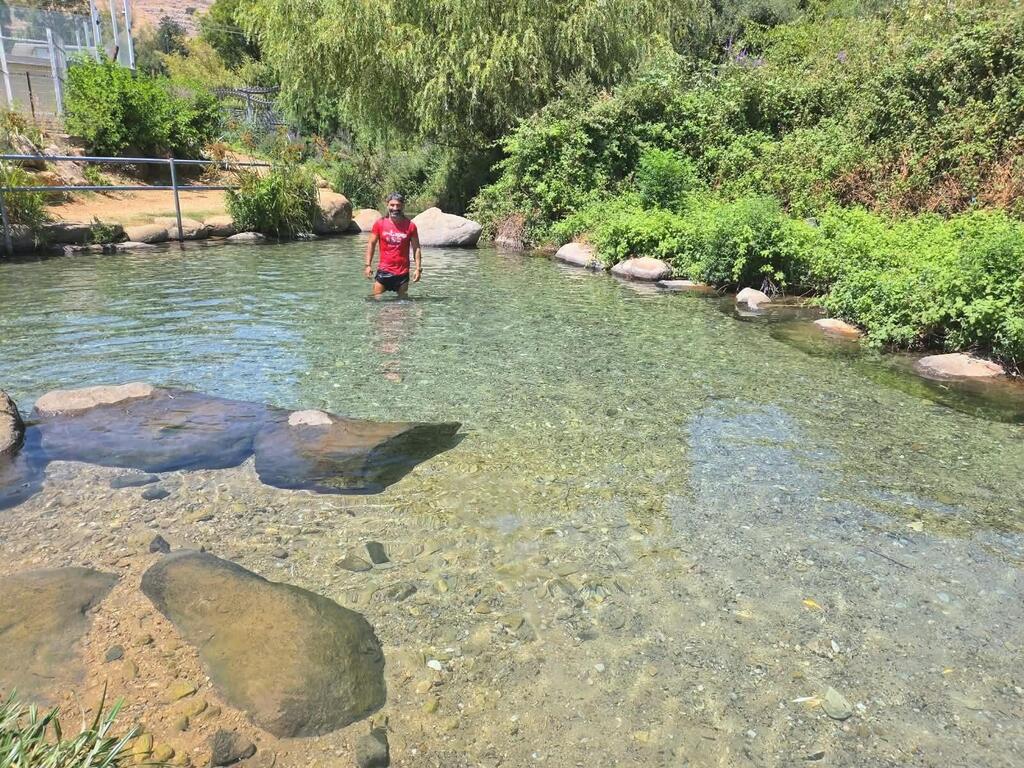
Kuku Trip at the Kurdish Spring, another surprising recommendation
(Photo: Courtesy of Kuku Trip)
“We used to hike with sirens. Now we hike with explosions.” The trip to northern Israel took place during Rosh Hashanah 2026, with the echoes of explosions from the direction of Lebanon occasionally audible in the background. Kuku acknowledged that the security situation is ever-present, but said that most of the time it is not felt too acutely.
“When I reach less-visited places, or places a little farther from the car, I can see that the vegetation has taken over, the trails are less well maintained and fewer people have been coming. These days, people tend to gather at places that are very close to the car.”
“People are lazy,” he joked. “When I post a place that’s a meter from the car, people go crazy for it. When I post somewhere you actually have to walk to, hardly anyone is interested.”
Still, he has no intention of giving up on the streams of northern Israel.
“This is our place. We don’t have anywhere else. It’s summer now and everything around us is dry. There are springs elsewhere, but we hardly have streams like these. It’s not as if we’re Austria and have thousands of streams. We’ve been through harder times. We used to hike with sirens, now we hike with explosions. That’s what you call a blast of a hike.”
How do you get to the Nahal HaZahav waterfall in Kiryat Shmona? Coming from the south on Route 90, turn right onto Uri Ilan Street, continue onto Rabbi Yosef Messas Street and drive to the intersection with HaYarden Street. The short path to the waterfall begins there.
How do you get to the Kurdish Spring in Kiryat Shmona? Take Route 90 into the city and turn right onto HaYarden Street. From there, turn left onto Ahad Ha’am Street, then take the first right onto David Shimoni Street. You can also enter “the Kurdish Spring” into Waze. Continue to the end of the street, where there is a dirt parking area near the water.
Warning: There are no lifeguard services at Nahal Ein HaZahav. Entering the water is at visitors’ own risk.