

In the middle of peak tourist season, a wave of anti-Israel protests was expected to erupt across Greece beginning on Thursday, Israel's most popular vacation destination.
Even before the organized demonstrations began, Israeli travelers were already encountering disturbing, hate-filled posters and graffiti in several locations, some written explicitly in Hebrew.

Yifat Tzaig, an Israeli currently traveling in Greece, described the hateful messages she and her family came across in the city of Ioannina, capital of the Epirus region in northwestern Greece. One graffiti message read: “Israel is a murderer. Free Palestine.”
Another poster, in both Hebrew and English, stated: “All IDF soldiers are war criminals—occupiers, rapists, murderers. You are not welcome here.” Stickers scattered around the city bore slogans in English and Greek such as: “War criminals not welcome,” “Stop the genocide,” “Free Gaza” and “Free Palestine.”
“We saw a lot of anti-Israel signs,” said Tzaig, who heads the Israeli community in Madrid. “What stood out this time was that some were in Hebrew—it felt like they were aimed directly at us. I’m here with my kids, and it created a very uncomfortable atmosphere. After seeing it for the first time, the kids didn’t want to leave the hotel room. It took us time to calm them down and ease their anxiety. But we’ve decided—we’re proud Israelis, and we won’t let this impact us.”

(Photo: Yifat Tzaig)
She added, “When we sat down with locals and spoke with them, it helped a bit. There’s a strange dissonance: on the one hand, there are these hateful signs, which make you more alert. On the other hand, the locals are kind and welcoming.”
Dr. Ariel Zilberlicht, also vacationing with his family in Greece, echoed the sentiment in a separate interview. “We’re now in Athens at the end of our trip. We started in northern Greece and were met along the way with anti-Israel signs that dampened the mood and made us more cautious,” he said.
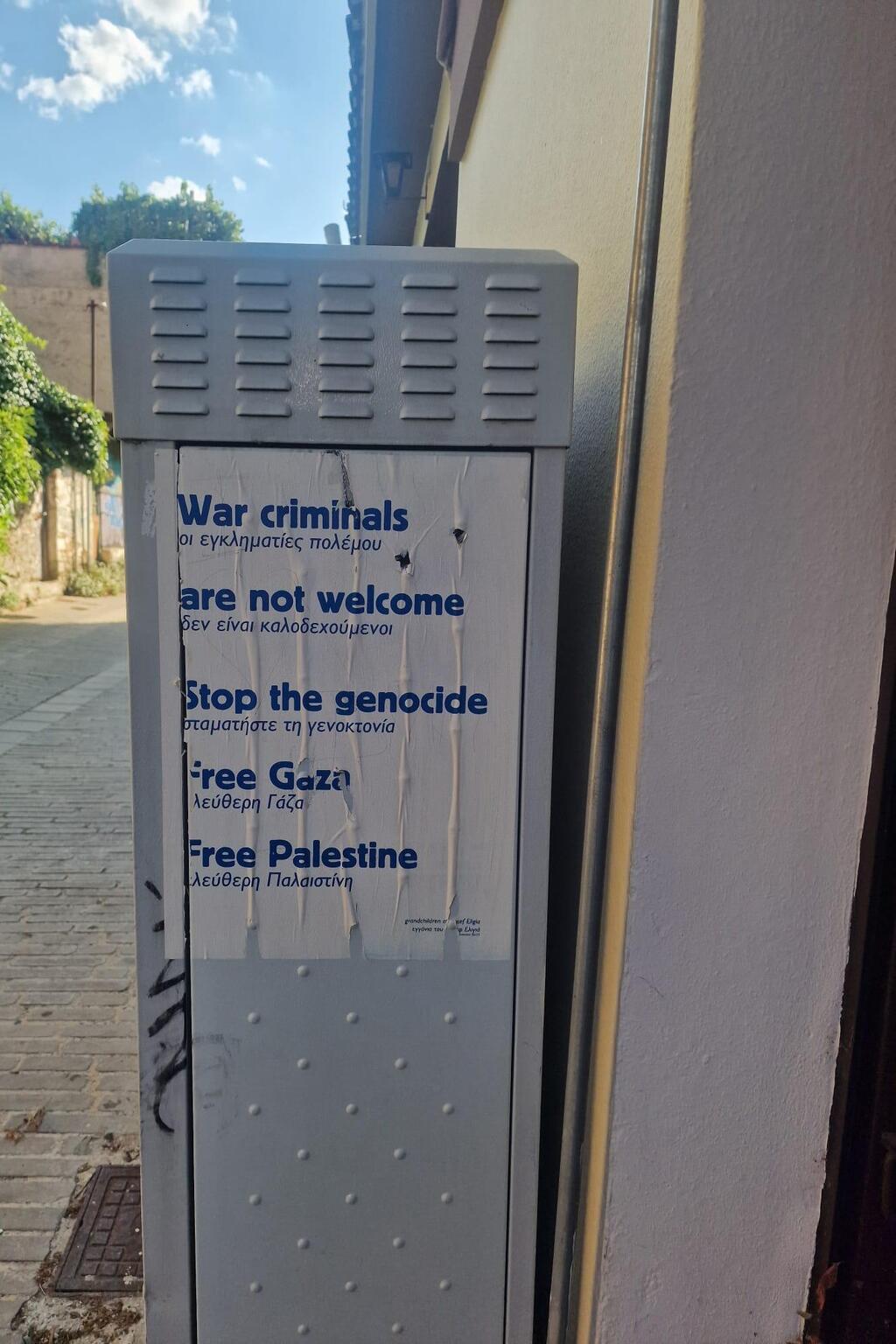
(Photo: Yifat Tzaig)
Still, Zilberlicht stressed that the protesters are a small minority. “It’s a challenging time to be Israeli,” he said. “Greece is still friendly and supportive of Israel. Everywhere you go, it’s a small group. We avoided political discussions—there’s no point in engaging.”
On Wednesday, Israel’s Center for Monitoring and Combating Antisemitism Online issued a series of warnings about upcoming events, “days of rage,” and demonstrations in Greece. According to a Ministry of Diaspora Affairs alert, a pro-Palestinian group is organizing protests in response to the planned arrival of the Israeli cruise ship Crown Iris in the port city of Volos, in the Pelion peninsula.
Get the Ynetnews app on your smartphone: Google Play: https://bit.ly/4eJ37pE | Apple App Store: https://bit.ly/3ZL7iNv
Scheduled demonstrations include a protest night Thursday on the Volos promenade and another on the morning of August 13, coinciding with the ship’s expected docking.
Additionally, on Sunday, August 10, a coordinated wave of anti-Israel protests is expected at more than 25 locations across Greece—especially in major tourist areas—under the banner of a global campaign called “Day of Action for Gaza.” Protests are planned in the islands of Rhodes, Kos, Crete, Samothraki, Andros, Lesbos, Tilos, Amorgos, Sifnos and others, as well as in mainland hotspots like Olympia, Kiato, Edessa and Preveza. Most are scheduled for the late afternoon and evening at prominent public sites such as ports, town squares and archaeological landmarks.
How to stay safe while abroad
Security officials emphasize that Israelis can still travel to Greece and do not need to cancel their plans due to the protests. However, heightened caution is advised to avoid unnecessary risks.
Key safety recommendations include:
- Avoid protest zones or areas where anti-Israel graffiti is visible. If encountered, cross the street and do not engage—even if provoked.
- Minimize overt displays of Israeli identity. Avoid Hebrew lettering on clothing and consider whether to wear visible religious items such as a kippah or tzitzit.
- Do not disclose your nationality, religion, or identity to strangers.
- Avoid attending large public events that lack official security.
- Limit interactions with strangers to hotel staff, car rental agencies, and other service providers.
- Refrain from sharing your travel plans or real-time updates on social media.
- Travel with only essential documents. Leave work IDs or unnecessary paperwork at home.
- Immediately report any threat or suspicious behavior to local police.