


Lilach, the mother of Cpl. Ofir Davidian walks through the IDF's Urim base in a clean uniform and stops beside a utility pole. “This is where the terrorists shot her,” she says. “It was her first Shabbat on base. She was in the women’s quarters, woke up to the sirens and went to the safety shelter. An announcement said there were terrorists on base and told them to go to the operations room because it was safer. As she ran from the quarters to the operations room, the terrorists shot her.”
Ofir, a 19-year-old logistics NCO, was killed at Urim base on the morning of October 7. Only a few dozen yards separate the living quarters from the operations room, but as Ofir ran there with her friends, they had no idea terrorists were waiting to massacre them.
“She was shot and fell on her stomach. I saw exactly how it happened,” her mother says in pain. “She lay there for 12 minutes. The terrorists saw she was still moving, took her weapon and confirmed the kill."
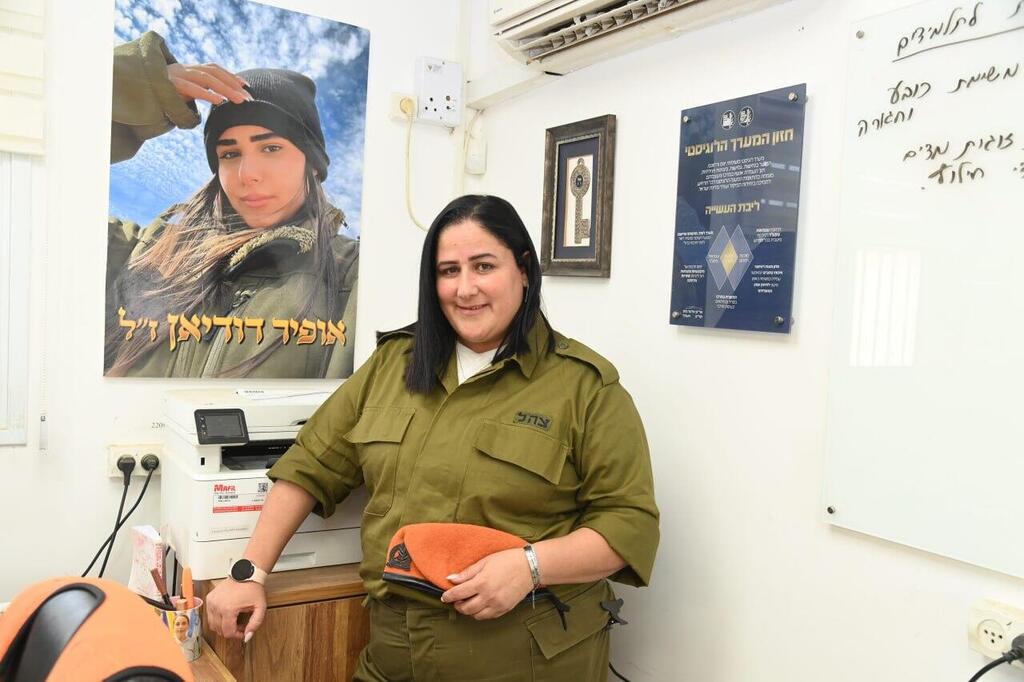
Over the past two months, 25 years after completing her own military service, Lilach, 45, returned to uniform and to reserve duty at the base where Ofir served. She wears her daughter's orange beret with pride, sits in the same office, fills the same role and even serves under the same commander.
“It started with wanting to understand exactly what she did,” Lilach says of the unusual decision. “Every time the army officials came to visit, I asked questions, I investigated and I requested to get to the base. They saw how much it meant to me and suggested I do reserve duty. I told them, ‘If I come back, it’s only in Ofir’s role and at Urim base.’ At first they were shocked. Once they understood I was serious, I received a call-up order."
She does not forget the first time she entered Ofir’s office. “I was so excited. I’m sitting at the same desk, and now there’s a photo of her on the wall. I salute her every time I walk in. I don’t feel I’m here just because someone is doing me a favor as a bereaved mother. I feel significant. I may be a reservist, but I do the job with total dedication.
"This is how I feel close to Ofir. I met her commander, the people who knew her. I truly gained another family. It helps me heal. Every time I come to the base, I’m filled with satisfaction. She was here only two and a half weeks, so I’m here so no one will say she left without finishing the job. I’m continuing her path."
3 View gallery
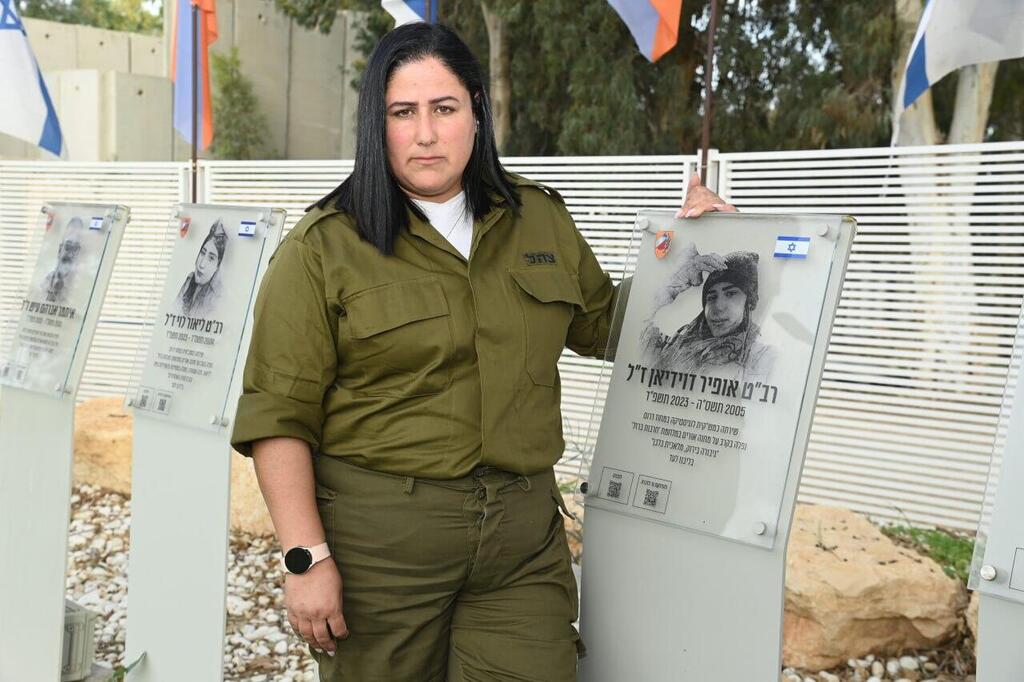
Lilach Davidian stands beside a memorial sign for her daughter
(Photo: Hertzel Yosef)
A special bond has formed between Lilach and the commander, Madlen. “I understand her too. Losing a soldier is not easy,” Lilach says. “We protect this togetherness. She was Ofir’s direct commander and now she’s mine."
On October 7, Lilach recalls, “Ofir had just started here after two months of basic training. She cried nonstop and said she didn’t want to stay on base over Shabbat and wanted to get medical leave.
"Her father and I told her, ‘Stay for Shabbat, don’t ruin it for your friends.’ We said we’d come and bring food, and we did, both Friday afternoon and at night. We said we’d talk in the morning, and like everyone else we woke up to the sirens.
“Ofir wrote to us from the shelter that she heard a loud boom and that ‘it sounds like they’re blowing up our base.’ Then she wrote that terrorists had infiltrated Urim, but we didn’t understand if she meant the base or the nearby kibbutz. She told us to lock the doors and take care of ourselves.
"After a while she wrote, ‘I’m going to die today.’ She stopped responding, and I called her commander, who told me she was in the bunker and was OK. It’s a good thing they didn’t tell me at that moment that she was dead. I would have run straight to the base."
3 View gallery
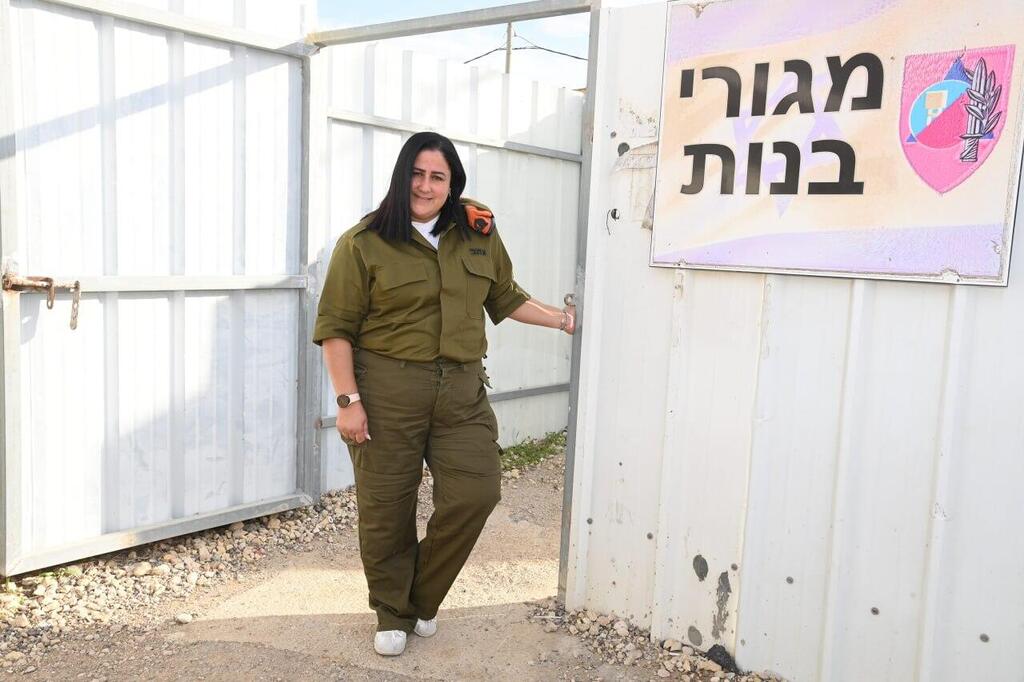
'She was in the women’s quarters, woke up to the sirens and went to the safety shelter'
(Photo: Hertzel Yosef)
The knock on the family’s door at their home in the moshav of Patish, a small community in southern Israel, came only the next morning, at 7:55 a.m. “At first I thought they were terrorists,” Lilach says. “Today I say I wish they had been terrorists. I saw they were our soldiers, but it didn’t occur to me at all that they were coming to tell us something. I thought they were conducting searches. I was happy and offered them food.
"My husband, Assaf, understood immediately and began screaming, ‘Not Ofir, No!’ The soldiers told us they had come to notify us that Ofir had died in battle. ‘What battle are you talking about?’ I told them. ‘She’s at Urim base, a noncombat soldier.’ I didn’t believe them. I shouted her personal ID number at them several times so they would re-check."
Returning to uniform is not the only change Lilach has made in her life following her daughter’s death. “Ofir was a girl full of joy, generosity, caring for everyone,” she says. “She was the glue among her friends, always making people happy and lifting everyone’s spirits wherever she went.
"She always believed in me and told me, ‘Mom, go study.’ I listened to her, and today I’m studying for a bachelor’s degree in education. I aspire to be an educator with a vision, someone who can lead and give my all, just as I give my all to my daughters at home."