


The Knesset Constitution, Law and Justice Committee began deliberations Monday on advancing legislation to establish a political commission of inquiry into the October 7 Hamas attack, as opposition parties boycotted the sessions and bereaved families demonstrated outside parliament calling instead for a state commission of inquiry.
The move came a day after the government told Israel’s Supreme Court that it has no authority to order the establishment of a state commission of inquiry, arguing that such a step would be an “extreme, unprecedented act” that violates the separation of powers.
The families’ protest outside the Knesset
(Photo: October Council)


Outside the Knesset, protesters included bereaved families, representatives of the so-called October Council — a group of relatives of victims of the October 7 attack — and women activists from a protest movement advocating the return of hostages held in Gaza. Demonstrators carried signs reading, “The government of massacre and abandonment — go home!”
Participants said that holding discussions on a political commission, rather than a state commission appointed independently, was an attempt by the government to evade responsibility for failures surrounding the October 7 attack, in which Hamas-led militants killed about 1,200 people in Israel and abducted some 250 others.
Michel Illouz, whose son Guy Illouz was abducted and later killed in captivity, said Sunday that any attempt to establish a non-state commission would be illegitimate. “This is not a political commission. This is a commission that must investigate what really happened on October 7,” he said. “Nothing connected to politics should be associated with it.” Illouz sharply criticized the political leadership, saying efforts to challenge who should appoint the commission amounted to “the greatest shame the State of Israel has known since October 7.” He added, “Not only was my son murdered in captivity, they murder me every day. I am a hostage of the state.”
Shimon Buskila, whose son Yarden Buskila was killed at the Nova music festival during the attack and who is a member of the October Council, described the fight to establish a state commission of inquiry as his life’s mission. “I know this won’t bring Yarden back,” he said. “But I have other children and grandchildren. I must know the truth, know where we failed and make sure we learned and fixed it.”
Buskila said it was unacceptable for “the investigated party to decide who the investigator is,” and warned that documents and evidence could be concealed as time passes. “Without truth, we will not have a better country, and without truth there can be no recovery,” he said.
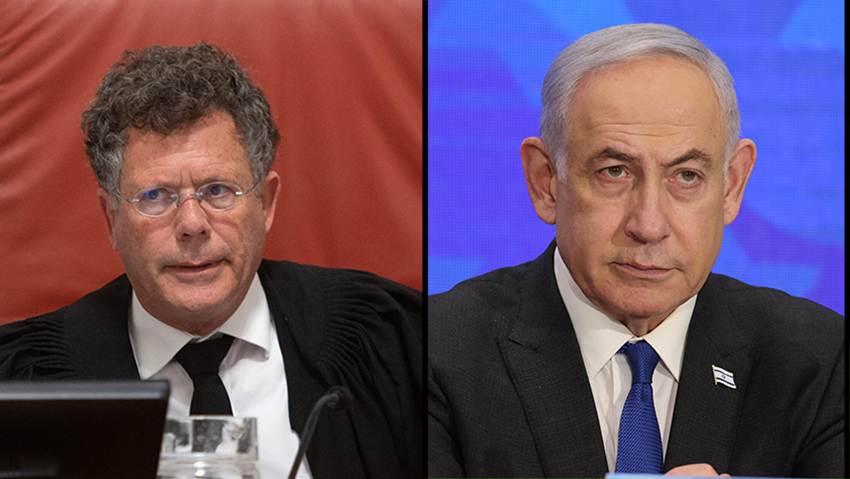
Netanyahu and Supreme Court President Amit
In its response Sunday to the Supreme Court, which issued an order to show cause regarding petitions demanding a state commission of inquiry whose members would be appointed by Supreme Court President Yitzhak Amit, the government said there was “no legal basis whatsoever” to make the order permanent and that the petitions should be dismissed outright.
According to the government’s filing, turning the order into a binding decision “would shatter the principle of separation of powers” and is outside the court’s authority. It said that ordering the establishment of a state commission of inquiry through a judicial ruling would be unprecedented, noting that since Israel’s founding the Supreme Court has never instructed the government to create such a commission — not on matters of war and security, public integrity and suspected corruption, economic issues or political affairs.