


Against the backdrop of the agreement between Iran and the United States, recent days have suggested that Prime Minister Benjamin Netanyahu and Israel are losing President Donald Trump — without a backup plan.
In the days before the war began, Trump reportedly believed the campaign would be a piece of cake. That was apparently the message conveyed to him by Netanyahu and Mossad Director David Barnea during a meeting at the White House. Senior administration officials already believed the situation was more complicated, but Trump chose to side with Netanyahu — only to discover later that reality was different.
Trump: I told Netanyahu he was "f***ng crazy"
(Video: Pod Force One, New York Post)


During the war, after significant exchanges of attacks, Iran not only refused to capitulate but also blocked the Strait of Hormuz, sending shock waves through the global economy. At that point, the American president realized the situation was becoming increasingly complicated and decided to cut his losses and bring the conflict to a close.
In fact, Trump had been trying for some time to end the war, including through threats directed at the Iranians — threats that, according to this account, they did not take seriously.
What happened next, when Israel struck in Beirut, was viewed in Washington as a slap in Trump's face. From the American perspective, the United States had gone to war alongside a partner, only to discover that Netanyahu was working behind the scenes to sabotage the negotiations.
Israeli officials familiar with the matter said this was how Trump saw it, and how people around him viewed it as well.
The American president, it should be noted, supports Israel and believes that without him it would not have survived. At the same time, he reportedly viewed the Beirut strike as a maneuver reflecting ingratitude.
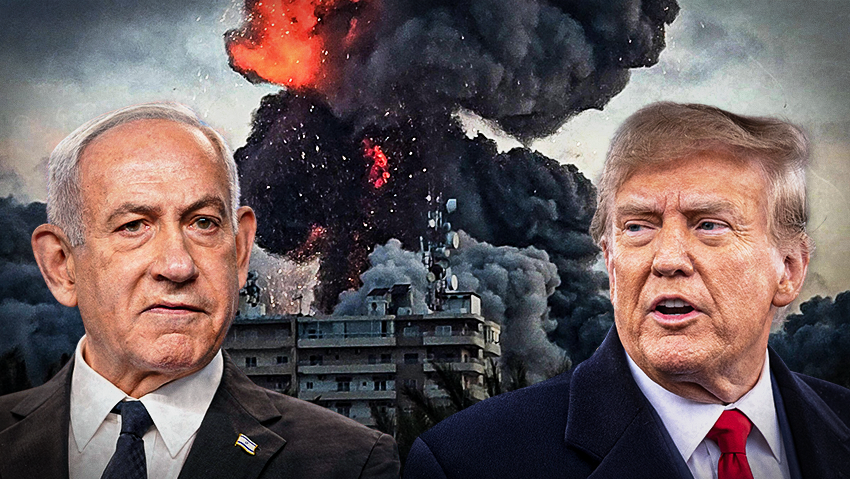
The American president, it should be noted, supports Israel and believes that without him it would not have survived
(Photo: Lev Radin/shutterstock, REUTERS/Nathan Howard, KAWANT HAJU/AFP)
"He realized that Bibi's outlook is not his outlook. Bibi wants something different. Bibi did not want to end the war. He does not want the agreement. He wants to go back to bombing," a source familiar with the matter said.
As a result, the U.S. president reportedly decided to weaken Netanyahu politically by suggesting that he might not run in the next election — a signal, in political terms, that he was showing him the door.
This comes in addition to Trump's remarks today that he had offered Syria the opportunity to deal with Hezbollah. In Trump's view, the situation in which Hezbollah fires at communities in northern Israel is effectively normal and does not require a response, provided no one is hurt.
Beyond that, Trump also said that regime change in Iran had never been an objective and that the current regime behaves rationally.
Trump apparently assumes that Netanyahu's hands are tied and that he cannot strike back. He knows Netanyahu has no alternative power base or political support network in the United States and is effectively dependent on him.
Netanyahu knows this as well and understands that he cannot afford to break the rope. Yet the moment is approaching when a confrontation with Trump — or an attempt to win him over — may become unavoidable.