


Mossad chief David Barnea said Tuesday that the agency had obtained strategic and tactical intelligence from the enemy’s “most guarded secrets,” expanded its operational reach in countries where it operates and advanced covert diplomacy to build regional alliances.
Barnea made the remarks at the Mossad’s 2025 citations ceremony, without addressing reports about optimistic forecasts he had made during the war that did not materialize.
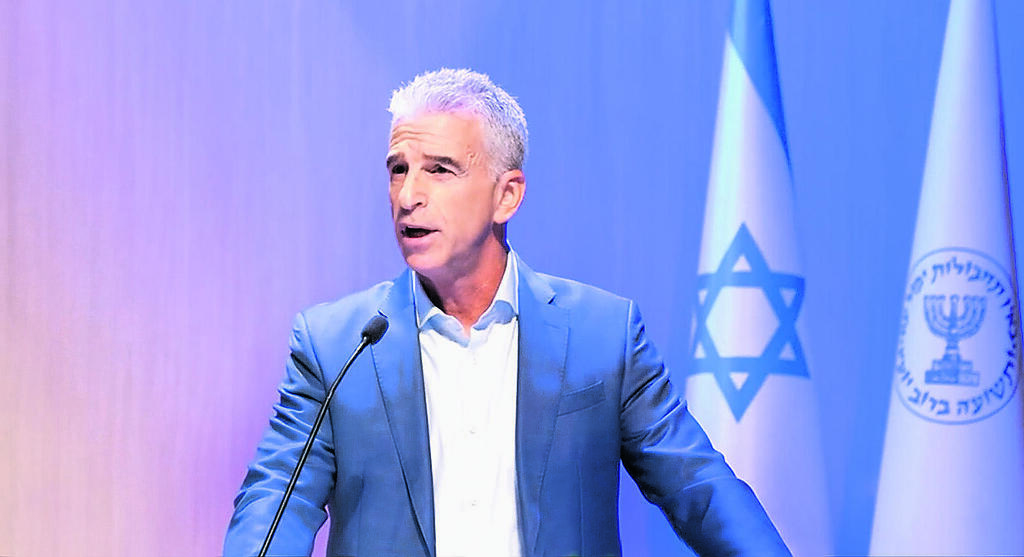
(Photo: Mossad)
According to reports during the war, Barnea told Prime Minister Benjamin Netanyahu that within days of the start of the campaign, the Mossad would be able to recruit the Iranian opposition and use it to spark unrest that could lead to the collapse of the Iranian regime. Israeli officials insist they did not hear him make such a promise, but say he did create the impression that it was an achievable goal. Barnea, for his part, has said he never committed to toppling the regime, either at the start of the campaign or during it.
At the ceremony, the Mossad awarded citations to 10 operations and projects that it said “made an exceptional contribution to Israel’s security and reflect groundbreaking work through close cooperation with security and intelligence agencies.”
In his remarks, Barnea said the Mossad had changed its operating model and become an “offensive and effective organization during wars,” rather than one whose covert operations are carried out mainly between wars, as in the past.
The agency said in a statement that the shift was reflected in the Mossad’s operations in the campaigns against Iran and Lebanon and was based, among other things, on the creation of new units and dedicated capabilities in recent years, as well as the adoption of advanced technologies and innovation across all areas of activity.
Among those honored were operations to obtain strategic and tactical intelligence from the enemy’s “most guarded secrets.” The Mossad said those operations enabled extensive activity in the campaign against Iran and on the northern front, while preserving Israel’s intelligence superiority.
A citation was also awarded for a series of operations carried out during Operation Rising Lion, in which the Mossad said it used new methods combining agents on the ground with advanced technological capabilities and deep covert penetration into Tehran.
Alongside offensive covert activity, a citation was also awarded for strategic activity led by the Mossad as part of a covert diplomatic campaign to expand Israel’s regional reach and forge new alliances. This year, a citation for bravery and courage was also awarded to a veteran operative for leading what the agency described as a daring, first-of-its-kind operation.
“In the campaigns against Iran and Hezbollah, we worked shoulder to shoulder with the IDF, both in defense and offense, and had an impact through our relative advantages and genuine partnership: in striking targets in Tehran, thwarting senior figures, achieving air superiority and defending the Israeli home front,” Barnea said.
“The operations that received citations this year allowed us to expand our operational reach in Lebanon and Iran. We obtained strategic and tactical intelligence from the enemy’s most guarded secrets,” he said.
Barnea added that the Mossad had “proved new and groundbreaking operational capabilities in countries where it operates” and demonstrated “the effectiveness of a powerful, innovative system for harming our enemies.”
“We carried out the covert diplomatic campaign, whose importance is critical to creating regional alliances and expanding Israel’s regional reach,” he said. “Together with the IDF, we changed the strategic posture of the State of Israel and strengthened its power.”
At the same time, Barnea said, the agency remained vigilant.
“We are committed to remaining vigilant, to intelligence and operational daring, and to readiness to act,” he said. “We will not rest on our laurels, and when we see a threat, we will act with full force.”