

Modern cities with sleek high-rises, a pristine coastline drawing tourists and a state-of-the-art port jutting into the Mediterranean. That, according to Jared Kushner, President Donald Trump’s son-in-law and Middle East adviser, is what Gaza could become.
In a 10-minute presentation at an economic forum in Davos, Switzerland, Kushner said that, given security, Gaza’s cities — now largely in ruins after more than two years of war between Israel and Hamas — could be rebuilt quickly.
Serious gaps and doubts emerge in Kushner’s Gaza rebuild plan
(Video: White House)


“In the Middle East, they build cities like this in three years,” Kushner said Thursday. “So stuff like this is very doable, if we make it happen.”
That timeline sharply contrasts with assessments by the United Nations and Palestinians, who expect a far longer and more complex recovery. Across Gaza, home to about 2 million people, former apartment blocks have been reduced to mountains of rubble. Unexploded ordnance lies beneath the debris, disease spreads through sewage-contaminated water, and streets resemble dirt canyons.
The U.N. Office for Project Services estimates Gaza contains more than 60 million tons of rubble — enough to fill nearly 3,000 container ships. Clearing it alone would take more than seven years, followed by additional time for demining.
Kushner spoke as Trump and other world leaders gathered to ratify the charter of the Board of Peace, the body meant to oversee the ceasefire and reconstruction process.
Reconstruction hinges on security
Kushner stressed that reconstruction would only be possible if Gaza achieved “security” — a major uncertainty.
It remains unclear whether Hamas would disarm, with the group saying they have a right to resist Israeli occupation, though some have indicated they might consider “freezing” their weapons as part of a path toward Palestinian statehood.
Kushner said the Board of Peace has been working with Israel on “de-escalation” and is turning to the demilitarization of Hamas — a process he said would be managed by a U.S.-backed Palestinian body overseeing Gaza, known as the NCAG.

Whether Hamas would accept the authority of that committee is far from certain. The group says it would dissolve the governing structure it runs in Gaza but has been vague about the fate of its fighters and weapons. Hamas seized control of Gaza from the Palestinian Authority in 2007.
Complicating matters further is the presence of rival armed groups in Gaza. Kushner’s presentation said such groups would either be dismantled or “integrated into the NCAG.” During the war, Israel has backed some armed Palestinian groups and gangs in Gaza as a counterweight to Hamas.
Without security, Kushner said, Gaza would not attract investors or generate jobs. A joint estimate by the U.N., the European Union and the World Bank puts the cost of rebuilding Gaza at $70 billion. One slide in the presentation stated that reconstruction would not begin in areas that were not fully disarmed.
Unanswered questions about civilian life
Kushner’s plan did not address how demining would be carried out or where Gaza’s residents would live while reconstruction is underway. Most families are currently sheltering in parts of Gaza City and along much of the coastline.
His vision includes new roads, a new airport — the previous one was destroyed by Israel more than 20 years ago — a new port, and a coastal zone designated for tourism, much of which is now densely populated by displaced Palestinians. The plan outlines eight “residential areas” separated by parks, agricultural land and sports facilities.
Kushner also highlighted zones for “advanced manufacturing,” “data centers” and an “industrial complex,” though he did not specify what industries would operate there.
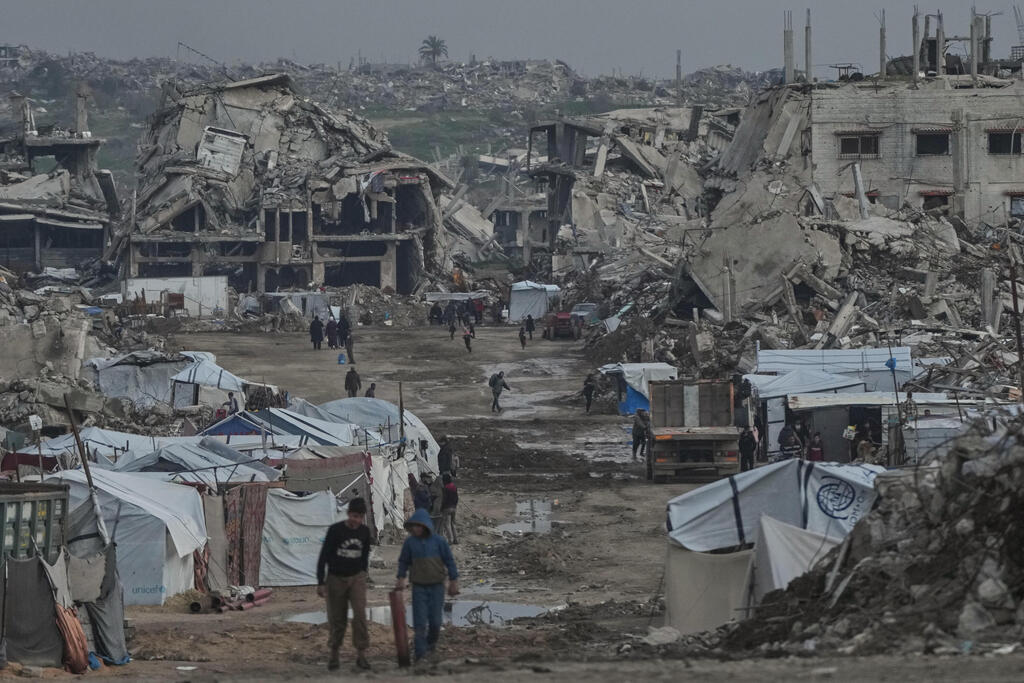
(Photo: AP Photo/Jehad Alshrafi)
He said construction would begin with “workforce housing” in Rafah, a southern city devastated during the war and currently under Israeli control. Rubble clearance and demolition, he said, are already underway there.
The presentation did not mention demining. The United Nations has warned that unexploded shells and missiles are widespread across Gaza, posing a deadly threat to residents searching rubble for belongings, relatives or firewood. Rights groups say large-scale rubble removal and demining have not begun in the areas where most Palestinians live because Israel has blocked the entry of heavy machinery.
After Rafah, Kushner said, reconstruction would move to Gaza City — referred to in his slides as “New Gaza” — which he said could become a hub of employment.
Will Israel accept it?
Nomi Bar-Yaacov, an international lawyer and conflict-resolution expert, called the board’s initial redevelopment vision “totally unrealistic,” saying it reflects Trump’s real estate mindset rather than a peace-building approach.
A landscape dominated by high-rise buildings would be unacceptable to Israel, she said, because it would offer clear views of Israeli military bases near the border. Bar-Yaacov is an associate fellow at the Geneva Centre for Security Policy.
Kushner’s presentation also envisioned the NCAG eventually transferring control of Gaza to a reformed Palestinian Authority. Prime Minister Benjamin Netanyahu has firmly opposed any postwar arrangement involving the Palestinian Authority. Even in the West Bank, where it governs, the authority is deeply unpopular due to corruption and perceptions of cooperation with Israel.