

The whipping, the starvation, the isolation. During captivity, Rom Braslavski learned to cope with suffering and physical pain, but he says it was the cruel humiliations inflicted on him that broke him. One example was when a terrorist forced him to open his mouth and spat inside. "You get used to the beatings," he says. "But that humiliation — that was my lowest moment in captivity."
During nearly two years in Gaza, Rom endured a long ordeal of torture. He spent most of the time in Deir al-Balah, first in safe apartments and later inside a vast camp of displaced persons' tents.
Gallery
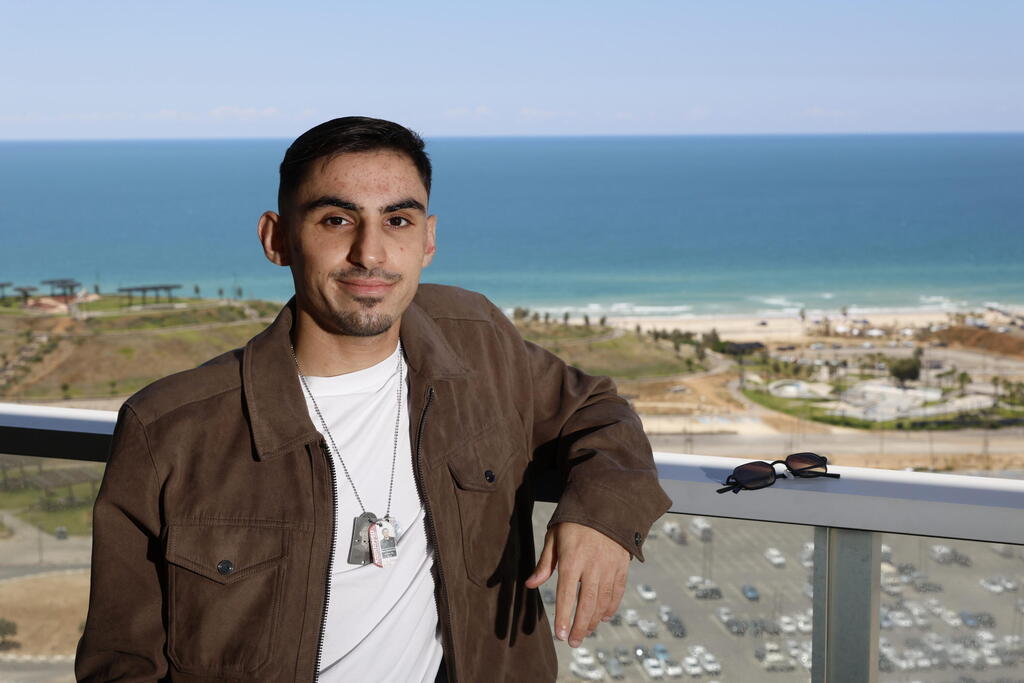
'My past is black. I'm just trying to make sure the future is pink. Rom Braslavski
(Photo: Ziv Koren)
"All around me there were tens of thousands of tents," he recalls. "I was inside a tent divided into three sections: in one lived the commanding terrorist and his family, in another the Islamic Jihad fighters, and in the third: me."
For long days he was kept bound hand and foot, often completely naked. For hours he was forced to stand facing a wall, blindfolded, with stones jammed into his ears so he could hear nothing.
"Every so often they would come in and whip the soles of my feet with a donkey whip," Rom says. "My feet were purple. I could barely stand."
According to him, the violence inside the tent was not directed only at him: "I saw how they treated their women and children. The children and wife of the terrorist guarding me were beaten nonstop. He was running a terror headquarters out of his home."
But, he says, it was the captors' inventive and brutal methods of abuse that left the deepest scars. On one occasion, after 28 days without a shower, he begged to be allowed to wash.
"My whole body was black with dirt," he says. The terrorist told him to prepare for a shower, then returned with a bucket full of sand and garbage and forced him to pour it over himself.
"They wanted me to feel like an animal," Rom says. "Not a human being."
"They hated me because I was a soldier"
Rom, 22, was abducted as a soldier from the Nova festival, where he worked as a security guard, and he is convinced that was also the reason for the especially brutal treatment he received.
One of his captors, Ahmad, who was a year younger than him, abused him constantly.
"If I fell asleep for a moment, he'd wake me up. Even when orders were given to stop beating me, he continued. They hated me because I was a soldier."
One day, Rom broke down: "I wasn't eating, I wasn't drinking, I couldn't see any future," he recalls. "I just lunged at him."
Rom choked the terrorist until others separated them.
"I didn't care about killing him and dying myself. I just wanted it to stop."
From that moment on, he says, the punishments only intensified.
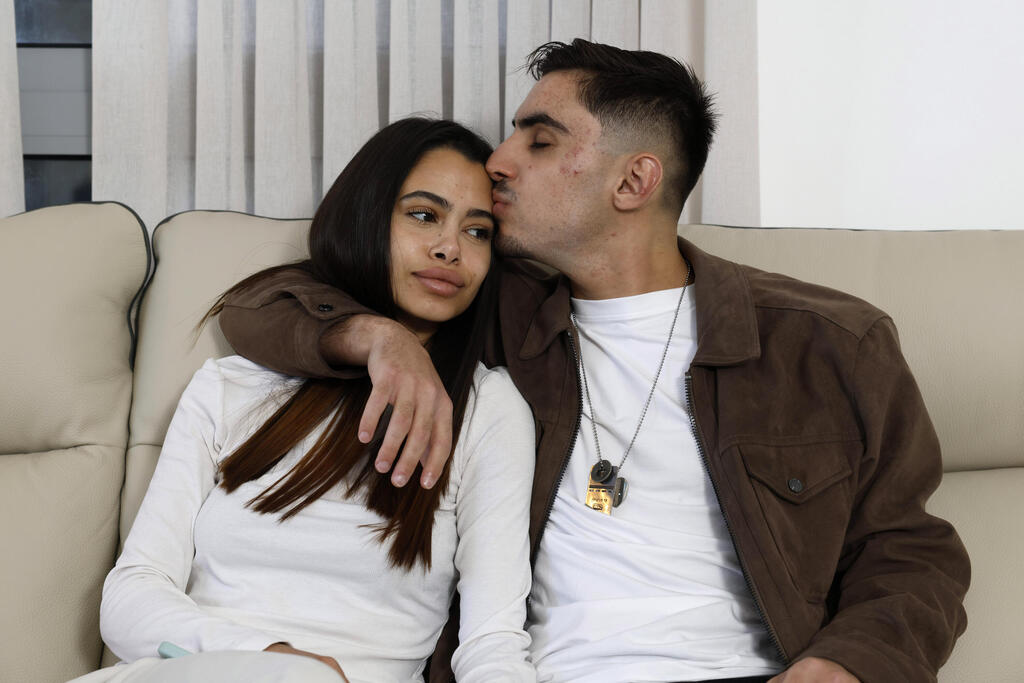
Rom Braslavski and his partner Shoham Talker
(Photo: Ziv Koren)
Now, months after being freed, Rom is trying to relearn how to live outside Gaza. He still suffers from chronic pain, nightmares and severe anxiety.
"90% of the Rom from before October 7 died on October 8," he says. "Maybe 10% of my joy for life and cynicism are left."
Recently, Rom began intensive psychological treatment: "In therapy, I go back through every day in captivity again. If I don't do it, it'll explode later," he says.
Medication, however, he refuses to take. While he was in captivity, his older brother suffered a severe psychotic episode because of the family's emotional collapse, and developed schizophrenia.
"He crashed his car into a pole and survived by a miracle. Since then, I'm afraid of losing control of my mind."
Since his release, he has also been carrying almost alone the financial burden of supporting his family: "My parents tried to go back to work and couldn't. Mentally, they aren't capable. My siblings also haven't really managed to recover."
The feeling that accompanies him more than anything today is that the public has already moved on.
"They forgot the hostages," he says painfully. "People aren't really dealing with our suffering."
"I don't care whether it's a state commission of inquiry or a national one," he says. "Just investigate already. Take responsibility for what happened here."
He is particularly troubled by what he sees as the hostage issue becoming a political tool: "As far as I'm concerned, everyone is guilty," he says. "They took our story and turned it into a political struggle."
"My body is constantly on alert"
Despite everything, Rom is finding reasons to start over. One of them is his new relationship with Shoham Talker.
'My biggest dream is to truly be free from captivity. Not physically — mentally'
(Photo: Ziv Koren)
She knows almost everything about him, but not everything.
"Sometimes, when she falls asleep on me, I wait a little until I'm sure she's asleep and only then start crying. I don't want to expose her to the pain and suffering I carry with me. I want to protect her from the evil I was exposed to."
Even before October 7, his life was not simple. He grew up in Jerusalem's Katamonim neighborhood, did not finish school and initially received an exemption from military service, but insisted on enlisting.
"I sat outside the military psychologist's office until he made time for me," he says.
Eventually he enlisted through the IDF Education and Youth Corps program at Havat HaShomer base: "In the first week I was still yelling at my commander, and in the end I graduated as an outstanding cadet in a behavioral improvement program."
Even now, after everything he has been through, he still speaks about wanting to serve in the reserves.
"I believe everyone should enlist, without exception," he says. "If I could serve in the past and still want to serve, everyone should. Torah students should also combine their studies with military service. I studied Torah and prayed too, and I still enlisted."
But his sense of security has collapsed. Since returning from Gaza, he carries pepper spray at all times, afraid of a terror attack, afraid of being abducted again: "My body is constantly on alert. From the outside, people may see someone who came back, but inside, I'm still there."
And for him, this war is far from over.
"My past is black," he says. "I'm just trying to make sure the future is pink. My biggest dream is to truly be free from captivity. Not physically — mentally."