

From the heights of a luxury penthouse in Moscow City, Bashar Assad’s life appears quiet and comfortable. The man who ruled Syria for 24 years, including more than a decade of bloody civil war, now lives a sleepy life of luxury in Moscow, this time at his own expense, or more precisely, on the billions he managed to move to Russia during his years in power.
According to reports, Assad owns some 20 apartments in Moscow, bought during his presidency. He and his family now split their time between two addresses: the penthouse in Moscow City, at the heart of the Russian capital, and a villa in the prestigious Rublyovka district west of the city, where Russia’s superrich mingle with the political elite. At the villa, he can even wave to a neighbor and fellow exile of sorts, ousted Ukrainian President Viktor Yanukovych.
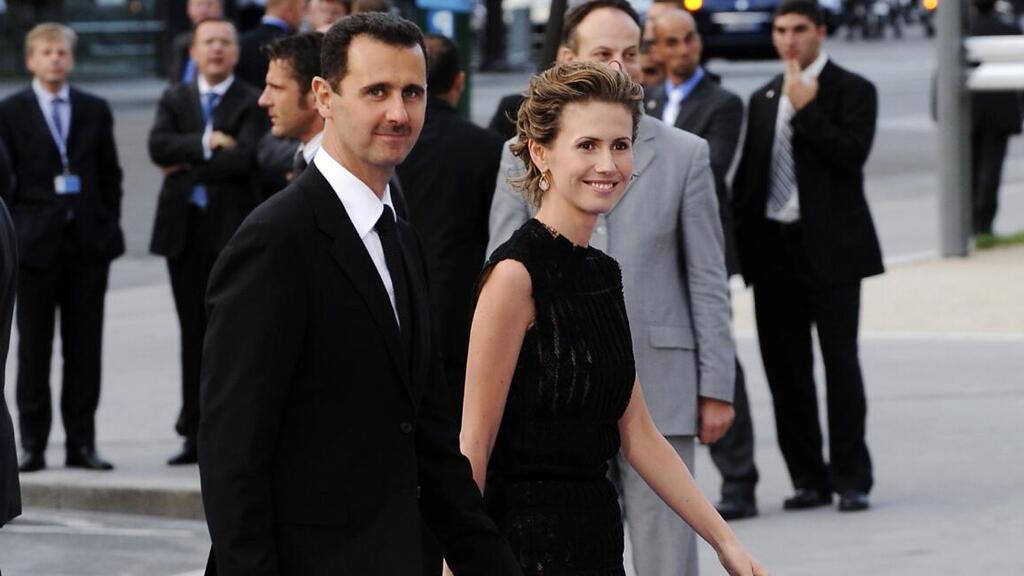
Sources close to Assad say that around 11 a.m., a security detail appears at the Moscow City tower and Assad follows them down to the lobby. Black coffee is served as soon as he sits down. The former president then immerses himself in ophthalmology books, the field he studied and practiced before rising to power in Damascus, before moving on to computer games and attempts to learn Russian. After two or three hours, he signals to the guards and returns upstairs. When he occasionally addresses the local guards in their language, trying out the limited Russian vocabulary he has struggled to learn, they pretend not to understand.
Since fleeing Syria in December 2024, Assad has still not left the apartment complex or the villa, not for shopping malls, not for the cinema, not for walks through Moscow. His three children, Hafez, 25, Zein, 23, and Karim, 22, and his wife Asma have been seen at times in luxury stores in the Russian capital and have also flown to the Emirate of Abu Dhabi for a break. When they returned, they begged to move there permanently, but Abu Dhabi ruler Mohammed bin Zayed rejected their requests outright.
“That is a real danger,” Emirati security officials told them. “You would become easy targets for assassination.”
Zein was also forced to stop her studies at the Abu Dhabi branch of France’s Sorbonne University after a public outcry and insults from students who discovered her identity. She later moved to the Moscow State Institute of International Relations, and last June received a bachelor’s degree at a ceremony attended by her mother and two brothers. Her father was not given permission to join them.
On Putin’s orders, journalists are barred from entering the compound, and no one has yet managed to photograph Bashar Assad, now 60, in exile. The man once regarded as Syria’s strongman is now described by Kremlin advisers as “irrelevant,” while Russia is already building ties with the new regime that replaced him.
His relationship with his wife is also said to be more fragile than ever, and recent reports claimed Asma is seeking a divorce and wants to renew her British passport.
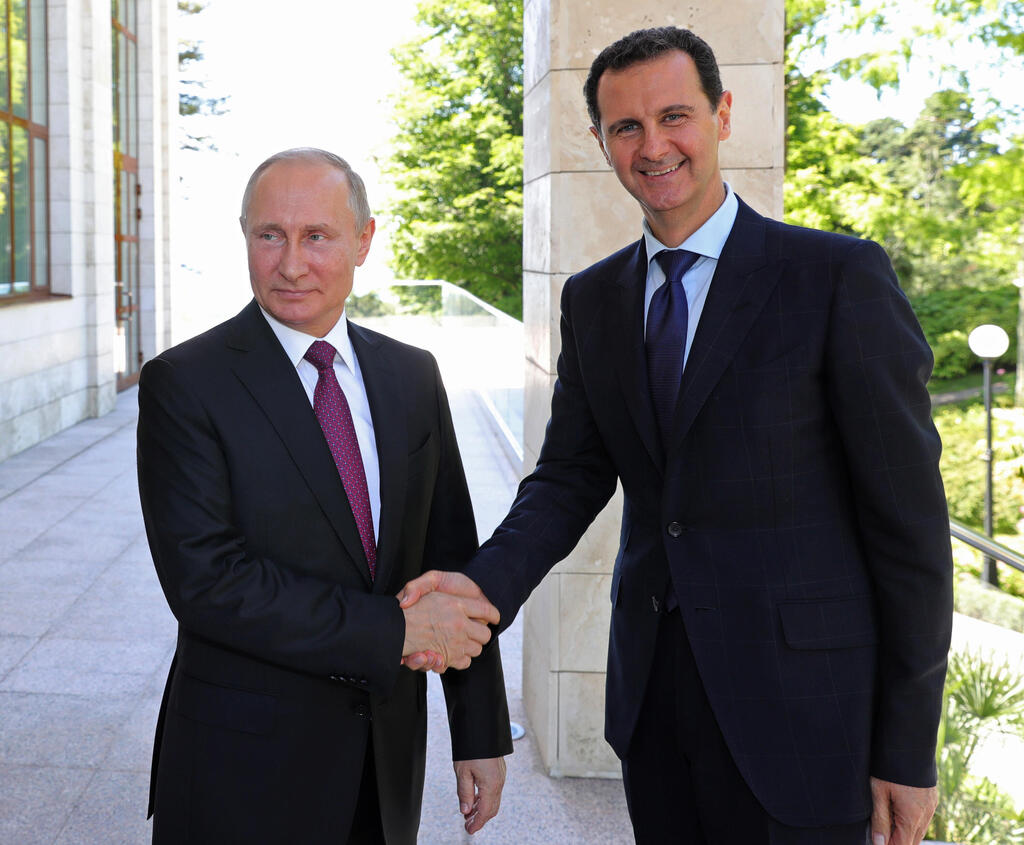
(Photo: Mikhail Klimentyev/Pool/AP)
Asma arrived in Moscow for medical treatment even before Bashar fled. In August 2018, she was diagnosed with breast cancer and treated at a hospital in Damascus. Her father, a cardiologist, and her mother, who worked at the Syrian Embassy in London, rushed to her side. After she recovered, they returned to London. In May 2024, it emerged that Asma had also been diagnosed with leukemia. Her parents accompanied her in Moscow during another round of treatment, but have since returned to London. Her efforts to join them have been rejected outright.
The British government is ignoring the citizenship of the woman who, before her marriage, was known as “Emma,” worked at a major London bank and had planned to move to a major financial institution in the United States. None of her colleagues at the bank had guessed that “Emma” was even of Syrian origin. Only when she abruptly moved to Damascus and married Assad was the identity of the talented beauty revealed.
As far as is known, her health is now relatively stable, and she undergoes periodic checkups and medical monitoring in Moscow.
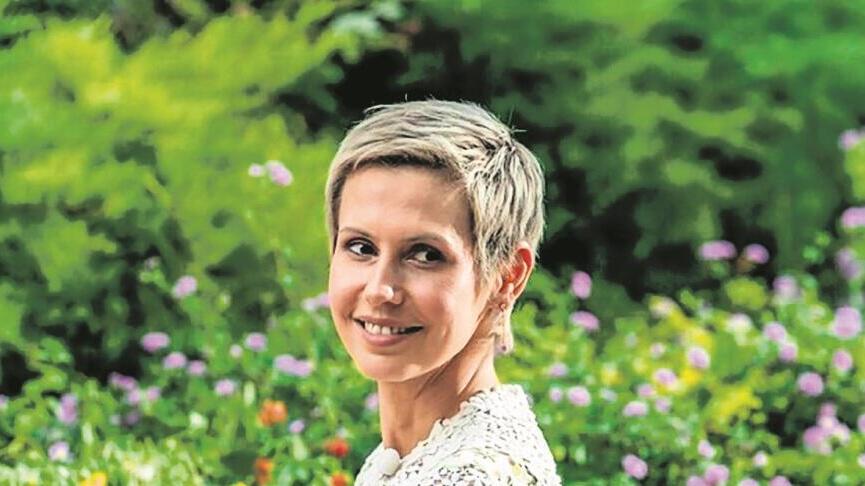
(Photo: AFP)
On April 26, Syria opened a series of show trials against those described as criminals of the old regime, known as the “Assad trials.” The main defendants, Bashar Assad and his brother Maher Assad, did not appear in court, but it is reasonable to assume that had Putin not granted the ousted president the status of “refugee for humanitarian reasons,” they would now be facing execution by hanging.
In their absence, indictments were read out at the first hearing at the High Criminal Court in Damascus. The judge ordered all their bank accounts confiscated and ordered all of Bashar Assad’s property, homes and palaces transferred to the Syrian state.
The second hearing convened on May 15. The defendant, Atef Najib, the former security chief in the southern province of Daraa and a cousin of Bashar and Maher Assad, was brought into the defendants’ cage wearing gray and black striped prison pajamas, shackled at his hands and feet. He was arrested in January 2025 and is accused of responsibility for the murder and torture of dozens of children, women and elderly people during the suppression of the uprising in Daraa. Relatives of the victims came to testify, holding photos of 16 children who died under severe torture.
The presiding judge, 83-year-old Fakhr al-Din al-Aryan, also survived persecution by the old regime. A former appeals court judge in northern Syria, he stepped down about a decade before Assad fled, after encountering what he saw as the regime’s injustices. He first found legal work in Idlib, but after learning that Assad had ordered all his property confiscated and sentenced him to death, he went underground. He managed to hide for five years. Only after the change of government was declared did he return to the bench, where he was appointed head of the High Criminal Court and chief judge in the Assad trials.
The show trials are being held under the watchful eye of Syria’s new interim president, Ahmad al-Sharaa. They began after two visits by al-Sharaa to Moscow, in 2025 and 2026, during which he demanded that Putin extradite Assad so he could be tried for war crimes. Once it became clear that would not happen, Damascus announced the opening of the trial.
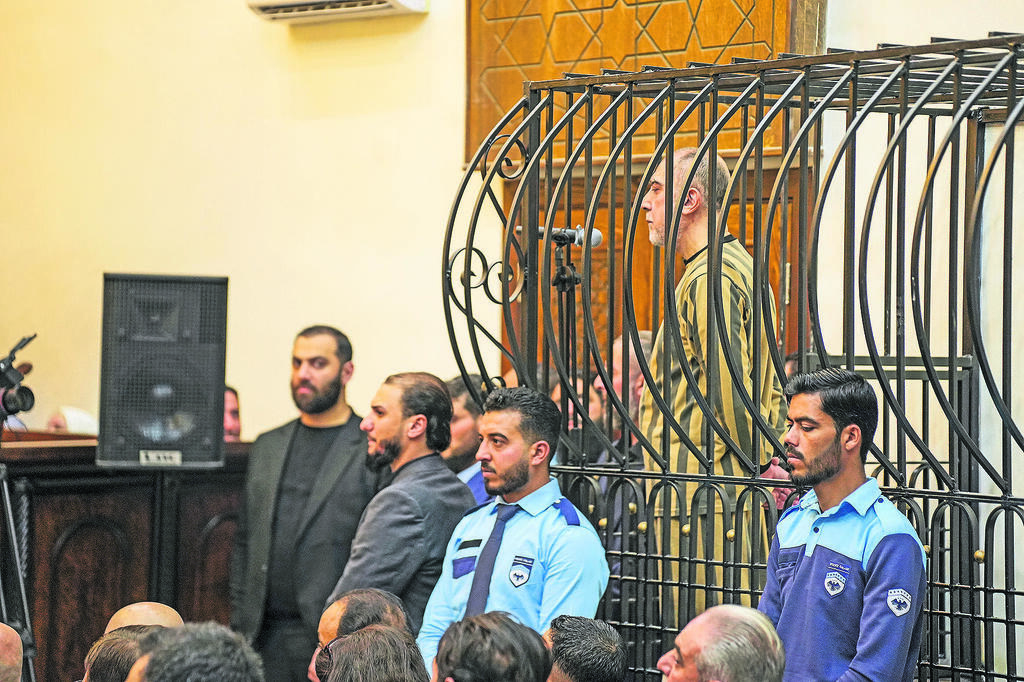
Atef Najib
(Photo: NurPhoto/Getty Images)
Putin, however, made sure Russian media reported that he had not met Assad and had no intention of inviting the exiled president to the Kremlin, despite Assad’s appeals. He also banned Assad from speaking to Russian, international or Arab media. “Not even a podcast,” he reportedly made clear.
Russian columnists also emphasized Putin’s lack of interest in Assad. “He despises the weak,” writers in Pravda and Izvestia said. “Assad is no longer interesting. He has nothing to offer. He is insignificant. Putin does not even pity him.”
“Bashar did not flee to Russia because Putin still has plans for him,” says Prof. Eyal Zisser, a Syria expert at Tel Aviv University. “For Putin, the decision to give him asylum was cynical, meant to prove that the Russians never abandon their friends and supporters, and that it is therefore worth cooperating with them. That stands in contrast to the United States, which during the Arab Spring cast aside rulers such as Hosni Mubarak, who had served it loyally for decades. With the Russians, it works differently.”
That leaves the former president alone in Moscow, entirely dependent on Putin’s goodwill.
“Bashar has been left with no future and no support in Syria,” Zisser says. “It is amazing to see how, in one moment, the father-and-son regime that ruled the country for 55 years was erased. He may still have a few billion dollars, though Western banks are closed to him and there is no one in the West who will mobilize to help him. The Arab world, too, has accepted the change of power in Syria and generally finds common ground with Ahmad al-Sharaa, the devout Sunni Muslim who replaced Bashar, an Alawite and friend of Shiite Iran.”
Zisser says the future does not look bright for the exiled dictator.
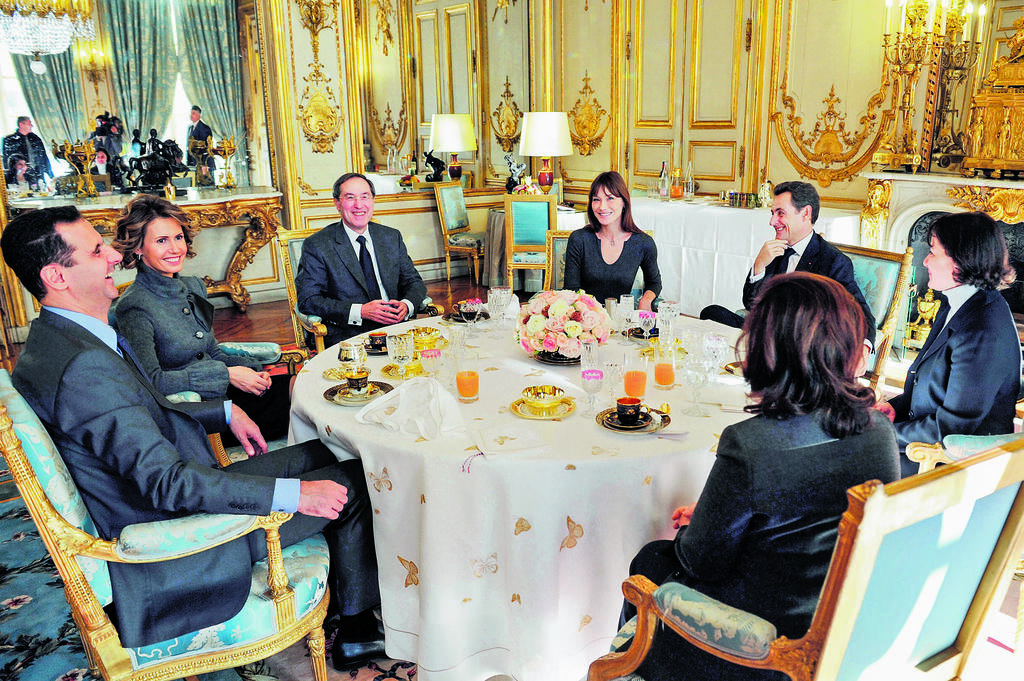
Bashar and Asma Assad, left, with Nicolas Sarkozy, third from right, and Carla Bruni in happier times
(Photo: Franck Fife/AP)
“Experience shows that sooner or later, someone will seek revenge against Assad for what he did to the Syrians. That is also why he keeps such a low profile on Putin’s orders, both to prevent diplomatic embarrassment for the Russian president and to protect the former president, whose head so many people are seeking.”
Despite Assad’s fall, Putin is not giving up his foothold in Syria, says Dr. Carmit Valensi, a senior researcher and head of the Syria program at the Institute for National Security Studies in Tel Aviv.
“Russia was for years the main patron of the Assad regime, guaranteeing its survival and waging a stubborn war against the rebel group Hayat Tahrir al-Sham,” she says. “With Assad’s fall, Moscow lost one of its most important strategic assets in the Middle East. To minimize the damage and avoid losing military presence and influence, it adopted a pragmatic policy: despite its long-standing loyalty to Assad, it began courting the new leadership in Damascus.”
That, she says, explains the surprising rapprochement between the sides.
“Putin, who saved Assad, is now conducting ties with those who toppled Assad, while Assad himself remains isolated, a living symbol of an era Syria is trying to leave behind.”
The Assad trials are now meant to serve as a foundation for the new Syria. With the fall of the regime, its symbols disappeared too: portraits were torn down, statues were toppled and sometimes publicly burned, in an attempt by the new regime to erase the ruler’s legacy and break free from decades of brutal authoritarian rule.
Al-Sharaa’s demand that Putin extradite Assad was not only about symbolic justice, but also about building domestic legitimacy and drawing a clear line from the past. Doubts and suspicions about the new regime are justified, Valensi says, but it is hard to argue with the scorched earth Assad left behind. Syrian officials say they inherited “the skeleton of a state” rather than a country: a shattered economy, corrupt and dysfunctional institutions, millions of refugees and a fractured society filled with acute sectarian and ethnic tensions.
The Assad family’s reign of terror ended on the night of December 7 to 8, 2024, when the exiled president was forced to flee his home under cover of darkness. In a secret and complex operation, his Russian escorts placed him in an armored vehicle with his eldest son, Hafez, and two economic advisers, businessman Nassar Ibrahim and Mansour Azzam. In another car were two other confidants: Qahtan Khalil, head of the Syrian air force intelligence team, and Ali Ayoub, the former defense minister.
The group reached Damascus airport and flew to Latakia in northwestern Syria. When the civilian plane landed, the passengers silently boarded cars that took them to a Russian aircraft waiting at Hmeimim air base, then under full Russian control. Assad, his son and his entourage boarded quickly. The plane took off without lights, flying low on a detour route to avoid radar.
When it landed in Moscow three and a half hours later, the passengers were taken straight to the Four Seasons Hotel near the Kremlin. A week in a guest apartment at the luxury hotel costs $13,000. The ousted president’s associates were alarmed by the bill. When they called Assad to ask for financial help, he did not answer, and they had to move immediately to a cheaper hotel. Since then, they have maintained only polite contact.
Bashar’s older sister Bushra Assad, a pharmacist, and his younger brother Maher, the longtime commander of the Syrian army’s Fourth Division, have also arrived in Moscow. She came from Abu Dhabi, he from Iraq. Bushra still blames Assad for the death of her husband, Gen. Assef Shawkat, a former senior security official killed in a sudden 2012 bombing at his office. Maher, who received no advance warning from his brother about the flight from the palace, managed to escape on his own to Iraq and from there to Moscow. Unlike Bashar, Maher took care of more than 100 companions who joined him, along with his wife and children.
No photos or documentation have leaked from Assad’s escape, which sounds as if it were taken straight from a movie. Bouthaina Shaaban, his former media adviser, described arriving as usual at 10 a.m. at the Syrian president’s residence in the upscale Malki district, only to discover no one was home.
“I was stunned to find the gates open, with no presidential guards and no one stopping me at the entrance,” she said. “I went in and found an empty house. The guards had disappeared, and those who arrived did not know whether they should stay or where the president had gone. I was sure I had made a mistake and should have gone to another office. I never imagined the president’s traces had vanished.”
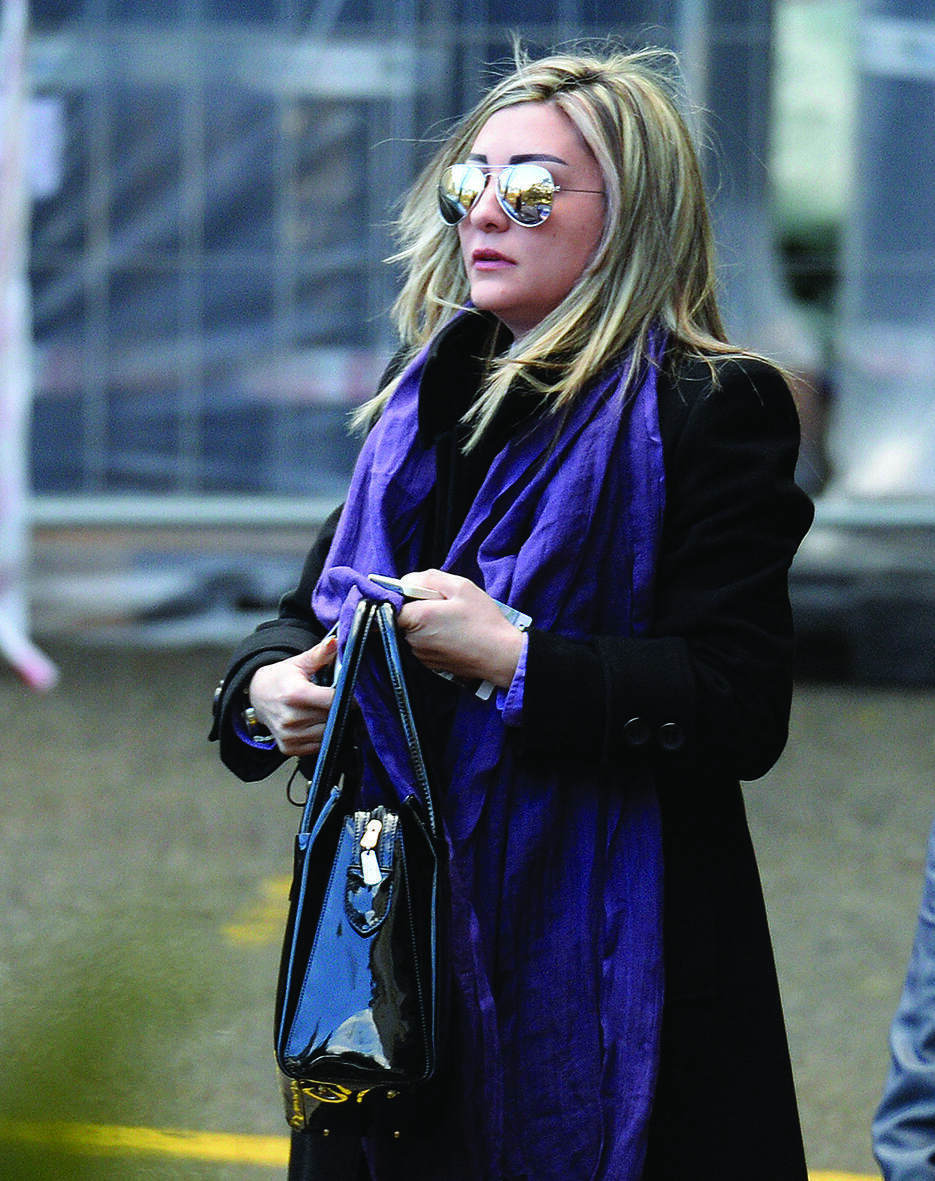
Luna Shibl
(Photo: Philippe Desmazes/AFP)
Shaaban, 73, holds a doctorate in English literature and had served as speechwriter and spokeswoman for Hafez Assad’s presidential palace. She too was humiliated in Bashar’s final years, when he promoted a younger and glamorous media adviser, Luna Shibl, with whom he also reportedly had an affair behind Asma’s back after she fell ill with leukemia.
On July 2, 2024, about five months before the regime fell, Shibl, 48, was driving on the highway between Qura al-Fawwar and Damascus when a heavy vehicle slammed into her car. She was thrown onto the road and was picked up only two hours later by an ambulance and taken to nearby al-Shami Hospital. Doctors struggled to identify the energetic adviser whose photos alongside Assad had appeared in magazines outside Syria. Rumors claimed the armored vehicle had hit her deliberately, and that the assassination was planned by Iran’s Revolutionary Guards or Hezbollah.
For three days, Shibl fought for her life in an isolated hospital room, with no visitors allowed, until she died. Only her husband, Ammar Saati, attended her small funeral. The presidential palace did not even send a wreath. The Revolutionary Guards in Tehran announced the death of “the traitor,” who had reportedly bought a luxury apartment in Moscow and planned to move there.
Her brother, Mulham Shibl, who served as a military attaché in Belarus, was arrested in April 2024 by Syrian intelligence and accused of cooperating with Israeli intelligence. The indictment against him revealed suspicions that he had leaked to the Mossad and the CIA the locations of meetings of an Iranian military delegation in Damascus, which was then attacked by Israel from the air, as well as information about drone development at Syria’s Scientific Studies and Research Center. He was transferred to an interrogation facility and has not been seen in public since. According to unconfirmed information, he was killed during questioning at one of the regime’s intelligence bases.
After Assad fled, a video was published showing him and Shibl in a car, with her driving and the president beside her, as the two opened the window and mocked Syrian villagers.
“What miserable people,” Assad said, pointing at a group of peasants in one village.
“Wave hello to them, so they know who you are,” Shibl urged him.
Ahmad al-Sharaa, formerly known as rebel leader Mohammed al-Golani, never met Bashar Assad. By the time al-Sharaa prepared to take Damascus, Assad was already on his way to Moscow. The new president’s second cousin, Farouk al-Sharaa, spent 20 years as a senior diplomat, foreign minister and vice president of Syria. In 2014, Assad pushed him out of the leadership, and he was held under house arrest in his hometown of Daraa. Only a year ago did he return to Damascus, where he was invited to meet the new president.
Throughout his years in power, Assad was boycotted and kept away from Arab leaders’ summits. In 2023, after 12 years of being ignored, Saudi Arabia decided to bring him back into the fold and sent a last-minute invitation to his palace in Damascus for the Jeddah summit. When he arrived for the traditional group photo, the other heads of state kept their distance. No one wanted to be seen beside the man viewed as a pariah and known as a dictator who slaughtered his own people. Assad looked embarrassed and confused, searching in vain for a partner.
“Assad stood there with bleary eyes and did not know what to say, with a distorted smile on his face,” a senior Lebanese official told Yedioth Ahronoth. “Everyone despised him because of the murder of Syrian civilians.”
Today, there is still no visual record of his new life. No image of him and Asma in formal dress, presenting a perfect marriage. In the past, Asma rejected an offer to leave for Qatar after the ground in Syria began to burn.
“I am fine here. I will never leave,” she promised the sister of Qatar’s ruler, who had offered her a luxurious villa and servants.
Since then, the Russian Ilyushin aircraft that smuggled Bashar to Moscow has returned to Syria after 17 months away. Now al-Sharaa is offering Putin a deal: return Russian forces to the naval base, and in exchange, hand over Bashar Assad.