

A senior Syrian official said Tuesday that security forces under the new government led by Ahmed al-Sharaa had uncovered remnants of the former regime’s secret chemical weapons program under Bashar Assad. According to the official, the materials included raw substances and munitions similar to those used in deadly gas attacks during Syria’s civil war, which began in 2011 and ended a year and a half ago with the regime’s overthrow.
The official, speaking to Reuters, was Mohamad Katoub, Syria’s permanent representative to the Organisation for the Prohibition of Chemical Weapons (OPCW). In an interview in The Hague, he said authorities had found more than 70 rockets and aerial bombs linked to chemical weapons, along with components of sarin nerve gas used by Assad’s forces.

Katoub said searches at three sites uncovered equipment for mixing and storing chemical weapons, as well as hexamine, a stabilizing agent known to have been used by Assad’s forces in the production of sarin gas. He added that Syria’s new authorities had arrested 18 suspects linked to Assad’s chemical weapons program, including senior military and political figures.
The Reuters report follows reports in March that Syria’s new government, with U.S. assistance, had launched a program to remove the remnants of chemical weapons used by forces loyal to former president Assad. Syria’s ambassador to the UN, Ibrahim Olabi, said at the time that an international team backed by the U.S., Germany, Britain, Canada and France would locate and destroy all remaining components of the chemical weapons program under OPCW supervision.

Research center in Damascus linked to Assad's chemical weapons program destroyed in Israeli strike
(Photo: Omar HAJ KADOUR / AFP)
The OPCW said then that around 100 sites in Syria would need to be examined to identify remaining toxic munitions and determine how to destroy them. A diplomatic source cited in Arab media said the sites could include military bases, laboratories and offices. The source added that implementing the program would likely take months if not years, and that the current situation in the Middle East was unlikely to help advance the destruction effort.
During Syria’s civil war, Bashar Assad’s regime became internationally isolated after carrying out a series of chemical attacks on rebel-held areas, killing civilians. The most notorious attack took place in August 2013 in the suburbs of Damascus, where dozens if not hundreds of people were killed by nerve gas exposure.
The incident triggered a major diplomatic crisis after then-U.S. President Barack Obama declared the use of chemical weapons a “red line” and threatened military action against the Syrian regime. However, Obama ultimately stepped back from direct military intervention and instead reached an agreement with Russia under which Moscow would help dismantle Syria’s chemical weapons stockpile. The deal was only partially implemented and later proved insufficient, as reports of chemical weapons use continued in subsequent years.
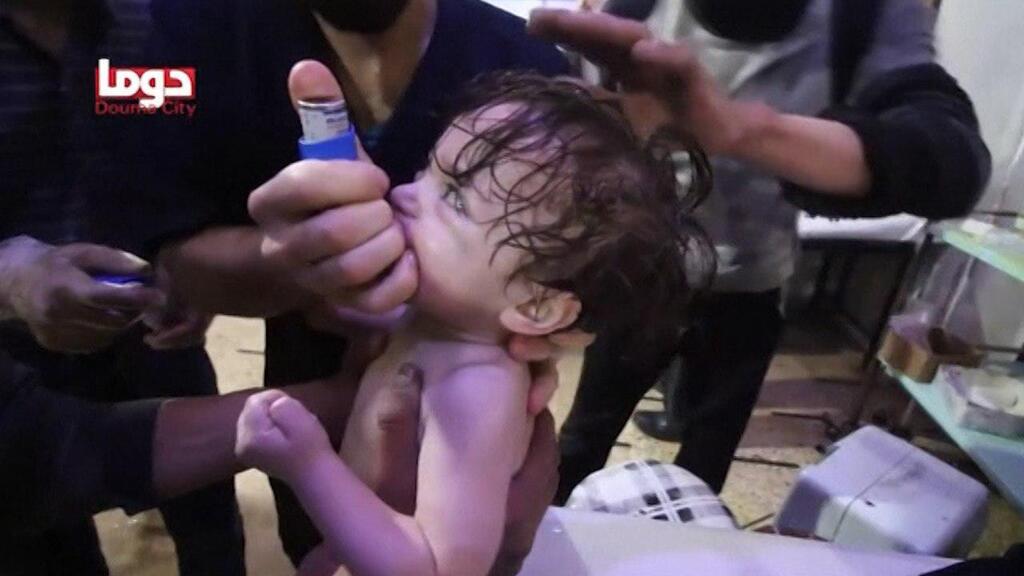
A child after a chemical attack in Syria in 2018
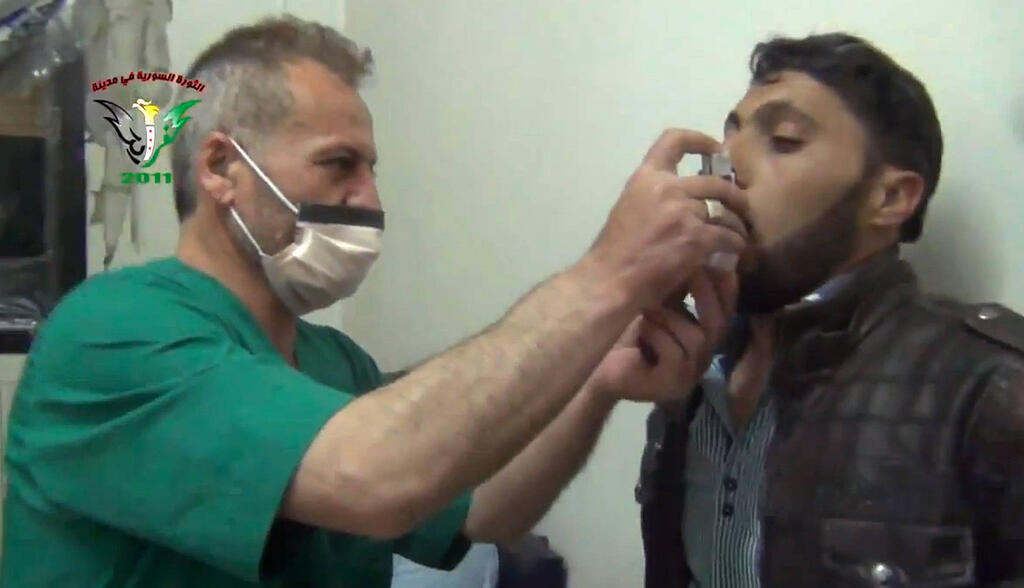
A man after a chemical attack in Syria in 2014
(Photo: AP)
Syria’s chemical weapons issue returned to the forefront in April 2017 after a chemical attack in the town of Khan Shaykhun killed dozens, including many children. U.S. President Donald Trump responded with military force, and later that month the U.S. launched dozens of Tomahawk cruise missiles at regime targets, including Syria’s Shayrat Air Base, from which the aircraft that carried out the chemical strike had taken off.
A year later, in April 2018, following another chemical attack in Douma, Trump led a coalition with Britain and France in a targeted strike against Syrian chemical weapons research and development facilities. The moves marked a significant shift in U.S. policy, from diplomatic threats alone to limited military action aimed at deterring the regime from using unconventional weapons again.