

While the Iranian public remains cut off from the internet, facing threats from the United States and growing uncertainty, the Islamic Republic has announced a new successor to the supreme leader. Senior political and military officials rushed to pledge loyalty and present a united, stable front, even as despair grows on the streets of Tehran and hopes for change are mixed with deep fear that the situation will only worsen.
A day after the announcement that Mojtaba Khamenei — the son of Supreme Leader Ali Khamenei, who was eliminated by Israel in the opening strike of the war — had been appointed to the position, senior regime figures staged a display of unity. With attacks still ongoing, they sought to project stability despite threats to eliminate the new successor.
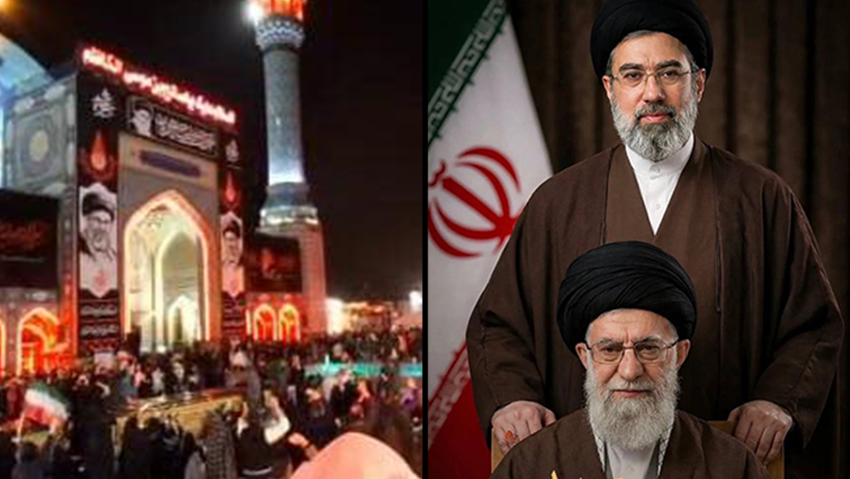
Mojtaba and his father, celebrations by regime supporters
Ali Larijani, secretary of Iran’s Supreme National Security Council, referred in a statement to direct threats from Washington: “We must thank the Assembly of Experts for convening despite Trump’s threats of attack, despite the special circumstances we are facing.”
Iranian Parliament Speaker Mohammad Bagher Ghalibaf described the appointment as a “blessed choice” for the Iranian people, “Muslims and lovers of freedom around the world.” He thanked the Assembly of Experts for what he called its “wise and appropriate” decision and declared full obedience to the new leadership.
The Islamic Revolutionary Guard Corps, the most powerful force center in the country, also quickly issued a statement of support and pledged loyalty: “We are ready for complete obedience and sacrifice in carrying out the orders of Supreme Leader Mojtaba Khamenei.”
'They don’t even need to change their chants'
But the reality on Iran’s streets appears very different, and voices from Tehran residents who managed to speak paint a picture of deep fracture.
“The slightest chance for change within the system has simply disappeared,” a Tehran resident in his 30s told the BBC. “The assembly chose the person closest to the previous leader. So everything will stay the same. They don’t even need to change their chants of support to match his name.”
Another Tehran resident, also in his 30s, expressed deep concern about what may come next. “He is vindictive. They killed his father and he will not let it go. If he cannot take revenge on the United States, he will take it out on us — the ordinary people. I hope Israel and the U.S. put him in their sights,” he said.
“It means nothing is going to change,” a third man said. “It’s the same path, maybe even worse. In any case, I don’t think this situation will last. I don’t think he will survive.”
Chants of 'Death to Mojtaba' after the announcement


Iran’s state media officially announced last night that Mojtaba Khamenei had been chosen as the next supreme leader. The position gives him enormous power in the midst of the war: he will directly control the Revolutionary Guard, and any agreement to end the war will require his approval — from someone who espouses the same hard-line path as his father.
The announcement of Mojtaba as supreme leader came hours after the IDF threatened to “hunt down” anyone selected for the role, and after U.S. President Donald Trump — who had repeatedly sought to influence the identity of Iran’s next leader and explicitly opposed Mojtaba’s selection — also issued a warning.
Trump said yesterday that without U.S. approval, the new leader would be unlikely to survive long. He has sought to influence the selection process in hopes Iran’s next leader would follow his demands under a “Venezuela model” — a prospect that now appears to have faded.
Iranian media quickly broadcast footage of celebrations in city streets, showing regime supporters waving flags of the Islamic Republic. At the same time, a media outlet associated with regime opponents published footage it said captured residents shouting from their balconies: “Death to Mojtaba!”