


U.S. Secretary of State Marco Rubio arrived in Israel on Thursday afternoon, just hours after Vice President J.D. Vance concluded a two-day visit, as part of Washington's push to ensure full implementation of President Donald Trump’s Gaza peace deal.
Rubio’s visit prompted the Security Cabinet to move up its scheduled meeting, which convened earlier at the Prime Minister’s Office in Jerusalem.
US Secretary of State Marco Rubio meets with Prime Minister Benjamin Netanyahu
(Video: GPO)


A few hours after landing in Israel, Rubio met with Prime Minister Benjamin Netanyahu. Netanyahu did not respond to President Donald Trump’s comment to Time magazine that West Bank annexation "won’t happen," instead highlighting the president’s historic role. “We've had incredible visits, first by President Trump in the Knesset—something that will be etched in our history. We've had the vice president yesterday, and you today. This is a circle of trust and partnership, and you've been an extraordinary friend of Israel. And now we face days of destiny. We want to advance peace, but we still have security challenges,” Netanyahu said.
Standing alongside the Israeli leader in a brief joint statement, Rubio said: “We’re back here just a little bit over a week after a historic day when President Trump's work, with our partners, led to this extraordinary breakthrough. Now we have more work ahead of us. We feel very positive about it, we're making good progress... no one is under any illusions—we've already done the impossible once, and we intend to keep doing that if we can. We have good partners that we're working with. We feel confident and positive about the progress that's been made, but we're clear-eyed about the challenges too.
Rubio’s visit follows directly after that of Vice President J.D. Vance, and will be followed Sunday by the arrival of Morgan Ortagus, the U.S. envoy to Lebanon. The string of visits—which some in Israel say amount to Washington “supervising” Netanyahu’s implementation of the peace deal—may continue with the possible arrival of U.S. Energy Secretary Chris Wright.
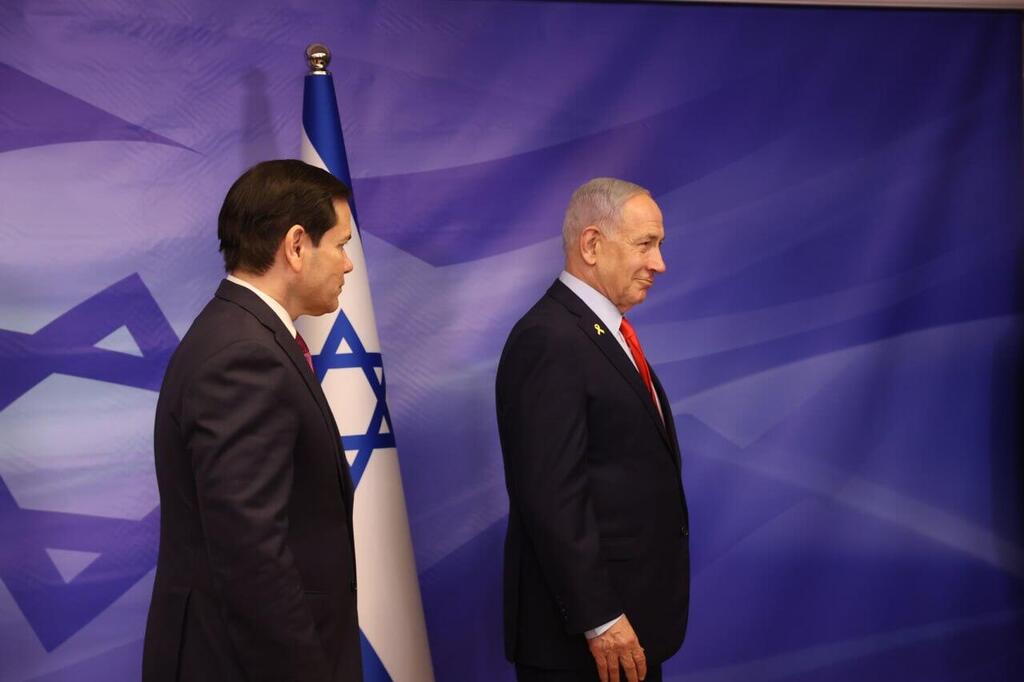
US Secretary of State Marco Rubio meets with Prime Minister Benjamin Netanyahu
(Photo: Alex Kolomoisky)
An Israeli official dismissed that claim as “ridiculous,” saying: “It’s not about ‘Bibi-sitting.’ This is a massive undertaking that requires extensive coordination. We’ve never done anything like this—setting up an international military force to stabilize Gaza. It’s a lot of moving parts that need syncing. That’s why they’re here. That’s why [Steve] Witkoff and [Jared] Kushner are hopping between Middle Eastern capitals.”
The official added that the U.S. was angered by the preliminary Knesset vote to apply Israeli sovereignty in the West Bank, which was seen as contradicting the peace framework. “They needed reassurance that it was only a preliminary reading and not something moving forward.”
Regarding the proposed multinational force, the Israeli source said the government conveyed to Washington that it would prefer not to include countries that have recognized Palestinian statehood and “rushed to malign Israel at The Hague.” Instead, Israel favors the inclusion of nations like Germany and Italy—but not France. “It’s not a veto,” the source clarified, “but it’s our preference.”
US Secretary of State Marco Rubio arrives in Israel
(Photo: Ziv Sokolov/US Embassy)
Speaking before boarding his flight to Israel on Wednesday, Rubio said countries outside the Middle East were ready to contribute to an international stabilization force in Gaza, calling Hamas’ rule over the Palestinian population “horrific.”
He also expressed concern over the Knesset's vote on Israeli sovereignty in the West Bank, warning that such moves pose a threat to the ceasefire and overall peace effort. “Well, that's a vote in the Knesset, but I think that the president has made clear that that's not something that we would be supportive of right now, and we think that's even threatening to the peace deal,” he said.
A senior Israeli official described mounting U.S. pressure on Israel to abide by the terms of the deal, noting a continuous stream of high-level American visits. “The Americans are frantic. They're going full bore,” the official said, adding that Washington's involvement is unprecedented, and American officials are determined not to let the agreement fall apart.
Marco Rubio on Knesset's West Bank sovereignty vote
(Video: Reuters)
A top U.S. priority remains the return of all fallen Israeli hostages still held in Gaza. Vice President Vance, before departing, noted that some bodies are believed to be buried deep underground, and locating them will take time. “Patience is needed,” he said, criticizing what he called “hysterical” Western media coverage that portrays any incident as a failure of the deal. Nonetheless, he voiced optimism and emphasized that tremendous effort is being invested to uphold the ceasefire.
Meanwhile, U.S. Central Command (CENTCOM) Commander Adm. Brad Cooper is actively leading efforts to establish a multinational stabilization force for Gaza. The force will also include a special task unit focused on locating the remains of hostages.
According to sources involved in the planning, the stabilization force would be tasked with verifying Hamas’s disarmament, enforcing the demilitarization of the Strip, and ensuring Israel refrains from military operations that could violate the ceasefire. The force is intended to serve as a counterweight to Hamas and offer a basic sense of security to Gaza’s civilian population.
First published: 20:32, 10.23.25