


Prime Minister Benjamin Netanyahu plans to present U.S. President Donald Trump with updated intelligence during their meeting in Florida next week, indicating that Iran is producing large quantities of ballistic missiles aimed at Israel, according to an Israeli official.
“If the Americans do not reach an agreement with the Iranians that halts their ballistic missile program, it may be necessary to confront Tehran,” the official told ynet. “We hope Trump succeeds in reaching an agreement, but we must prepare for the possibility that he does not.”
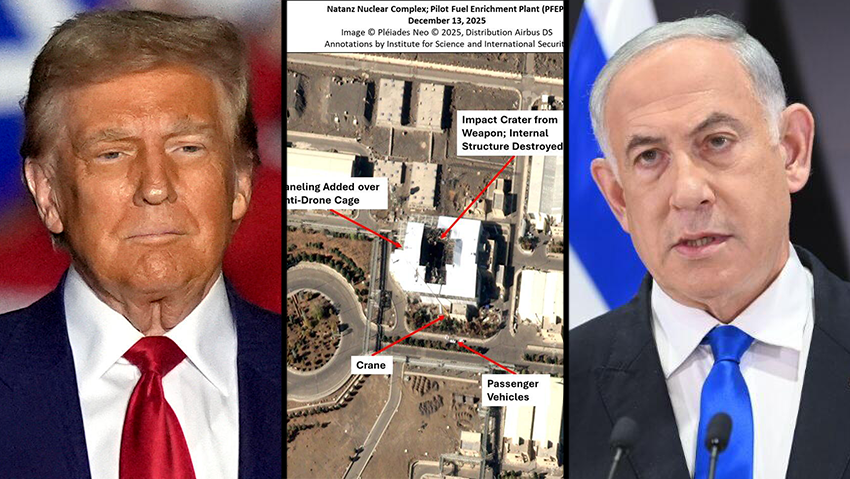
(Photo: Yair Sagi, AP/Carlos Osorio)
Iran said this week that its ballistic missile production is not subject to negotiation. Foreign Ministry spokesman Esmail Baghaei said the missiles are intended for self-defense and deterrence and that their production is “not open to talks,” according to the Israeli official.
The official described the missile buildup as a grave threat, saying a mass launch toward Israel could cause damage comparable to a small nuclear bomb. “This is something Israel cannot accept and will not accept,” the official said.
Satellite images taken by Planet Labs indicate that Iran is rebuilding missile production sites damaged in Israeli strikes, according to Sam Lair, a researcher at the James Martin Center for Nonproliferation Studies, a nongovernmental organization focused on preventing the spread of weapons of mass destruction. Lair, who analyzed the images, told The Wall Street Journal that if Iran succeeds in operating its facilities at full capacity, it could produce hundreds of missiles a month.
Footage from Iran’s missile tests


Activity at the sites suggests Iran may already be producing new missiles, Lair said, though he added there is not enough evidence to confirm that definitively. “It appears the Iranians have restored part of their missile production capability, but they are not where they were before,” he said. “They are allocating resources to rebuild these facilities and could reach that point again.”
Since the 12-day war earlier this year, senior Israeli military officials have warned that Israel’s public briefings about renewed tensions with Iran could be misinterpreted in Tehran. Israeli security officials assess that Iran has little interest in retaliation until it improves its capabilities, strengthens intelligence collection and further arms Hezbollah and Yemen’s Houthi rebels.
In that context, officials say regime survival appears to outweigh Iran’s desire for revenge, but a mistaken impression of Israeli preparations could prompt Tehran to launch a preemptive strike.
Against that backdrop, Netanyahu convened Israel’s Security Cabinet on Saturday night for a late session ahead of his trip to Florida. Defense officials presented scenarios for Gaza, ranging from moving to the second phase of the ceasefire agreement to renewing fighting with Hamas. Israeli officials are concerned that Trump may pressure Netanyahu to accept Hamas’ claim that it cannot locate the body of slain hostage Ran Gvili, despite Israel having already provided mediators with intelligence it believes could lead to his location.
Trump advisers, particularly Steve Witkoff and Jared Kushner, believe Israel is obstructing the transition to the second phase of the agreement and is too quick to use force in enforcing the buffer zone in Gaza, according to Israeli officials. They have conveyed their frustration to Trump.
Netanyahu has delayed his departure and is not expected to spend the weekend in the United States. He is now scheduled to depart Sunday morning Israel time and meet Trump on Monday afternoon U.S. time. Israel’s ambassador to Washington, Yechiel Leiter, has already arrived in Florida and met with Trump’s advisers to prepare for the talks.