


Iran’s foreign ministry spokesman on Monday insisted Tehran’s expanding ballistic missile production is strictly for “self‑defense and deterrence,” rejecting any negotiations to curb the program amid rising tensions with Israel.
Spokesman Esmail Baghaei said at a news conference in Tehran that Iran’s missiles are meant to protect the country from attack and would not be subject to diplomatic talks. “Iran’s defensive capabilities, designed to deter any aggressor from considering an attack on the country, are not up for discussion,” he said.
Missile drills in Iran


Iran’s Fars News Agency reported missile tests in several regions, including Khoramabad, Mahabad, Isfahan, Mashhad, and Tehran, but it remained unclear whether ballistic missiles were actually launched. Iranian broadcasters later quoted unnamed sources saying widely circulated footage purported to show missile launches was inaccurate and instead depicted an aircraft contrail.
In a separate announcement, Iranian authorities said three domestically made satellites are scheduled for launch into space later this week.
Baghaei’s comments followed remarks broadcast on Iran’s state‑linked PressTV, including Hebrew‑language content launched about a month ago, quoting Islamic Republic Army commander Maj. Gen. Amir Hatami saying Iran would “respond forcefully to any malicious act,” a reference to the possibility of renewed Israeli strikes inside Iran.
Hatami said morale along Iran’s borders is high and that equipment and forces have been prepared based on lessons learned from the recent conflict with Israel in June. “With determination and resolve, the army stands ready with all necessary means to confront enemies and continuously enhance its preparedness to meet any threat, including asymmetric and irregular warfare,” he said. “We are closely monitoring all enemy movements and will respond decisively to any malicious act.”
Israeli, US planning amid heightened concerns
The statements from Tehran come against a backdrop of ongoing concern in Israel about Iran’s expanding missile and military capabilities. Israeli officials are weighing potential strikes on Iranian targets, and U.S. television network NBC reported that Prime Minister Benjamin Netanyahu plans to present U.S. President Donald Trump with options for action — with or without American participation — during their scheduled meeting later this month in Florida.
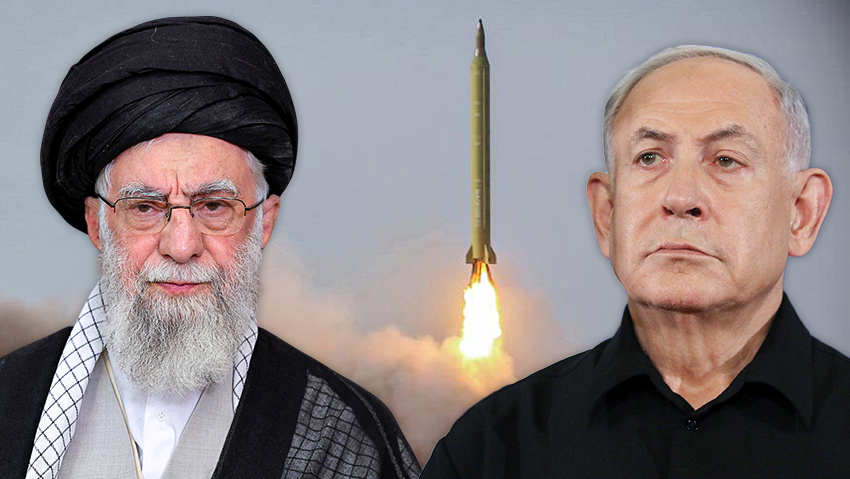
(Photo: Dana Kopel, WANA (West Asia News Agency) via REUTERS, Sepahnews/Handout/Anadolu Agency via Getty Images)
According to the NBC report, Iran could be producing as many as 3,000 ballistic missiles per year unless production is curtailed. Iran’s missiles reportedly use liquid fuel rather than solid fuel, after Israel allegedly destroyed critical components for solid‑fuel production, including planetary mixers. Western reports also suggest Iran is restoring damaged ballistic missile production capabilities.
U.S. and Israeli officials speaking to NBC expressed particular concern that Iran is repairing both its missile production sites and severely damaged air‑defense systems.
Unusual activity by Revolutionary Guard units
Opposition‑linked Iran International reported that Western intelligence detected atypical activity by Islamic Revolutionary Guard Corps (IRGC) air units, leading to heightened surveillance. Sources said movements and coordination involving drones, missiles and air‑defense systems diverged from normal patterns. While the activity may relate to military exercises, the scale and synchronicity drew special attention.
U.S. and Israeli officials told news site Axios that IDF Chief of Staff Lt. Gen. Eyal Zamir warned U.S. Central Command leadership on Saturday that recent IRGC missile drills could serve as cover for a surprise attack against Israel. One Israeli source said the likelihood of an Iranian strike was “less than 50 percent,” but cautioned against assuming the activity was solely an exercise. A U.S. official told Axios that U.S. intelligence sees no indication of an imminent Iranian attack.