

With less than three weeks until Israel's election, anxiety is growing among opposition parties as polls suggest neither political bloc is headed for a decisive victory. But Gadi Eisenkot, the former IDF chief of staff and leader of the Yashar party, remains confident that he will be Israel's next prime minister. Some in his own camp even describe that confidence as excessive. Eisenkot sees the same political deadlock as everyone else, but insists the opposition still has a path to power.
"I'm working to reach 61 Knesset members from the basic bloc of four parties: Yashar, Yisrael Beytenu, the Democrats and Beyachad," he says in an interview with Yedioth Ahronoth. "I look at what's happening on the ground and feel tremendous momentum." He claims to encounter dozens of Likud supporters every day, including party central committee members, and says his goal in the remaining campaign period is to attract moderate right-wing voters and members of the religious Zionist community.
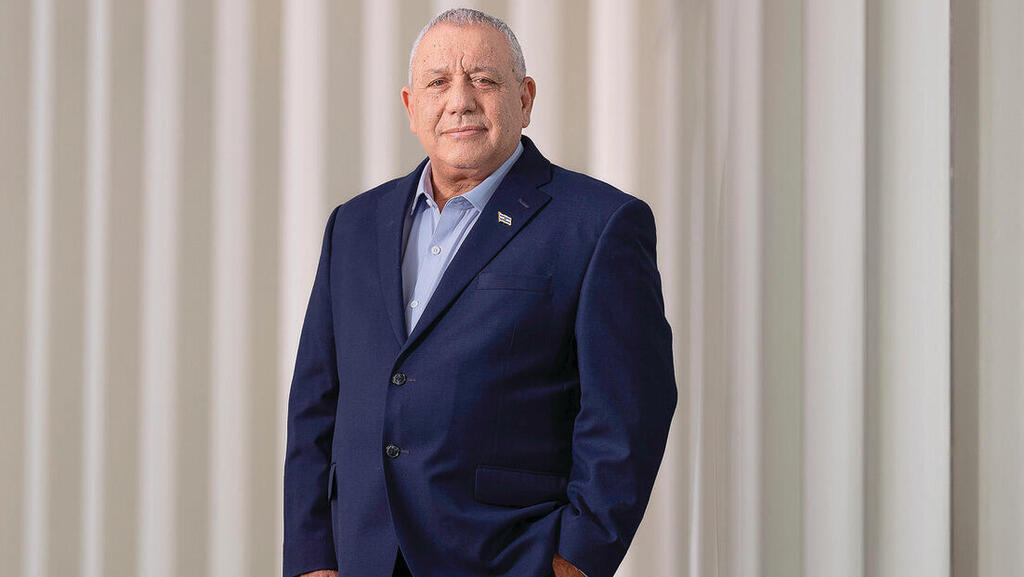
The numbers, however, present a challenge. The opposition bloc had previously appeared to be approaching the 61-seat majority needed to control the Knesset, but Netanyahu's camp has narrowed the gap in recent surveys. Eisenkot rejects the suggestion that his strategy has failed. "On the contrary. I've been very successful in recent months," he says. "The four parties in our bloc have organized themselves with surplus-vote agreements, and we're completely coordinated."
He argues that the opposition is no longer threatened by small parties failing to cross the electoral threshold, as happened with Meretz in the 2022 election. Instead, he predicts that Ofer Winter's Amcha Yisrael party and Yaron Zelekha's party will fail to enter the Knesset, leaving Netanyahu in the more difficult position. "When you take them out, that brings us to around 61," he says.
For Eisenkot, the election is about more than changing the prime minister. He wants to dismantle the traditional political division between left and right and build what he calls a broad, Zionist, national alliance. "My life's purpose in entering politics is to break the left-right divide and establish a national camp," he says. "That was the idea behind Blue and White, but it didn't succeed. I'm advancing it through Yashar. We need to throw away the curse of left versus right, which has gotten us nowhere."
He describes his preferred political coalition as an "alliance of those who serve," arguing that a broad national movement should lead Israel rather than parties representing ideological extremes. In his view, the current government is dominated by far-right politicians and ultra-Orthodox parties, with a liberal national minority caught between them.
‘I won't let Netanyahu win by not losing’
Eisenkot believes Netanyahu has a political interest in an inconclusive election. He argues that the prime minister understands that a large majority of Israelis support military or national service and the establishment of a state commission of inquiry into the October 7 massacre, making a clear electoral victory difficult.
"He understands politics extremely well," Eisenkot says. "He knows he can't win, so he's following the pattern he's used in recent years, which is winning by not losing." He accuses Netanyahu of delegitimizing Arab political parties and seeking to remain in office through political deadlock rather than a decisive victory.
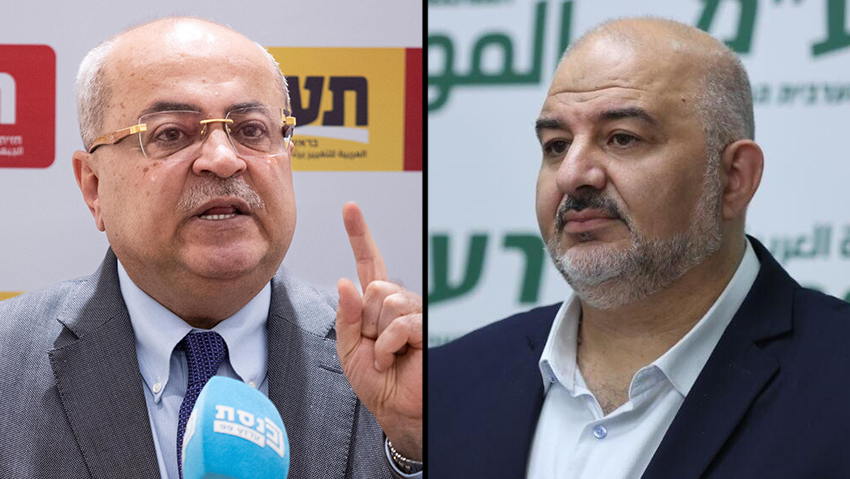
Ahmad Tibi and Mansour Abbas
(Photo: Alex Kolomoisky)
Eisenkot says his goal is to defeat Netanyahu's bloc by 63 seats to 45. But even if the opposition falls short of 61, he insists he will not allow Netanyahu to remain prime minister indefinitely at the head of a caretaker government.
"If you think you're going to do to me what you did to others in the past, meaning that you'll remain in a caretaker government, that won't happen," he says. "If the worst-case scenario occurs and we don't reach 61, I'll put it to a vote on the strength of the Zionist majority."
Under that scenario, Eisenkot says he would call on all 120 Knesset members to vote according to their conscience. He would not seek support from ultra-Orthodox or Arab lawmakers, but believes he could still win a decisive majority.
He acknowledges that such a move would involve political risk, but maintains that Netanyahu's long-standing election strategy is vulnerable. According to Eisenkot, the prime minister repeatedly relies on three central arguments: that only the right can provide security, that his opponents would establish a Palestinian state, and that Arab political parties are disloyal to Israel.
Eisenkot points to the security failure of October 7 as a challenge to the first argument and accuses Netanyahu of repeatedly portraying Arab citizens as a threat. "This is the only prime minister in the world who attacks 21% of his own citizens," he says.
Yet Eisenkot himself rules out a governing partnership with Arab parties under their current positions. He says any coalition partner must accept four principles: Israel as a Jewish, democratic and liberal state; the values of the Declaration of Independence; compulsory IDF or national service; and recognition of Hamas as a terrorist organization that must be destroyed. "I don't know of any Arab party that accepts that," he says.
Nor does Eisenkot envision serving under Netanyahu again, even if the alternative is another election. "I don't see him continuing," he says. "It cannot be that after the failure of October 7 we continue seeing him in Israeli political life. I don't hate him, but I think that if we allow him to be appointed to another leadership position, we're crossing out the word 'accountability.'"
Fears of a government ‘surrounded by criminals’
Eisenkot stresses that his opposition to Netanyahu is not driven by personal animosity but by what he describes as deep concerns about the country's future. He warns that another term for the current coalition could lead to social, economic and diplomatic deterioration and leave Israel increasingly isolated internationally.
"It's not just Netanyahu, but his team and everyone who would surround him," he says, describing a hypothetical cabinet in which Itamar Ben-Gvir becomes defense minister, Bezalel Smotrich foreign minister, Tally Gotliv justice minister and Yaakov Bardugo communications minister. "I see this as a very serious threat to the State of Israel. That's why I'm sounding the alarm and saying this group will drag the country into an abyss that's difficult to imagine."
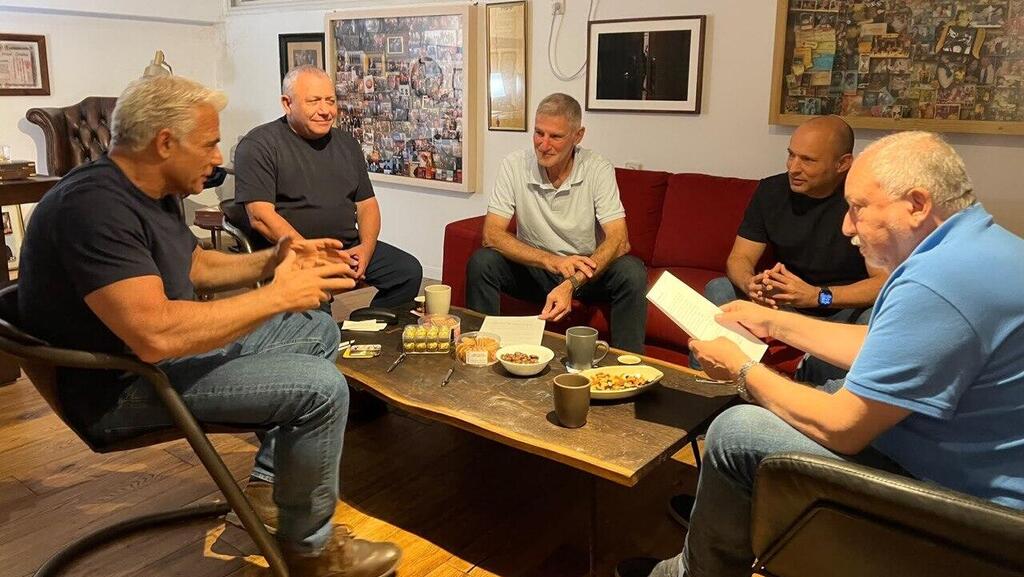
Heads of the anti-Netanyahu bloc
(Photo: Lihi Lapid)
Asked about concerns raised by Avigdor Liberman and Yair Golan that Netanyahu might disrupt the election, potentially citing security circumstances, Eisenkot says he cannot rule out improper or illegal actions. "My concern stems from the fact that Netanyahu is surrounded by a criminal environment, so I don't rule out criminal acts," he says, citing Yonatan Urich, who is facing trial in the Bild affair, and Tzachi Braverman, who has been summoned to a hearing in connection with the so-called late-night meeting affair.
Eisenkot goes further, accusing Netanyahu of allowing political considerations to determine national security decisions. "Political motives guide him as prime minister, rather than considerations of national security," he says. Unlike many of Netanyahu's other critics, Eisenkot was a member of the emergency government and the small war cabinet from October 2023 until his resignation on June 13, 2024, giving him firsthand knowledge of the internal deliberations during the war.
He recalls a letter he sent Netanyahu and the chairman of the Knesset Foreign Affairs and Defense Committee less than two months before the October 7 massacre. In it, he urged the government to suspend its judicial overhaul legislation, warning that the internal crisis was damaging the IDF and endangering national security. "I wrote to them, listen carefully, the situation is extremely dangerous. The threats in the strategic environment have worsened. We could face an event like the Yom Kippur War."
‘Political considerations completely took over Netanyahu’
One of Eisenkot's most serious accusations concerns Netanyahu's handling of negotiations to release Israeli hostages from Gaza. He claims that the prime minister repeatedly put his coalition's survival ahead of opportunities to secure their release, leaving some hostages in Hamas captivity who might otherwise have returned alive.
He describes a cabinet meeting during the first hostage release deal in November 2023, when ministers discussed expanding the categories of hostages eligible for release. The initial agreement focused on women and children, but the proposed expansion would have included elderly and wounded captives, including Hersh Goldberg-Polin.
According to Eisenkot, Netanyahu retreated from the proposal because he feared National Security Minister Itamar Ben-Gvir, who had issued an ultimatum shortly beforehand. Ben-Gvir threatened to bring down the government unless the military campaign resumed within 10 days. Eisenkot argues that Netanyahu chose political survival over the possibility of saving more hostages.
"I'm saying this unequivocally," he says. "Just this morning I heard Yoav Gallant being interviewed and saying that Nitzan Alon was right, that hostages did not return because of political considerations. Ultimately, that's why I left the government. I saw how political considerations completely took over Netanyahu. I lost trust in him."
Eisenkot recounts another episode from May 27, 2024, when Netanyahu unexpectedly presented the small war cabinet with a document titled "General Principles for an Agreement Between the Israeli Side and the Palestinian Side in Gaza Regarding the Exchange of Hostages and Prisoners and the Restoration of Sustainable Calm."
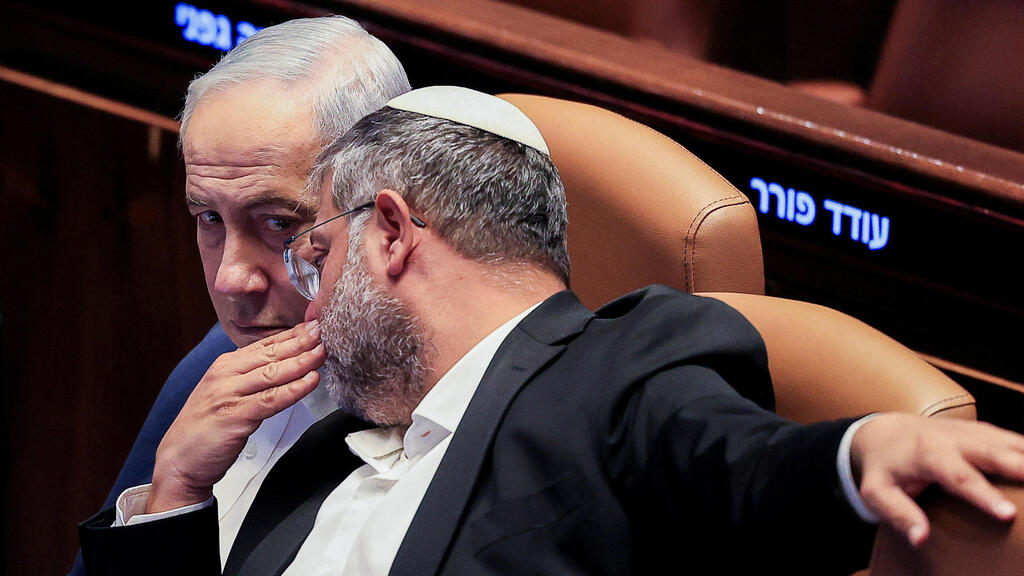
Benjamin Netanyahu and Itamar Ben-Gvir
(Photo: REUTERS/Ronen Zvulun)
Netanyahu told the ministers that he wanted to approve a decision on releasing hostages. Eisenkot says he examined the proposal, which included a 42-day suspension of fighting and Israeli troop withdrawals from designated areas, before telling the prime minister that despite the difficult terms, he supported it.
"I read the paper, looked at Netanyahu and said to him, 'This is a very difficult document, but I support it and recommend that you accept it,'" Eisenkot recalls. According to his account, the proposal was put to a vote and approved by all the cabinet members present, including Eisenkot, Gallant, Benny Gantz, Ron Dermer, Aryeh Deri and Netanyahu himself.
Two days later, Eisenkot says, commentators associated with Netanyahu, including Bardugo, began criticizing the proposal. He initially dismissed the attacks. But after then-US President Joe Biden publicly outlined the Israeli ceasefire and hostage-release proposal on May 31, 2024, Netanyahu distanced himself from the initiative.
Eisenkot attributes the change to threats from Ben-Gvir and Smotrich to collapse the coalition if the agreement moved forward. "He passed a cabinet decision and then went back on it," Eisenkot says. "It's insane. It shows the state of vertigo he's in. Political considerations are present at every stage."
Eisenkot also rejects Netanyahu's assertion that he opposed an IDF operation in Rafah and wanted to end the war without dismantling Hamas rule. "Netanyahu is a pathological liar," he says, while pointing to Government Secretary Yossi Fuchs as someone whose account he trusts. Fuchs served under Eisenkot in the military, and the former chief of staff says the minutes of the May 2024 cabinet vote would establish that every minister, including himself, supported the Rafah operation.
He also cites a letter he sent Netanyahu on February 15, 2024, urging further military action. "Prime Minister, wake up," the letter said, according to Eisenkot. "The right thing to do is complete the operation in Khan Younis, intensify the operation in Rafah and maneuver." For Eisenkot, the document directly contradicts Netanyahu's account of his wartime position. "Credibility is not Netanyahu's strong suit," he says.
‘There is no total victory’
When the discussion turns to Netanyahu's repeated promises of "total victory," Eisenkot produces an old newspaper article that gives the phrase a deeply personal meaning.
The article, written by Yedioth Ahronoth military correspondent Alex Fishman and published on April 11, 2004, featured a young Brig. Gen. Gadi Eisenkot, then commanding IDF forces in the West Bank. Asked about the campaign against Palestinian terrorism, he offered a bleak assessment.
"Terrorism will continue for many years," Eisenkot said at the time. "The bitter truth is that there is no total victory in this struggle. Our job is to minimize Palestinian achievements. I expect that even my youngest son, who is now 5, will fight in the territories."
His youngest son was Gal Eisenkot, who was killed fighting in Gaza in December 2023.

Gadi and his son Gal
For Eisenkot, the passage underscores both the limitations of military power and the personal cost of the conflict. More than two decades after making that prediction, he remains convinced that promises of absolute victory misrepresent the nature of Israel's security challenges.
He is equally critical of Netanyahu's refusal to establish a state commission of inquiry into the October 7 failures. Eisenkot suspects that some of the records submitted concerning the period before the massacre may have been manipulated.
"I see something that carries potential criminal implications," he says. "In my assessment, reports were falsified. When I look at what was distributed to the state comptroller, and I know, as a cabinet member and member of the intelligence subcommittee, what material was there, I have a very deep suspicion of document falsification. In my opinion, this is a document somebody cooked up."
One document at the center of the dispute concerns possible operations against senior Hamas leaders. It was prepared by Netanyahu's military secretary on October 1, 2023, and placed on the prime minister's desk. The document referred to "advancing operational readiness for the recommended targeted killings, Hamas leaders, with an emphasis on emergency scenarios."
The document indicates that discussions about potential operations against Hamas leaders in Gaza did take place less than a week before the massacre, contrary to the account attributed to Netanyahu. A separate investigation by Yedioth Ahronoth journalists Ronen Bergman and Yuval Rubowitz examines the prime minister's account of the decisions and intelligence assessments that preceded October 7.
Eisenkot's allegations about falsified records remain allegations, but they form part of his broader argument that the government must face an independent examination of its conduct before and during the war.
Gantz, Winter and the battle for opposition votes
Returning to the election, Eisenkot faces challenges not only from Netanyahu's right-wing bloc but also from potential partners within the opposition. Despite his strong standing in the polls, other party leaders have been reluctant to declare him their candidate for prime minister.
Eisenkot recalls that when his party was polling at around six seats a year ago, he publicly argued that the leader of the largest party in the bloc should become its candidate for prime minister. He says that principle should still apply. "Under the circumstances that have developed, I'm the only candidate who knows how to defeat Netanyahu. I'm the only person in decades who has led him by a significant margin in polls asking who is best suited to be prime minister. I don't see this as an obsession with honor or power, but as a mission and a duty."
Benny Gantz
(Photo: Yuval Chen)
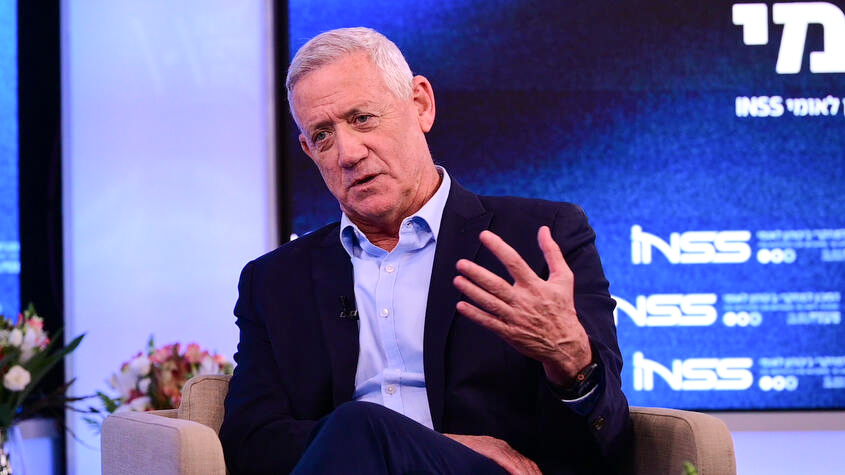
One unresolved issue is Benny Gantz, Eisenkot's former political partner in the National Unity party. The two were once close, but Eisenkot now believes Gantz should withdraw his Blue and White party from the race because polls indicate it will fail to cross the electoral threshold.
"I've met with him quite a few times, and we talk," Eisenkot says. "Gantz has made a major contribution to the country, but he's a political figure and he'll have to make a decision. Under the current circumstances, I'm convinced he'll decide to withdraw. I don't think he'll run all the way when the polls give him 1.5%. I'm certain he'll make a rational decision."
Gantz, however, declared Saturday evening that he intends to remain in the race until the end, despite the unfavorable polling. He argued that his campaign offers a path toward national unity rather than another government built around the traditional political blocs.
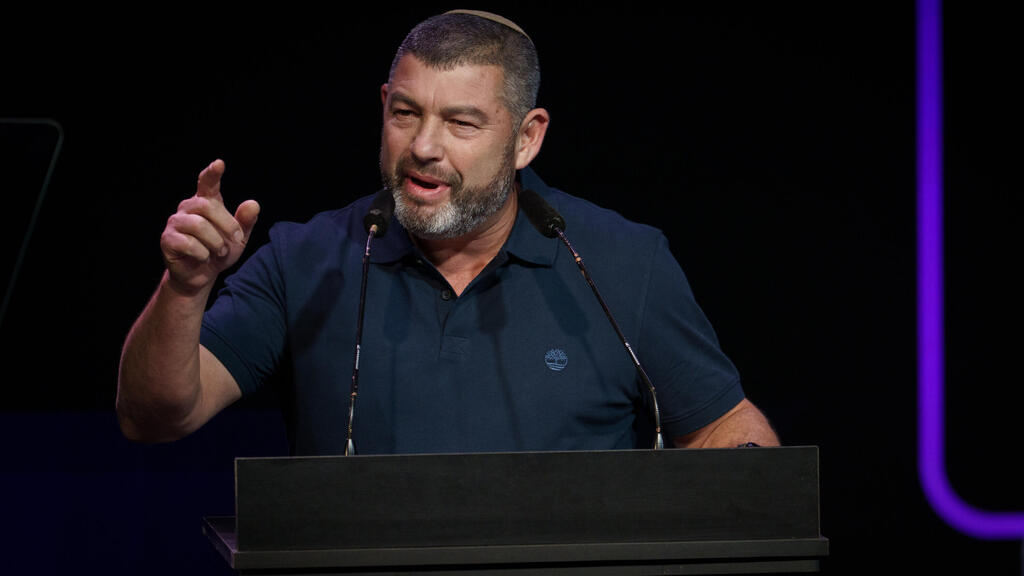
Eisenkot is more open to a partnership with Ofer Winter, the former IDF general who leads the Amcha Yisrael party, although his assessment of Winter's campaign is far from flattering. He says Winter accepts the four principles he has established for coalition partners but considers his party politically immature and unfocused.
"I see a party that isn't ready, that is very unfocused and confused about its own ideas," Eisenkot says. "I see pressure and panic, and they're firing in every direction. They're in favor of military service, but they go with Netanyahu, Goldknopf and draft evasion. Winter very much wants to uncover the truth, but he goes with Netanyahu, who doesn't want to establish a state commission of inquiry."
Winter recently told Yedioth Ahronoth that Eisenkot was not fit to become prime minister but could make an excellent culture minister. Eisenkot dismisses the criticism. "I don't judge him. He's under pressure."
Ofer Winter
(Photo: Shalev Shalom)
Another issue facing Eisenkot is the composition of his own party list, which includes numerous political newcomers. Some within the opposition are concerned that inexperienced lawmakers could eventually defect or abandon the party, as happened with Idit Silman and Amichai Chikli during the previous political upheavals.
Eisenkot insists he has carefully examined the candidates he recruited, some of whom he has known for decades and others for only months. He says he has held meetings with prospective Knesset members to establish a shared understanding of political conduct, emphasizing that disagreements are legitimate but abandoning the party to join a rival political camp is not.
"I told them, look, I'm not going to ask you to sign anything, but I want there to be a covenant between us, a cultural understanding that we're practicing a different kind of politics," he says. "We argue and stand by our positions. If someone thinks something contradicts their values, I'll respect that very much, but I expect them to do what Matan Kahana and I did: resign and leave."
He expresses complete confidence that he can prevent defections of the kind that undermined previous governments. "I promise that there won't be a single Silman or Chikli in my party," Eisenkot says. A lawmaker might resign over a fundamental disagreement, he acknowledges, but he insists none would remain in the Knesset after switching allegiance to another party.
‘At this stage of my life, it's very hard to scare me’
The interview ends with a different concern: personal security. Eisenkot and Democrats leader Yair Golan have both raised questions about the level of official protection provided to them as senior opposition figures.
Eisenkot describes what he considers an unusual chain of decisions. According to his account, an advisory committee headed by Ronen Cohen recommended providing Golan with personal security. The recommendation reached Justice Minister Yariv Levin, who chaired the relevant ministerial committee, but Eisenkot says the meeting failed to proceed because the other members did not attend.
Levin then transferred responsibility to the Shin Bet, according to Eisenkot, who says the security agency eventually sent him a letter authorizing his privately hired guards to carry firearms.
Eisenkot suggests, without presenting evidence, that political considerations may have influenced the process. "I wouldn't be surprised if Netanyahu told the head of the Shin Bet that it would be preferable for Gadi Eisenkot not to have security, but that it shouldn't look like something that could help him in the campaign," he says.
He contrasts Netanyahu's concern for his own protection with his decision to waive the security arrangements available to him after leaving the IDF.
"As chief of staff, I was entitled to four years of security, but after six months I announced that I was taking responsibility for my own safety," Eisenkot says. "I asked to be released from the security detail, and from that point on, anything that happened to me in the future would be entirely my responsibility."
But his concerns are not merely theoretical. Eisenkot reveals that someone recently left a threatening message directed at him on the grave of his son Gal, who was killed in Gaza in December 2023.
"Someone made the effort to go to the cemetery and leave a threatening message aimed at me on Gal's grave," he says.
For a father who lost his son during the war, the choice of location adds a particularly painful dimension to the threat. Yet Eisenkot says he ultimately decided not to respond or take any action.
"I debated what to do about it, and in the end I decided to do nothing," he says. "At this stage of my life, it's very hard to scare me."