


Israel is holding high-level consultations over how to respond to French President Emmanuel Macron’s announced intention to recognize a Palestinian state, a move expected to be made official in September, according to Israeli officials.
Among the options being considered are the extension of Israeli sovereignty in parts of the West Bank—an initiative supported by most members of the current Knesset—and the closure of the French consulate in Jerusalem, which formally serves Palestinian residents. Another possible response under review is recalling the Israeli ambassador to Paris for consultations.
US President Donald Trump dismisses Macron's decision to recognize a Palestinian state as 'irrelevant'
(Video: FOX NEWS)


Foreign Minister Gideon Sa’ar told his Canadian counterpart on Friday that the French-led initiative would force Israel to take countermeasures. A senior Israeli official added that Macron would be “excluded from any future role in the peace process.”
Israeli leaders are weighing whether to act preemptively or wait until France formalizes its recognition in September. Some officials argue that responding now could deter other countries from following France’s lead. Macron reportedly delayed the formal announcement in the hope that additional countries—including the United Kingdom, Canada, Australia, Belgium, Malta and New Zealand—would join the move by the fall.
In May of last year, Ireland, Spain, Norway and Slovenia jointly recognized a Palestinian state, followed by Armenia a month later. Israeli officials acknowledge that France’s potential recognition carries far more weight due to its status as a permanent member of the UN Security Council and a G7 member. Should the UK follow suit, it would represent a major diplomatic blow to Israel.
Israeli officials are seeking to coordinate their response with the United States, which is expected to play a critical role in persuading other countries not to join the French initiative.
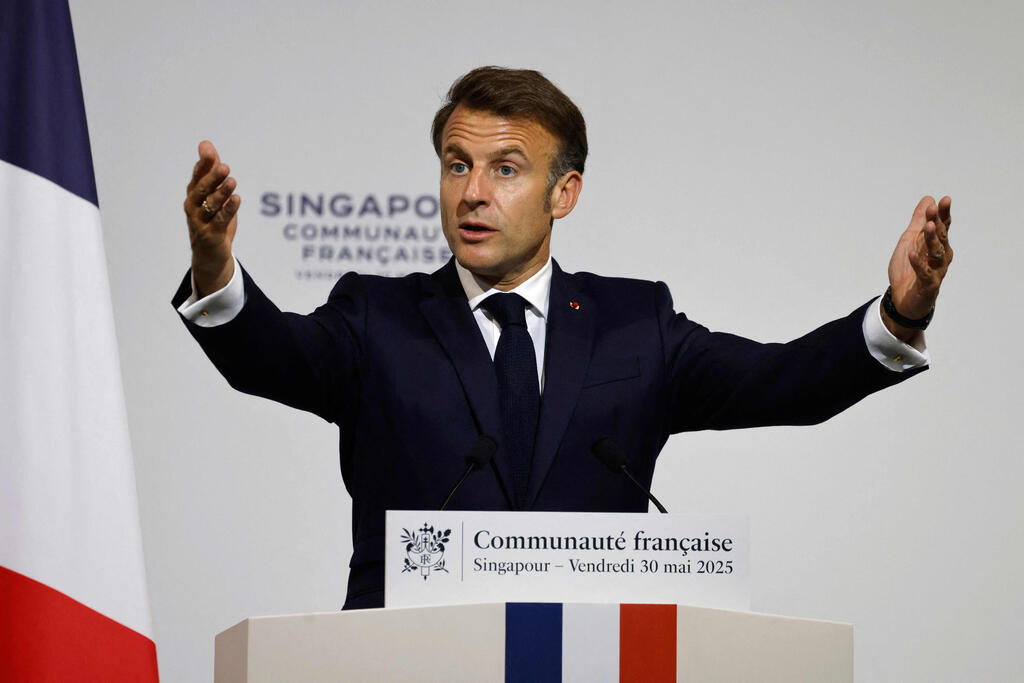
Prime Minister Benjamin Netanyahu sharply condemned Macron’s plan, saying, “We vehemently condemn the decision to recognize a Palestinian State neighboring Tel Aviv after the October 7 massacre. This is a gift to Hamas and runs the risk of creating a new Iranian proxy, just as the Gaza Strip had become.”
Macron launched a broad diplomatic push, but was left alone
Even before announcing his intention to recognize a Palestinian state, Macron sought to lead a wide-ranging international initiative. In coordination with Saudi Arabia, Macron crafted a plan under which France, the United Kingdom and Canada—three G7 members—would jointly recognize Palestinian statehood while encouraging Arab nations to adopt a more moderate stance toward Israel.
Get the Ynetnews app on your smartphone: Google Play: https://bit.ly/4eJ37pE | Apple App Store: https://bit.ly/3ZL7iNv
As he noted in his declaration, the effort was intended to culminate at a planned United Nations conference. Macron aimed to create dual diplomatic momentum, both with the Palestinians and regional states, but after weeks of discussions, he was left to move forward alone.
Three diplomats familiar with the details told Reuters that the UK declined to join the initiative, fearing a confrontation with the United States, while Canada adopted a similar position. “It became increasingly clear we can’t wait for partners to join,” a French diplomat said, adding that Paris will continue efforts to rally additional countries ahead of the planned UN conference in September, where Macron intends to make his recognition official.
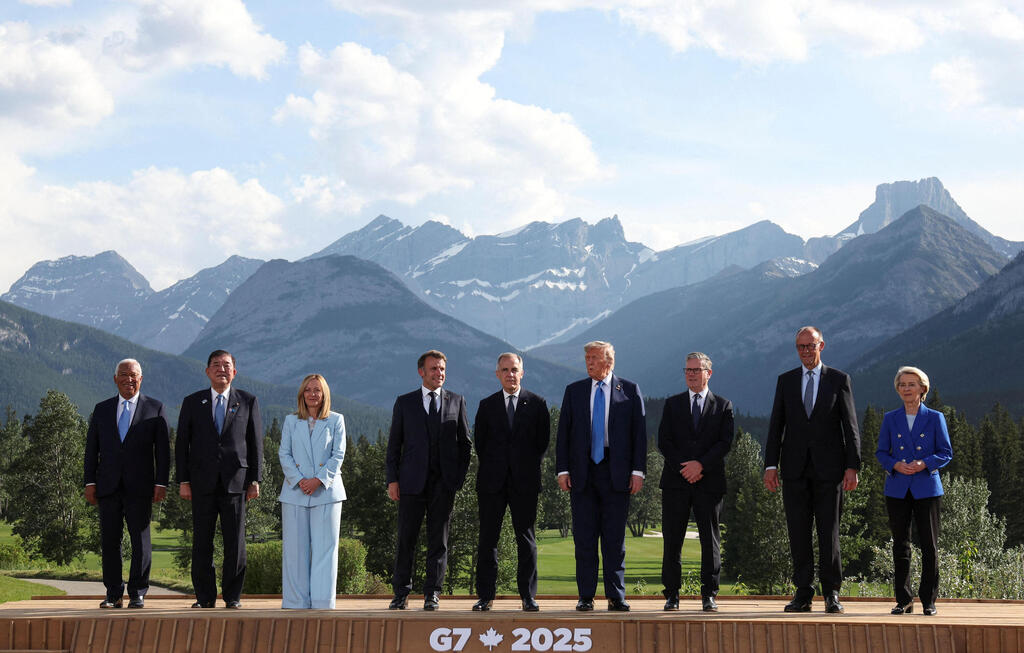
Macron (fourth from left) at the G7 summit
(Photo: Suzanne Plunkett / POOL / AFP)
In addition to UK Prime Minister Keir Starmer, who has been hesitant to align with Macron, Italian Prime Minister Giorgia Meloni told La Repubblica on Saturday that while she supports the idea of a Palestinian state, she opposes premature recognition before it is established in practice. “I am very much in favor of the State of Palestine, but I am not in favor of recognizing it prior to establishing it," she said. "If something that doesn't exist is recognized on paper, the problem could appear to be solved when it isn't."
Italian Foreign Minister Antonio Tajani added that, from Rome’s perspective, any recognition of Palestine must be accompanied by Palestinian recognition of Israel.
Germany, too, has adopted a cautious stance. A government spokesperson said Friday that Berlin has no plans to recognize a Palestinian state in the near term, adding that Germany is focused on making "long-overdue progress" toward a two-state solution.