

The apology phone call by Prime Minister Benjamin Netanyahu to Qatar, the personal connection between U.S.envoy Steve Witkoff and Khalil al‑Hayya in Cairo, and the millions earned in business dealings with Doha: Witkoff and Jared Kushner summed up in an interview on CBS’s “60 Minutes” the weeks that led to the ceasefire deal with Hamas and also talked about its fragility.
In a break with U.S. diplomatic protocol, President Donald Trump authorized his two envoys — one of them his son‑in‑law — to speak directly with Hamas, notwithstanding its terrorist designation. The pair arrived in Egypt on October 8 and there met Khalil al‑Hayya, who heads Hamas’ negotiating team and whose son was killed in the Israeli strike in Doha.
Steve Witkoff and Jared Kushner interviewed on '60 Minutes' about what led up to the Israel-Gaza ceasefire
(Video: '60 Minutes', CBS)


"We expressed our condolences to him for the loss of his son," Witkoff shared in the interview. “He mentioned it and I told him that I too had lost a son, and we were both members of the same really bad club – parents who had buried their children.”
Kushner described the moment when Witkoff comforted the senior Hamas official and the effect it had on the talks. "When Steve and him spoke about their sons, it turned from a negotiation with a terrorist group to seeing two human beings kind of showing a vulnerability with each other," Kushner said.
On the days leading up to signing the deal, Kushner said that when Trump asked him what chance they had of success, he replied: “100 %.”
"We wanted the hostages to come out," Kushner said. "We wanted a real ceasefire that both sides would respect. We needed a way to bring humanitarian aid into the people."
He added that they "had to write all these complex words to deal with the 50 years of stupid word games that everyone in that region is so used to playing. Both sides wanted the objective. And we just needed to find a way to help everyone get there."
'People apologize'
In the promo released on Saturday, the two said they felt betrayed by the Israeli strike in Doha. Interviewer Lesley Stahl said: “People need to understand that Netanyahu, the Israelis, bombed the peace team, the negotiation team.”
Gallery
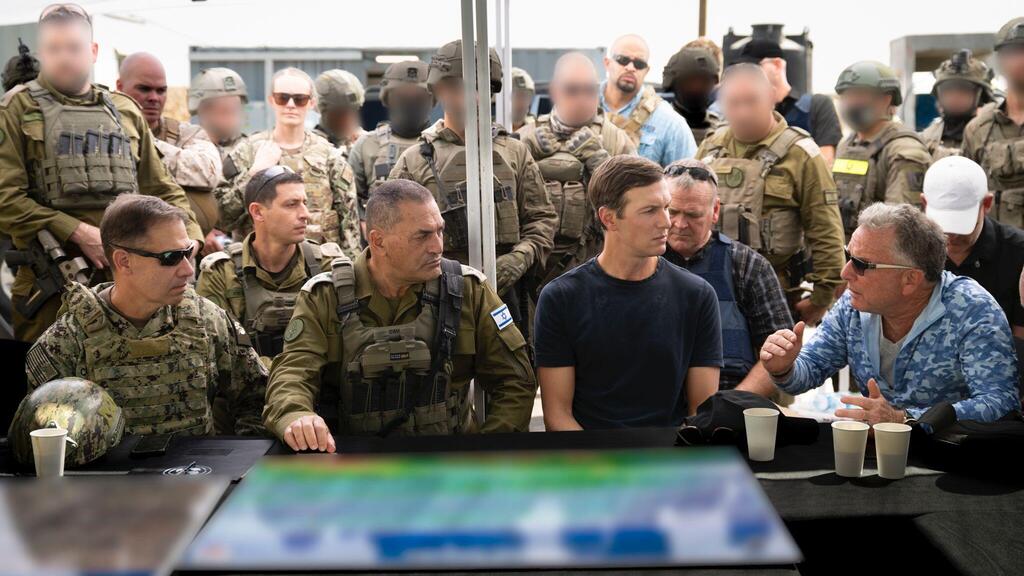
Chief of Staff, Maj. Gen. Eyal Zamir on a tour of the Gaza Strip together with American envoys Steve Witkoff and Jared Kushner
(Photo: IDF Spokesperson's Unit)
Witkoff did not deny her claim. "It had a metastasizing effect because the Qataris were critical to the negotiation, as were the Egyptians and the Turks," Witkoff said. "We had lost the confidence of the Qataris. And so Hamas went underground, and it was very, very difficult to get to them."
Stahl pointed out that what brought the Qataris back to the table was Netanyahu’s apology to Qatar’s Prime Minister Mohammed bin Abdulrahman Al‑Thani — “a phone call which I think Trump forced Netanyahu to make to the Qataris.”
Witkoff responded: “I wouldn’t call it forced. I’d say the apology was pivotal. It was the linchpin that got us to the next place. The apology needed to happen. It just did. We were not moving forward without that apology." And the president said to him, 'People apologize.'"

At Hostage's Square
(Photo:Alona Pattimer)
Kushner added, with a smile: “Now he’s a diplomat.”
Witkoff further explained that a key step in convincing Hamas to accept the deal was to make them understand that the 20 living hostages were no longer an asset but a liability.
"What did Hamas gain by keeping these hostages? You had tens of thousands of Palestinians who were killed in these wars," Kushner said. Vast areas were destroyed, "and yet Hamas still hesitated, fearing that if it released the hostages Israel would strike again.”
Although the interview was conducted before Sunday’s ceasefire breach, the Americans followed through on their promise to the terrorist organization about guarantees preventing a renewal of fighting, by placing pressure on Israel.
“Trump promised that the U.S. would stand behind the deal, that both sides would be treated fairly and that the U.S. would not let the agreement be broken.”
Stahl asked the pair why they visited the Gaza Strip after the deal. Kushner said:
“It looked almost like a nuclear bomb had been dropped there… I’m looking around, everything is ruins.”
He described seeing Gazans returning home: “It’s sad because they really have nowhere to go.”
When asked whether it was “genocide,” Kushner quickly responded: “No, no.”
“Absolutely not. No,” Witkoff said. “No, there was a war being fought.”