

Prime Minister Benjamin Netanyahu issued an unusual public condemnation on Sunday of a deadly missile attack on Saudi Arabia's main international airport, offering condolences on behalf of Israelis after a strike blamed on Yemen's Iran-backed Houthi rebels killed 12 people and wounded 309 in Riyadh.
"I condemn in the strongest possible terms the shocking terrorist attack at Riyadh airport," Netanyahu said in a statement. "On behalf of the citizens of Israel, I extend our deepest condolences to the families of those murdered and wish the injured a full recovery."
Damage and panic at King Khalid International Airport in Riyadh after the deadly Houthi missile strike


"Terrorism targets innocent people and seeks to spread fear and instability. It must be confronted with determination," he continued. "Israel looks forward to a strong Middle East, one that stands united against threats, protects its people and builds a future of security, cooperation and prosperity for all the peoples of the region."
The unusually direct message of solidarity came as the Houthis threatened further attacks across Saudi Arabia and a new projectile struck a passenger terminal at Riyadh's King Khalid International Airport on Sunday afternoon, less than a day after Saturday's deadly attack.
Gallery
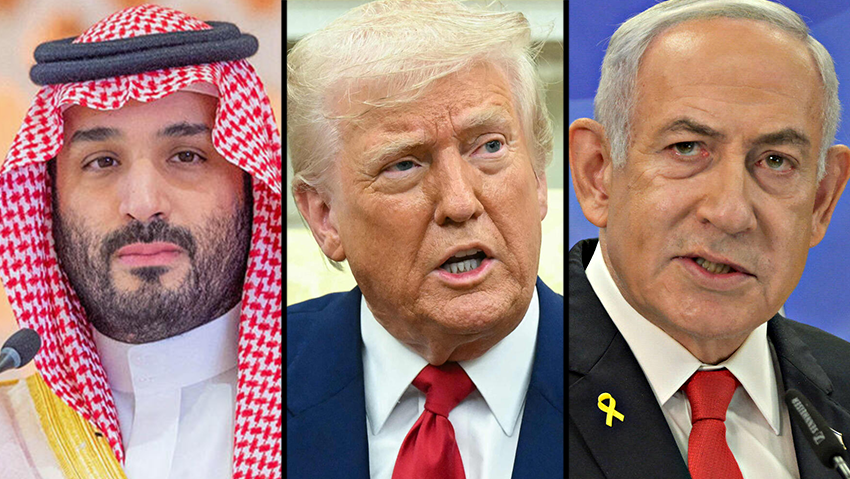
Netanyahu issues rare condemnation of Houthi attack in Saudi Arabia that killed 12
(Photo: Maayan Toaf/GPO, SAUL LOEB / AFP, gettyimages)
Houthis threaten further strikes as Riyadh airport remains closed
The Saudi-led coalition reported that another projectile struck Terminal 4 on Sunday, triggering a fire. It also reported intercepting a separate cruise missile. Around the same time, reports emerged of an attack on the airport in Sanaa, Yemen's Houthi-controlled capital.
Earlier Sunday, Houthi military spokesman Yahya Saree reaffirmed the group's intention to enforce what it described as an aerial blockade of Saudi Arabia, warning international airlines, airport employees and passengers against using the kingdom's airports and airspace.
The facilities, he warned, had become "theaters of operations for our forces."
Saree said the Houthis remained determined to enforce their declared principle of "airport for airport, blockade for blockade and escalation for escalation" until their objectives were achieved.
He accused Saudi Arabia of bearing responsibility for the consequences of failed attempts to intercept Houthi missiles and urged the public to take the group's warnings seriously.
(Video: X)
The spokesman said all areas of Saudi Arabia were potential targets except Mecca and Medina, Islam's two holiest cities. The clarification followed Saudi accusations last month that the Houthis had fired toward Mecca, home to the Kaaba, one of Islam's most sacred sites.
An aviation industry source in Saudi Arabia told AFP on Sunday morning that operations at Riyadh's international airport remained suspended. Flight-tracking website Flightradar24 reported that the shutdown had been extended, with flights not expected to resume before midnight Sunday local time.
Twelve killed, hundreds injured in deadliest Gulf attack since Iran war began
Saturday's missile struck the area housing terminals 3 and 4 of King Khalid International Airport, which serve domestic flights.
Saudi aviation authorities said the dead included four Saudi nationals, two Bangladeshis and one person each from the United States, Egypt, Jordan, Syria, Sudan and the Palestinian territories.
Among the 309 wounded, several were reported to be in critical condition, with hospitals across the Saudi capital treating large numbers of casualties.
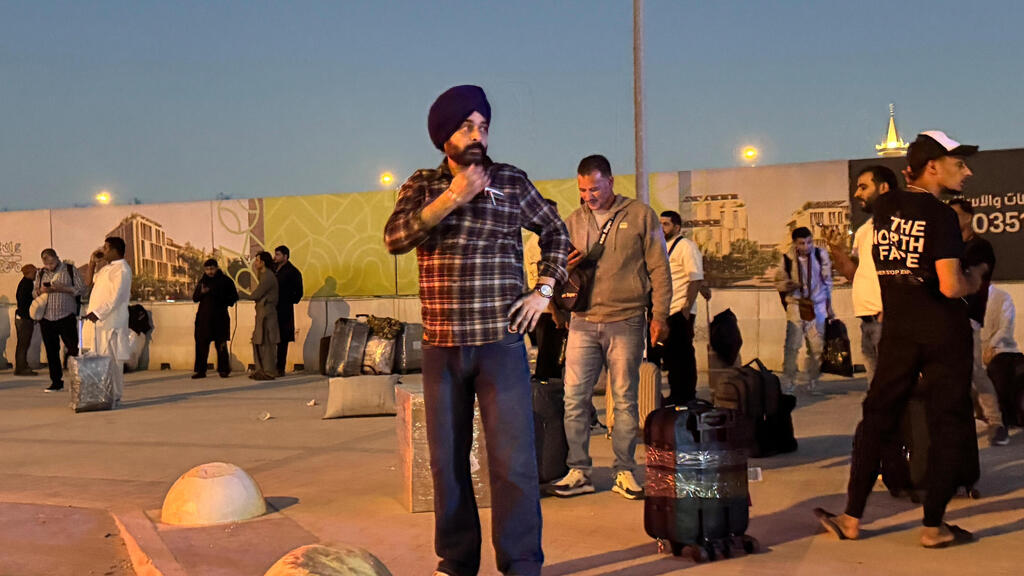
People gather near Riyadh airport after an attack that killed nationals of several countries
(Photo: AP)
The strike was the deadliest attack on a Gulf Arab country since the war involving Iran began in February.
Western sources said information gathered after the attack suggested there had been no advance warning and that no warning sirens sounded before the missile struck.
The attack came just two days after another deadly Houthi strike on the same airport killed three Saudi nationals, including a pilot, and damaged at least one passenger aircraft that was empty at the time.
Several other attacks targeted airports in Riyadh and Abha earlier in the week, killing three more people.
The growing focus on Saudi airports marks a significant escalation in the conflict between the Houthis and Saudi Arabia, which is supporting Yemen's internationally recognized government with extensive airstrikes against rebel-held territory.
Trump weighs military intervention as international condemnation grows
U.S. President Donald Trump said Saturday that Washington was considering joining Saudi military operations against the Houthis, although he emphasized that no decision had been made.
Trump later described the attack on Riyadh airport as "terrible" and "unacceptable."
The possibility of direct American involvement comes as the conflict in Yemen increasingly intersects with the broader war involving Iran, a longtime backer of the Houthis.
United Nations Secretary-General Antonio Guterres expressed deep shock over the deadly strike, while European Commission President Ursula von der Leyen condemned what she called a dangerous escalation. Germany also joined the international condemnation.
Why the fighting in Yemen is escalating
The renewed confrontation between Saudi Arabia and the Houthis began in July, ending roughly four years of relative calm in Yemen's civil war, which erupted in 2014.
The latest escalation followed Houthi attempts to break the Saudi-imposed air blockade on rebel-held territory, coinciding with renewed fighting involving Iran.
Last month, Houthi forces launched a rapid offensive that brought strategic coastal areas of southwestern Yemen under their control, strengthening their position around the Bab el-Mandeb Strait.
The narrow waterway connects the Red Sea to the Gulf of Aden and forms part of a vital shipping route between Europe and Asia through the Suez Canal, carrying approximately 12% of global trade.
Although the Houthis already possessed the ability to strike ships in the Red Sea using missiles and drones, their territorial gains gave them greater control over the strategic passage.
Its importance to Saudi Arabia has increased dramatically because of the closure of the Strait of Hormuz, on the opposite side of the Arabian Peninsula, during the war with Iran.
Earlier last week, Yemeni government forces backed by Riyadh launched a major ground offensive aimed at pushing the Houthis out of their newly captured territory and restoring control over Bab el-Mandeb.
Saudi Arabia has provided extensive air support for the operation, carrying out heavy bombardments of Houthi positions.
Reports indicate that pro-Saudi forces have made advances near the strait, although the extent of those gains remains unclear. The Houthis deny claims by Yemen's internationally recognized government that its forces have already regained control of Bab el-Mandeb.
The intensifying conflict has now brought Saudi Arabia's civilian aviation infrastructure directly into the fighting, while Netanyahu's condemnation and Trump's consideration of military intervention underscore the widening regional repercussions.