

Yemen's Houthi rebels vowed Sunday to continue enforcing their declared air blockade of neighboring Saudi Arabia, hours after a Houthi missile exploded at King Khalid International Airport in Riyadh, killing 12 people and wounding 309.
The rebels renewed their warnings to airlines and passengers as the Saudi capital's main airport remained closed following the unprecedented attack. In an official statement Sunday morning, Houthi military spokesman Yahya Saree warned airlines, airport employees and passengers against using Saudi airports or airspace, saying they "serve as theaters of operations for our forces."
Destruction and panic at King Khalid International Airport in Riyadh after the deadly Houthi missile strike
(Video: Reuters)


In his statement, Saree declared that the Houthis remained determined to enforce the rules they had announced: "Airport for airport, blockade for blockade and escalation for escalation, until our objectives are achieved." He also accused Saudi Arabia of bearing responsibility for the consequences of any failed attempts to intercept missiles launched by the Houthis, urging the public to take the group's warnings seriously. Saree said the Houthis regarded all areas of Saudi Arabia as potential theaters of military operations, except Mecca and Medina, Islam's two holiest cities. His comments followed accusations by Riyadh last month that the Houthis had fired a missile toward Mecca, the destination of the annual Muslim pilgrimage and home to the Kaaba, one of Islam's most sacred sites. The accusation portrayed the rebels as threatening Islam's holy places.
Hours after Saturday's missile attack, flight operations at King Khalid International Airport remained suspended. A source in the Saudi aviation industry told AFP on Sunday morning that the airport was still shut. Flight-tracking website Flightradar24 reported on X that the closure had been extended by another 24 hours, until midnight between Sunday and Monday, Israel time.
According to reports from Saudi Arabia, the Houthi missile exploded in the area housing Terminals 3 and 4, which serve domestic flights. The dead reportedly included four Saudi citizens, two Bangladeshis, an American, an Egyptian, a Jordanian, a Sudanese and a Palestinian. Many of the 309 people wounded were reported to be in serious condition. Reports Sunday morning indicated that hospitals in Riyadh remained filled with casualties from the attack. The strike was the deadliest attack on any Gulf Arab country since the war with Iran began in February.
According to Western sources, information collected following the attack indicates that the missile struck without any advance warning and that no sirens sounded before the impact. The deadly attack came just two days after an earlier Houthi strike on the same airport, in which at least one passenger aircraft, empty at the time, was hit. Three Saudi citizens, including a pilot, were killed in that attack. Several additional attacks targeted airports in Riyadh and the southern Saudi city of Abha earlier last week, killing three more people. The series of attacks marks a new peak in the escalating confrontation between the Houthis and Saudi Arabia, which has intensified in recent weeks alongside renewed fighting inside Yemen between the rebels and forces loyal to the internationally recognized Yemeni government. Saudi Arabia has supported those government forces with extensive airstrikes on Houthi-controlled territory.
The scene of the aircraft strike two days before the missile attack that killed 12 people
(Video: X)
On Saturday, President Donald Trump said the United States could join the fighting and assist Saudi Arabia in conducting strikes against the Yemeni rebels, although he emphasized that no decision had yet been made. Trump subsequently described the Houthi attack on Riyadh as "a terrible thing" and "unacceptable." United Nations Secretary-General António Guterres expressed "deep shock" over the airport attack Sunday morning. Germany also condemned the strike, while European Commission President Ursula von der Leyen described it as "a dangerous escalation."
The Houthis have intensified their attacks on Saudi cities in recent days, increasingly targeting airports as part of a campaign to disrupt the kingdom's aviation industry and effectively close its skies. The rebels say the campaign is retaliation for Saudi airstrikes against Houthi positions in Yemen. At the beginning of last week, the Houthis warned international airlines not to operate in Saudi airspace, declaring it an operational zone for attacks against the kingdom. They said they would not accept responsibility for the consequences if airlines continued to fly there.
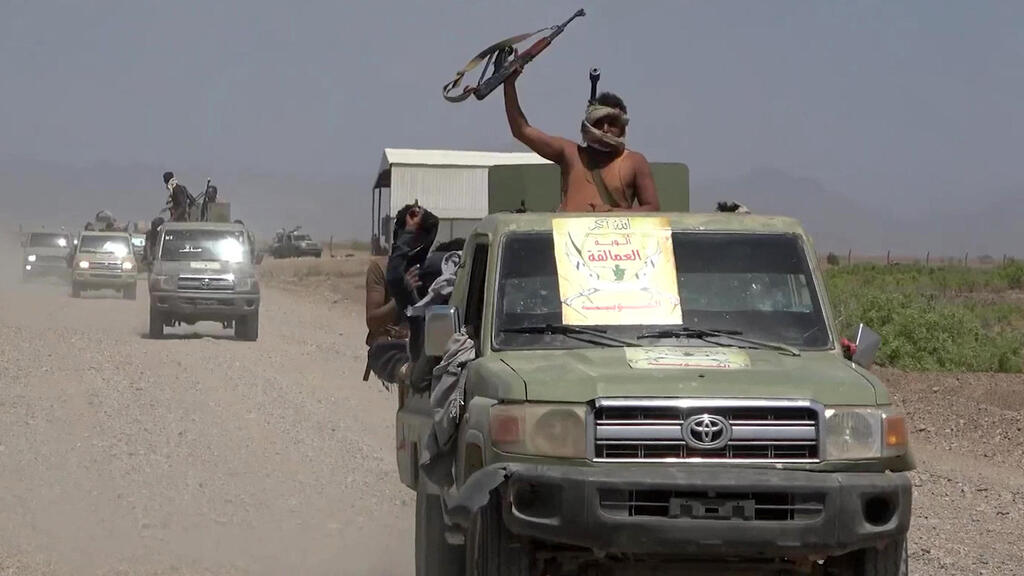
Pro-Saudi Yemeni government forces fighting near Bab el-Mandeb on October 6
(Photo: AFP PHOTO / YEMEN SOUTHERN GIANTS BRIGADES MEDIA CENTRE)
The renewed confrontation between the Houthis and Saudi Arabia began in July, ending a four-year lull in Yemen's civil war. That conflict erupted in 2014, with Riyadh subsequently intervening in support of Yemen's internationally recognized government. The latest escalation began after the Houthis attempted to break the air blockade imposed on them by Saudi Arabia, against the backdrop of an intensifying war involving Iran, their regional ally. Last month, the Houthis launched a rapid territorial offensive, capturing strategic coastal areas in southwestern Yemen overlooking the Bab el-Mandeb Strait. The territorial gains strengthened their position along one of the world's most important maritime shipping routes. The Houthis had already demonstrated their ability to attack shipping in the Red Sea using long-range missiles and drones, but their advances on the coast gave them tighter control over movement through the strategic passage. Bab el-Mandeb links the Red Sea and Suez Canal shipping route between Europe and Asia, carrying approximately 12% of global trade.
Its strategic importance, particularly for Saudi Arabia, has increased dramatically because of the closure of the Strait of Hormuz on the opposite side of the Arabian Peninsula during the war with Iran. Early last week, Yemeni government forces aligned with Riyadh launched a major ground offensive aimed at driving the Houthis from their newly captured territory and regaining control of Bab el-Mandeb. Saudi Arabia has provided extensive air support for the operation, including heavy bombardment of Houthi-held areas. Reports indicate that pro-Saudi forces have advanced in the area surrounding the strait, although the extent of those gains remains unclear. The Houthis dispute claims by Yemen's internationally recognized government that its forces have already recaptured Bab el-Mandeb, leaving control of the vital waterway contested as the fighting escalates on both sides of the Arabian Peninsula.