

U.S. President Donald Trump suggested Wednesday that Israel and Lebanon could be heading toward rare direct leader-level contact between Prime Minister Benjamin Netanyahu and Lebanese President Joseph Aoun, saying talks between the two sides are expected Thursday.
“It has been a long time since two leaders have spoken, like 34 years. It will happen tomorrow,” Trump said, adding he was trying “to get a little breathing room” between the countries.
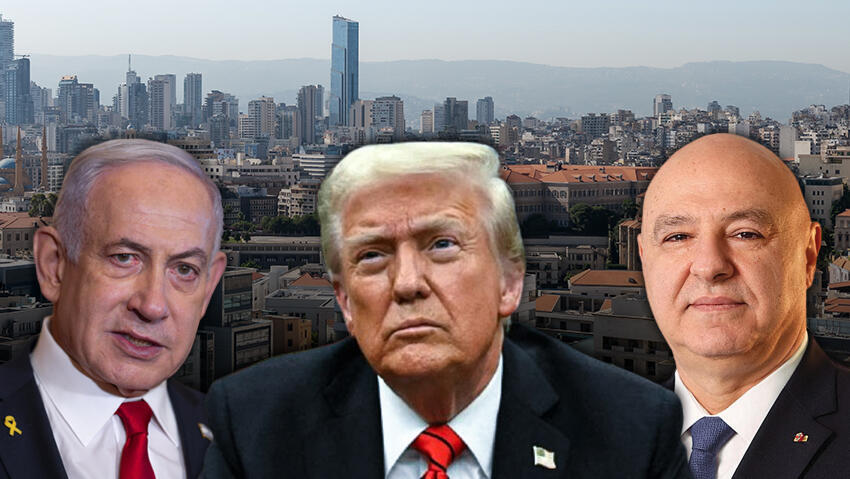
(Photo: ANDREW_CABALLERO-REYNOLDS_AFP, AFP PHOTO / HO / LEBANESE PRESIDENCY, J. Scott Applewhite AP,paul saad / Shutterstock)
His remarks came as fire from Lebanon into northern Israel continued and diplomatic contacts advanced behind the scenes. A meeting between the Israeli and Lebanese ambassadors was held Tuesday in Washington, with both sides now awaiting a framework from U.S. Secretary of State Marco Rubio aimed at advancing efforts toward a ceasefire.
Despite the diplomatic push, a senior Israeli official said no decision has been made on a ceasefire with Hezbollah, and fighting on the ground continues. Under U.S. pressure, Israel has refrained from striking the Beirut area for about a week, while Washington seeks either a halt in fighting or a temporary pause.
Behind the talks, significant gaps remain.
Israel is seeking the disarmament of Hezbollah, while Lebanon’s ability — and willingness — to deliver such a step remains uncertain.
Experts say most border disputes between Israel and Lebanon are minor and technical, involving about a dozen points along the frontier, some no larger than a football field. The more symbolic dispute over the Shebaa Farms area depends largely on Syria’s position, making it a broader regional issue.
Proposals under discussion include layered security arrangements in southern Lebanon, with demilitarized zones extending north of the border. But enforcement remains a central challenge.
The key issue is Hezbollah, the Iran-backed Shiite group that maintains significant military power and can act independently of the Lebanese government. Analysts are divided over whether the group can be weakened through political pressure or would require a broader confrontation.
Lebanon’s current leadership is seen as more willing to challenge Hezbollah than in the past, following the appointment of Aoun and the formation of a government not dominated by the group. Still, the system remains fragile, with limited capacity to enforce major decisions.
Experts say that while a full peace agreement is unlikely in the near term, more limited outcomes — such as a more stable ceasefire or interim security arrangements — may be possible, depending largely on Hezbollah’s future role and broader regional dynamics.