


Fire from Lebanon toward northern Israel continued Wednesday, even as behind-the-scenes contacts between the two countries advance efforts toward a ceasefire.
Following a meeting Tuesday in Washington between the Israeli and Lebanese ambassadors, both sides are now awaiting a framework from U.S. Secretary of State Marco Rubio aimed at advancing attempts to reach an agreement.
Gallery
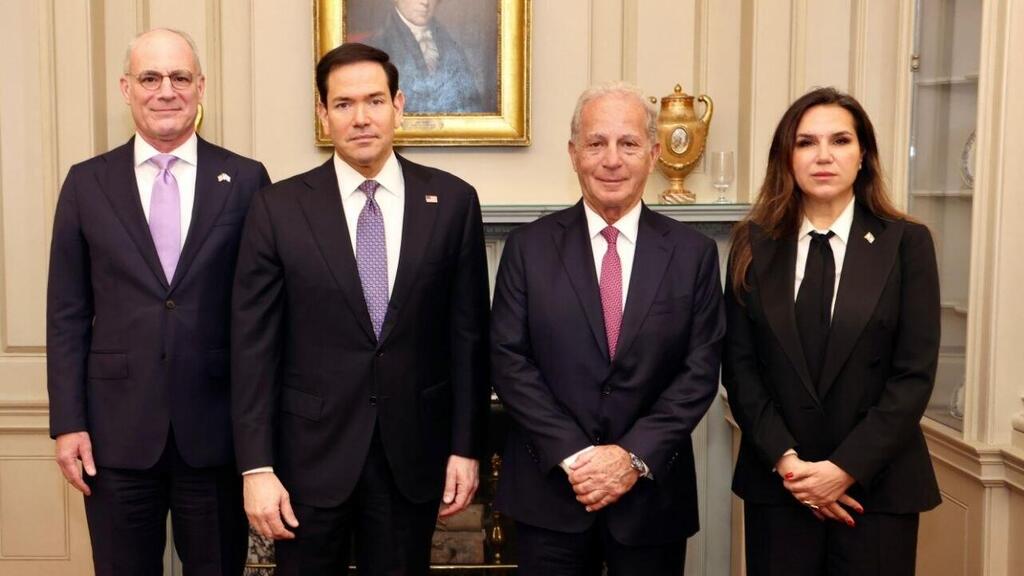
Meeting between the Lebanese ambassador and the Israeli ambassador to the United States
(Photo: Shmulik Almani, Israeli Embassy in Washington)
The talks have generated unusual interest across the Middle East, not only because they are taking place at all, but because of the central question: whether this marks a historic breakthrough or just another fleeting episode in a region marked by repeated disappointments.
Behind the cautious optimism lies a complex reality. There remains a deep gap between what Israel seeks to achieve, primarily the disarmament of Hezbollah, and what Lebanon is capable of or willing to deliver.
These are the key issues at stake:
Border disputes measured in meters
Surprisingly, most experts agree there is no major territorial dispute between Israel and Lebanon. Along the border, there are roughly 13 points of disagreement, but these involve very small areas, sometimes the size of a football field or less.
These are largely technical issues related to border demarcation and are considered solvable within the framework of an agreement.
Shebaa Farms: a Syrian issue
The Shebaa Farms area is seen as more symbolic than substantive. Israel considers it Syrian territory captured in 1967, while Lebanon claims ownership.
In practice, the resolution depends on Syria’s position, making it a regional rather than strictly bilateral issue. If Syria recognizes the area as its own, the dispute could effectively be resolved. If not, Israel and Lebanon will need to find an alternative solution. Even here, the territory involved is limited.
Security arrangements: the demilitarized zone model
One proposal under discussion is the creation of a model similar to those established in agreements with Egypt and Syria, involving layered security zones.
This would include a demilitarized area in southern Lebanon up to the Litani River; a zone without military forces but with police presence extending from the Litani to the Awali River near Beirut; and an area north of Beirut under Lebanese army control, with restrictions on heavy weapons and international oversight.
On paper, this is a workable solution. The key question is who would enforce it on the ground.
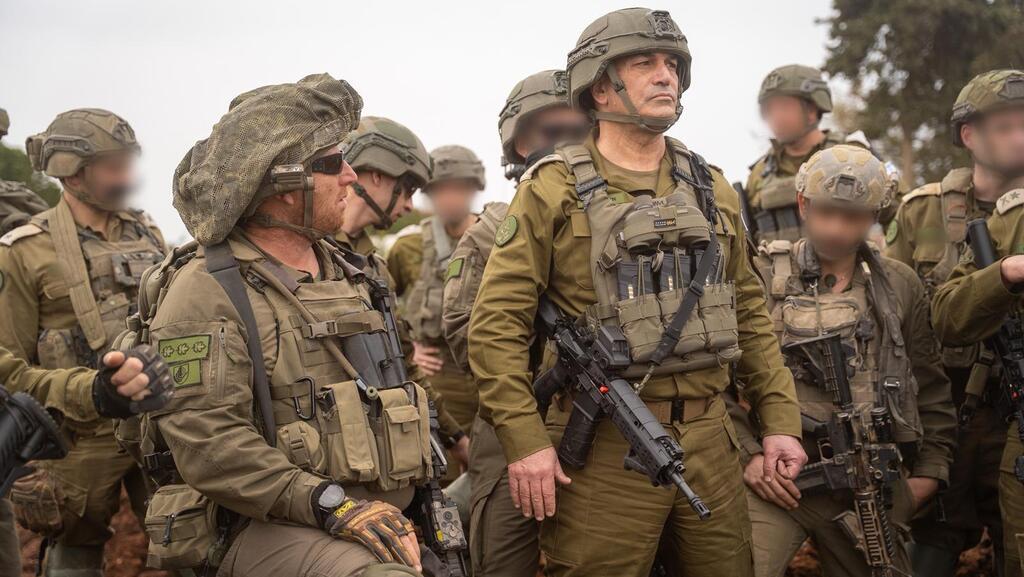
IDF Chief of Staff in southern Lebanon
(Photo: IDF)
The central issue: Hezbollah
If there is one factor that will determine the outcome of negotiations, it is Hezbollah.
The Shiite organization remains a powerful military force capable of initiating conflict with Israel independently, sometimes even against the interests of the Lebanese government.
Experts are divided into two camps. The pessimistic view holds that Hezbollah is too strong to be disarmed without a violent internal confrontation or broad external intervention.
The more optimistic view suggests the group has been weakened by the war, is losing political standing and facing growing domestic criticism, a process that could allow gradual change.
Either way, without addressing Hezbollah’s status, no progress toward a peace agreement is possible.
Can the “new Lebanon” deliver?
Lebanon’s current government is presenting a relatively firm stance toward Hezbollah, something not seen in years.
The appointment of President Joseph Aoun and the formation of a government not dominated by Hezbollah are seen as an opportunity. However, the system remains fragile.
The Lebanese army is still influenced by Hezbollah, there are concerns about internal instability or political violence, and the government’s ability to implement decisions is limited.
In other words, there may be a diplomatic partner, but not necessarily an effective governing authority.
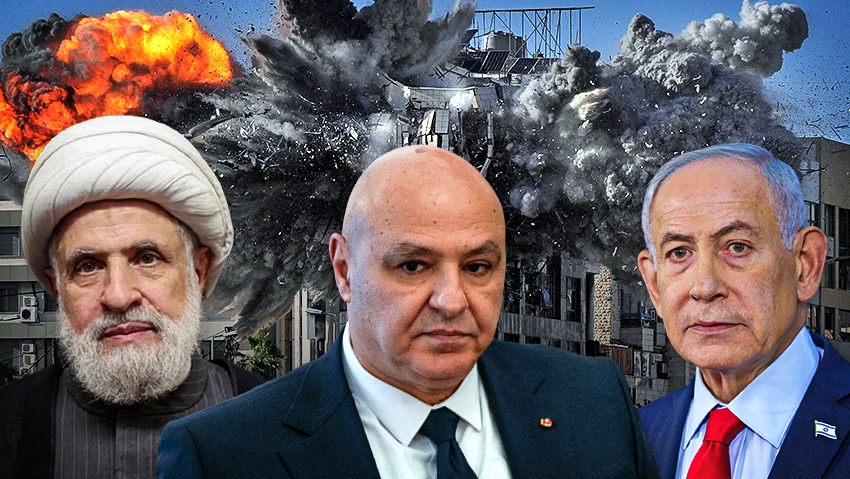
Hezbollah Secretary-General Qassem, Lebanese President Aoun, Prime Minister Benjamin Netanyahu
(Photo: Petros Karadjias/Reuters, Shalev Shalom, Mohammad Yassine/ Reuters)
Is peace realistic?
In the short term, the answer is almost certainly no. The gaps are too wide and Lebanon’s internal situation too complex.
In the longer term, three scenarios are possible: an improved status quo with a more stable ceasefire and monitoring mechanisms; an interim security agreement based on demilitarized zones and military arrangements; or a full peace agreement, which would likely require a dramatic weakening of Hezbollah or broader regional change, such as a shift in Iran.
Bottom line
The negotiations between Israel and Lebanon are both a positive and historic development, and at the same time a highly limited process.
Will they lead to peace? The chances are low in the foreseeable future.
Can they produce gradual change? Possibly yes.
In the Middle East, that alone can be significant.
At the same time, a senior Israeli official said no decision has been made regarding a ceasefire with Hezbollah. Despite that, contacts are ongoing, with Washington pushing for either a halt to the fighting or a temporary pause.
At this stage, such a move appears unlikely, as Hezbollah continues firing into Israel.
Under U.S. pressure, Israel has refrained from striking the Beirut area for about a week. Ahead of renewed U.S.-Iran negotiations on a ceasefire framework, pressure is being applied both on Washington and from Washington on Israel to agree to a full ceasefire in Lebanon.
Jerusalem has not agreed, and the situation on the ground remains active. Still, the United States is seeking to bring the conflict to a close and avoid a prolonged war in Lebanon.
Expert views
Prof. Eyal Zisser, an expert on Syria and Lebanon, said: “The Lebanese aim mainly to achieve a ceasefire and stop the fighting. It is not certain they can go beyond that, to disarming Hezbollah and negotiating a peace agreement. Hezbollah represents the largest community in the country and has significant military power, so it is hard to see a solution.”
Orna Mizrahi, former deputy head of Israel’s National Security Council and head of the Lebanon program at the Institute for National Security Studies, said:
“It is not accurate to say Hezbollah controls Lebanon, but it is very accurate to say the Lebanese government is weak. There are opportunities. Hezbollah has been weakened. Hamas is under pressure. Syria has a regime hostile to Hezbollah. Iran is in a complex situation.”
She added that the current Lebanese leadership increasingly views Hezbollah as an obstacle to state sovereignty, but faces major challenges in implementing change.
“This will require changes in the Lebanese army, international involvement and strengthening the government. If that happens, relations between Israel and Lebanon could eventually shift. The key issue remains Hezbollah and how to disarm it, which is a shared interest.”
Col. (res.) Dr. Jacques Neriah, a senior researcher at the Jerusalem Center for Foreign Affairs and Security and former adviser to Yitzhak Rabin, was more pessimistic.
“The Shiites intend to take over Lebanon. You hear it everywhere,” he said. “There is talk among Lebanese Christians about possible intervention. We need to think about dividing spheres of influence with Syria. That may be the only way to achieve a stable system. I am pessimistic. An arrangement may be possible, but turning it into something real is another matter.”