

Over the past two years, public discourse around the issue of hostages has undergone a dramatic shift, and Gil Elias, a cousin of Avera Mengistu, who was held in Hamas captivity in Gaza for nearly 11 years, says that for the first time he feels that people truly understood what he and his family have been going through.
“When everyone talked about how important it is to close the circle, how meaningful it is to have a grave to visit, it kept hitting me,” he says. “I know what that absence is like, what it means to live without certainty.”
Elias is not speaking only about his relative who was held captive for over a decade. As a small child, during his family’s immigration journey from Ethiopia to Israel via Sudan, three of his siblings died. “Six siblings set out and three arrived,” he recalls. “I was seven or eight years old — it’s impossible to know exactly, because my ID lists ‘00’ as my birth date.”
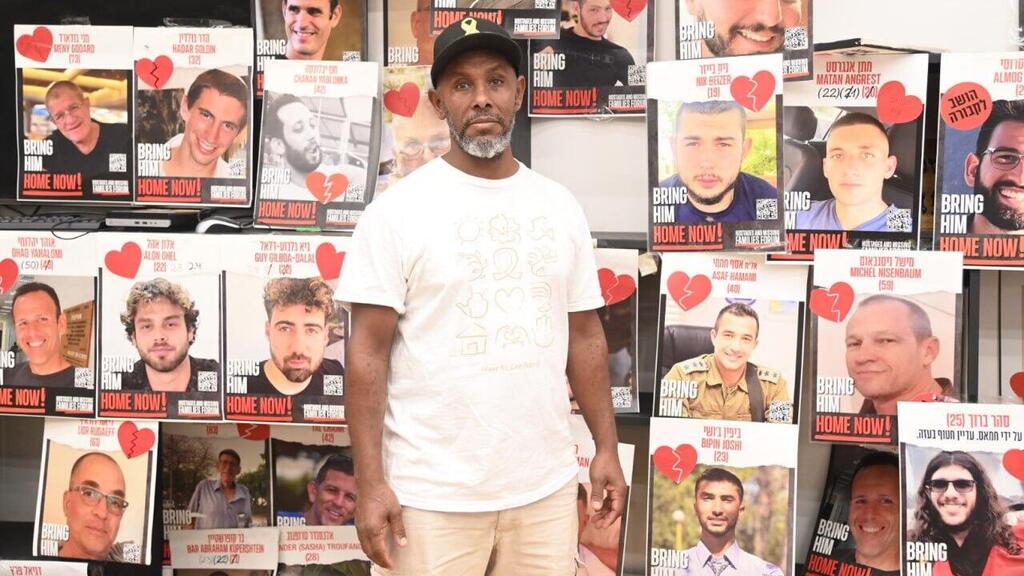
The three siblings died along the way, apparently of malaria. “To this day we don’t know where they are buried,” Elias says. “About 4,000 people died on that journey. We have no grave to visit, we didn’t say Kaddish, we didn’t hold a memorial. My mother still mutters to herself while cooking about the pain and about there being no grave. They matter. They are part of our lives.”
That inability to find closure has also marked the past decade, since Avera, who suffers from mental health challenges, crossed into Gaza in 2014 on his own, walking across the border near a beach in southern Israel.
“Before October 7, the issue of captives was barely part of the public conversation,” Elias says. “After Gilad Shalit, a kind of red line formed around the issue. People preferred silence. Avera, Hisham al-Sayed, Hadar Goldin and Oron Shaul — they were there for years, and hardly anyone talked about them. We were told, ‘Avera crossed the fence. What do you want from us?’ He was blamed. But this was a serious military failure. How do you let a civilian cross the fence? A normative person doesn’t cross a fence and end up in Gaza. But because he is a person with mental illness, from the periphery, from a marginalized population, it was easy to ignore him.”
Avera Mengistu is reunited with his family after his release from Hamas captivity
(Photo: Oz Shechter / GPO)


After October 7, he says, everything changed. “Suddenly people in the square came up to me and apologized. They said they hadn’t been there for us. Suddenly they understood what it means to live with this kind of uncertainty. Before that, we were alone. There was no support system. The hostage families gave me strength,” he says.
Since Avera returned to Israel, Elias visits him about once every three weeks. “He’s still in rehabilitation, in a residential care facility. Slowly he’s starting to understand that many people know who he is, and he doesn’t understand why. He has a great sense of humor. He calls the Nukhba fighters ‘Teenage Mutant Ninja Turtles’ because of the green bandanas on their heads,” Elias says with a smile.
Avera, now 39, was held in Gaza from the age of 28. Since his return, he barely speaks about captivity. “He can say that he crossed the fence, that they caught him and moved him from place to place,” Elias says, “but he doesn’t talk about tunnels or abuse. That’s probably a defense mechanism. But his behavior shows he went through very hard things. At first, for example, if no one explicitly told him ‘eat,’ he wouldn’t eat. That’s how they conditioned him there.”
The gap between the world Avera left and the one he returned to is evident in the smallest details. “Smartphones, WhatsApp, the Rav-Kav transit card — everything changed. At first he wanted to buy a paper bus ticket. Even cigarette packs — they used to be colorful, now they aren’t," his cousin says. "Avera will need support and guidance for the rest of his life. He left as a person with mental illness and returned with additional trauma and anxiety."
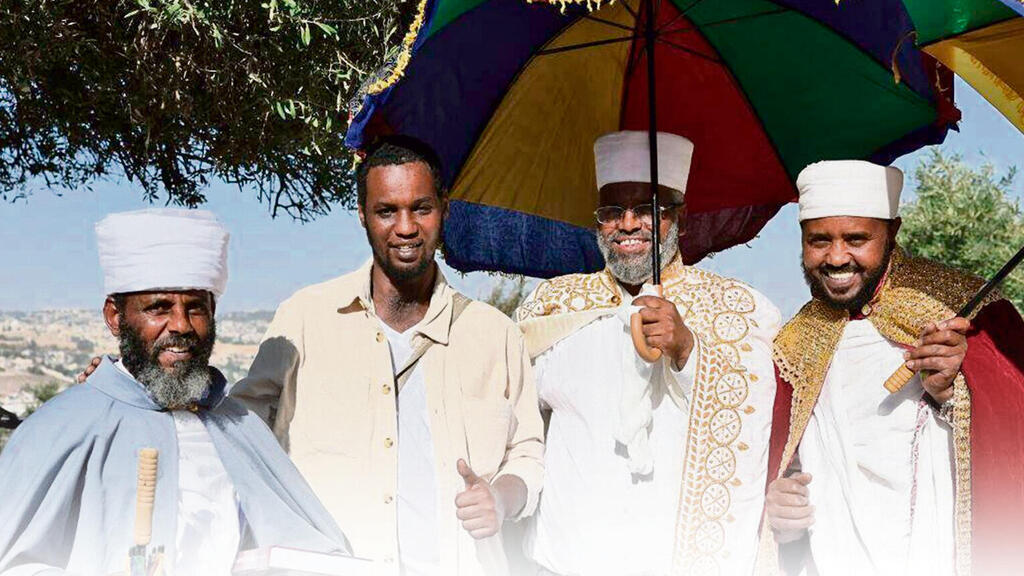
Avera Mengistu, second from left, marks his fist Sigd since his release from captivity
(Photo: Arnon Busani)
Elias explains that Avera’s story is part of a broader pattern of mistreatment of the Ethiopian community in Israel. “The recent case of Moshe Mengistu, also a person with mental illness, who was filmed in a violent confrontation with police; the disappearance of Haymanot Kasau; the death of Solomon Teka; the case of Rafael Adana. Police violence and profiling are nothing new to us. Members of the community don’t have the privilege of not fighting, of saying this has nothing to do with us,” he says.
“I’m exhausted," he adds candidly. "More than 10 years around Avera took almost everything from me. One day I opened my closet and realized I didn’t have any regular clothes — everything was clothes from the struggle for Avera. I want to breathe, but the reality in this country doesn’t really allow disengagement.”
Still, he ends on a hopeful note. “In Ethiopia, we had everything. We didn’t come because it was bad — we came out of Zionism. We paid a heavy price, lost three siblings, and still my parents fulfilled a dream. So there is hope.”