


Operation Eternal Darkness, Wednesday's massive surprise strike on Hezbollah, was intended as the opening blow of a broader move planned before the current war. However, Hezbollah changed its deployment, requiring the IDF to adapt — and it succeeded in locating the new headquarters and striking commanders inside them.
Nearly all of Hezbollah’s clandestine headquarters were hit in the opening strike, in what officials described as one of the most consequential blows dealt to the Iran-backed group in the war.
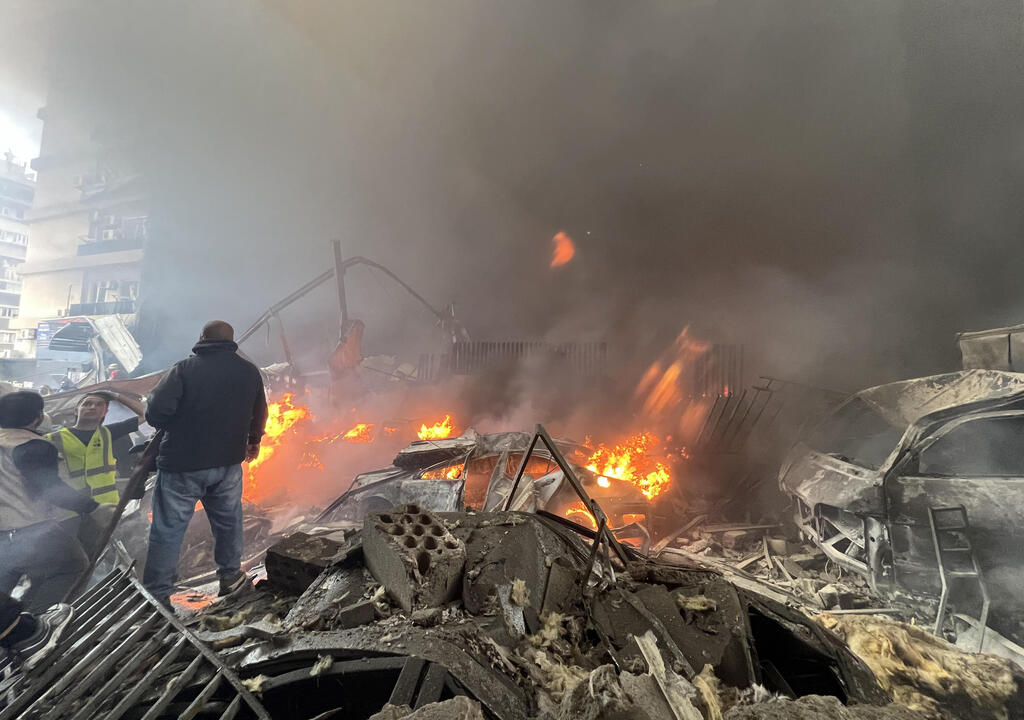
(Photo: AP Photo/Hussein Malla)
Reports indicated that 100 headquarters were hit within 10 minutes and that between 300 and 350 Hezbollah operatives, including senior commanders, were killed.
The operation was described as a more significant success than the 2024 exploding-pager attack, which primarily killed and maimed field operatives rather than top commanders.
Northern Beirut, with its dense population, high-rise buildings and large civilian concentrations, has become an area where Hezbollah operatives can hide in plain sight. According to the IDF, Hezbollah considers these neighborhoods safer than its home base in the capital's southern suburbs and uses the civilian population to mask its activity.
The strike was defined not only by its scale, but by how deeply it penetrated Hezbollah’s command structure, targeting not just operatives but the group’s command-and-control core inside its headquarters.
According to the IDF, Hezbollah has shifted its deployment in recent years, moving beyond its traditional strongholds — especially in Beirut’s Dahieh district — and dispersing into mixed civilian areas across Lebanon after concluding that its headquarters in Beirut were being systematically targeted.
The military says Hezbollah has increasingly used civilian areas as cover, expanding a tactic once concentrated largely in Shiite neighborhoods. The result, according to the army, was a multi-pronged strike aimed not only at Hezbollah operatives but at the heart of its command-and-control network, in an effort to disrupt the group’s ability to regroup even in areas to which it had tried to relocate.