

Hezbollah has informed Lebanese Parliament Speaker Nabih Berri that it does not intend to intervene on Iran's behalf if a new war breaks out between Tehran and the United States and Israel, Saudi newspaper Asharq Al-Awsat reported Saturday. The reported assurance comes amid growing fears of renewed military confrontation and warnings that another conflict could have devastating consequences for Lebanon.
According to Lebanese parliamentary sources cited by the newspaper, Iranian Deputy Foreign Minister Saeed Khatibzadeh told lawmakers affiliated with Hezbollah and the allied Amal Movement during a recent visit to Beirut that Tehran would not ask the Lebanese terrorist group to participate in another war. Iran, he reportedly said, was capable of defending itself against American attacks without Hezbollah's assistance.
"We have made significant progress in our preparations to prevent the United States from achieving its objectives," Khatibzadeh reportedly told the lawmakers. The sources said Tehran's position reflected the significant military imbalance between Hezbollah and Israel, which meant that Hezbollah's involvement would be unlikely to alter the outcome of a broader confrontation.
Another consideration is the potential backlash from Hezbollah's own supporters. According to the report, Lebanon's Shiite community would be unlikely to accept another costly war fought on Iran's behalf, particularly after the heavy losses and displacement caused by previous confrontations with Israel. Hezbollah's leadership would face considerable difficulty justifying another intervention.
However, the Iranian Embassy in Lebanon issued a statement Saturday denying media reports concerning Khatibzadeh's recent visit and the contents of his meetings, casting doubt on the account attributed to the Iranian official.
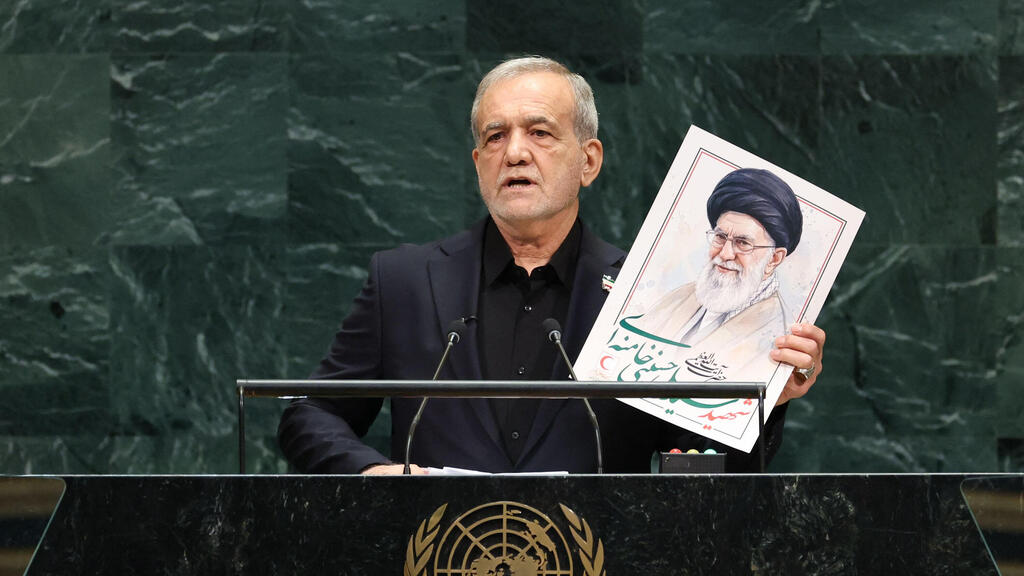
Iranian President Masoud Pezeshkian
(Photo: TIMOTHY A. CLARY / AFP)
Meanwhile, Iranian President Masoud Pezeshkian appeared to favor renewed diplomacy. Speaking on Iranian state television Saturday, he blamed Washington for the collapse of an earlier agreement but said negotiations should resume. "We were having negotiations. The cowards ruined everything. I still think we should complete it," he said.
Diplomatic contacts have continued despite the escalating rhetoric. Pakistan's army chief, Asim Munir, who has played a mediating role between Washington and Tehran since their most recent ceasefire, visited Iran earlier this week. A Qatar-based media report subsequently claimed that the two sides had reached preliminary understandings on resuming negotiations, including measures to prevent renewed fighting and the possible release of $6 billion in Iranian funds held in Qatari banks.
Yet Iranian officials offered a far more pessimistic assessment in comments to Reuters, saying Tehran expected the United States and Israel to resume military operations rather than reach an agreement. One official said Iran was preparing for renewed attacks, while others acknowledged that Tehran had deliberately prolonged negotiations in hopes of weakening President Donald Trump politically ahead of the November 3 U.S. midterm elections.
Trump: 'We may do another little Operation Epic Fury'


The growing tensions have also prompted Washington to reduce its diplomatic presence across the Middle East. According to an intelligence memorandum dated October 23 and reported by Axios, Iran has significantly intensified efforts to target American diplomats and senior officials abroad, with alleged assassination plots reaching advanced stages. The warning has contributed to heightened security measures at U.S. diplomatic missions.
Trump added to the uncertainty Friday during a rally in Florida, warning that another American military operation against Iran remained possible unless Tehran agreed to a deal. "We may do another little Operation Epic Fury, or the Iranians will agree to a deal," he said, adding that Iran should return to negotiations.
With Iranian missile testing reportedly continuing and Washington preparing for the possibility of renewed hostilities, Hezbollah's reported decision to remain on the sidelines could prove significant. Whether the group would maintain that position if fighting resumed, however, remains uncertain.