

Less than a day before what many are calling Hungary’s most consequential election since the fall of communism, young voters across the country are expressing both hope and anxiety over whether Prime Minister Viktor Orbán’s 16-year rule may finally come to an end.
Large crowds of mostly young protesters filled the streets of Budapest this weekend, underscoring the intensity of the moment. More than 100,000 people attended a massive rally in the capital, where over 50 popular Hungarian bands performed during a seven-hour event titled “Breaking the System,” urging citizens to vote and unseat Orbán’s government.
Massive anti-Orbán rally in Budapest
(Video: Reuters)


Many in the younger generation are pinning their hopes on opposition leader Péter Magyar, a former Orbán ally who now leads the Tisza party. But even among his supporters, expectations are tempered.
“If Orbán stays, we leave — and the country will go with us,” said Hanga Pölöp, a 22-year-old art student in Budapest who is voting for the first time. In recent months, she and her classmates have been campaigning actively, putting up posters, graffiti and stickers across the city in an effort to mobilize voters.
Pölöp said she has shifted her focus away from her studies to political activism, driven by a desire to restore what she described as her generation’s lost sense of pride in Hungary. She criticized older generations for failing to bring about change, adding that the current moment feels historic. “We’ve had dramatic moments before — after World War I and II, during the Cold War, the Soviet invasion, the fall of communism — but nothing compares to this,” she said.
Despite the enthusiasm, there is broad agreement that even if Magyar wins, Hungary may not undergo a fundamental transformation. A former senior figure within Orbán’s ruling Fidesz party — and once married to his justice minister — Magyar broke away in 2024 following a controversial pardon granted by Orbán in a case involving sexual abuse at a children’s home.
Magyar has campaigned on reducing corruption and focusing on domestic issues such as the cost of living, healthcare, education and welfare. However, he remains a conservative nationalist, with positions similar to Orbán’s on energy dependence, migration, gender equality and LGBTQ rights.
“There are no illusions,” Pölöp said. “We’re like Freud’s lost children — between hope and despair.”
Orbán’s influence over Hungary’s political and institutional landscape looms large over the election. Over the years, critics say he has built a system in which key state institutions — including the judiciary, media and public funding mechanisms — are dominated by loyalists, many of whom rose to prominence through government contracts and patronage.
That system is visible across Budapest, where campaign messaging from Fidesz remains highly visible. Opposition activists point to the role of wealthy allies of Orbán, who control much of the advertising space and have filled it with messaging portraying Magyar alongside Ukrainian President Volodymyr Zelenskyy under warnings not to let them “win.”
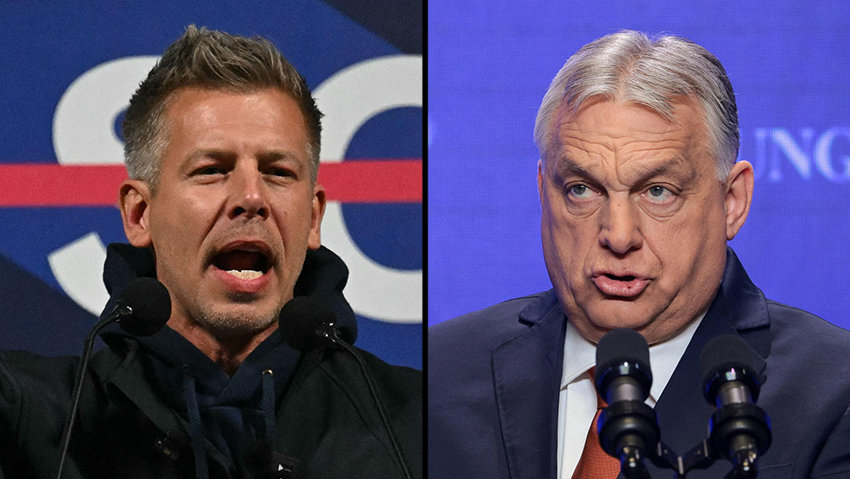
Péter Magyar and Viktor Orbán
(Photo: REUTERS/Jonathan Ernst/Pool, Attila KISBENEDEK / AFP)
Hungary, once considered a model for post-communist democratic reform, now ranks among the European Union’s lowest in measures of corruption and public services, while also leading in suicide rates. Its economy has lagged behind regional peers.
The election carries broader geopolitical implications. The United States and Russia are both seen as backing Orbán, and the outcome could influence the future direction of the European Union. At the same time, Hungary remains internally divided — torn between a desire to integrate more deeply with Europe and skepticism toward its values, as well as between fear of Russia and reluctance to support Ukraine.
A political adviser in Budapest said that even if Orbán loses, he is unlikely to disappear from the political scene. “He is only 62 — very young politically,” the adviser said. “Figures like him, like Trump or Netanyahu, often return stronger from opposition, with a desire for revenge.”
Magyar has labeled Orbán a “mafia boss running a mafia state,” while younger voters have coined the nickname “Viktator,” blending his name with the word “dictator.”
Polls suggest a significant generational shift: about 65% of voters from the so-called “Orbán generation” — those born after he first came to power in 2010 — are expected to support the opposition.
Still, uncertainty remains high. Some voters express concern that change may be superficial, while others warn that an Orbán victory could trigger unprecedented unrest.
“If he wins, the ground here will shake,” the political adviser said. “Europe will see protests it has never seen before. People have endured a lot over the past 16 years, but they are not ready to lose hope.”