



With the elimination of Abu Obaida—Hamas’s most prominent media icon to date—the terror group has lost not only its official spokesman, but also one of the most symbolic and influential figures in its history.
His absence was evident in the terrorist group’s first propaganda clip released after his death. In the clip, issued Wednesday as the IDF prepared for a ground operation in Gaza City and just before Hamas announced it was open to a “comprehensive" hostage deal, the group wrote in particularly broken Hebrew: “Urgent warning, decision to expand your criminal operations, the lives of your soldiers and prisoners.”
Gallery
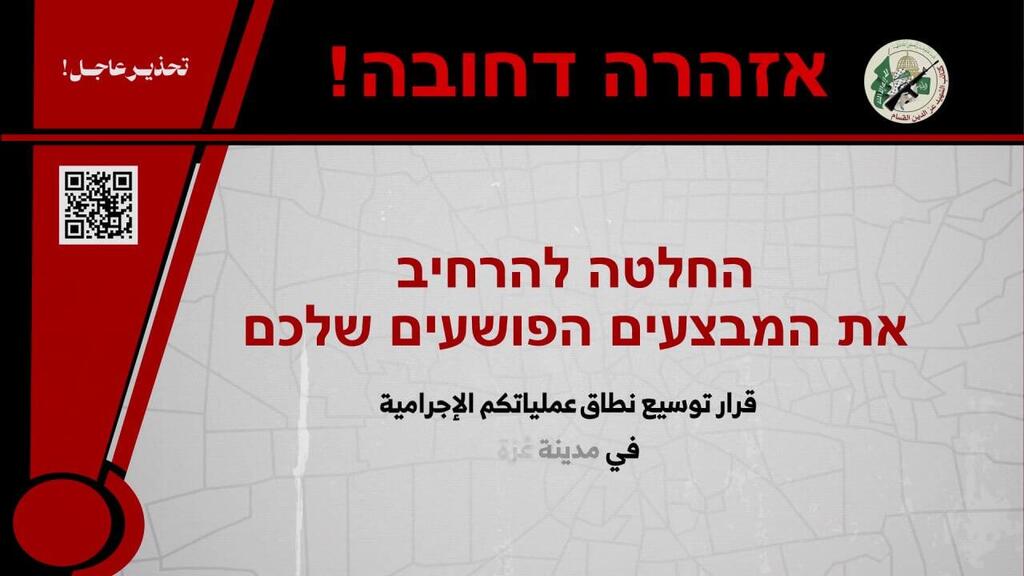
Screengrab from the first Hamas propaganda video released after the assassination of the group’s spokesman Abu Obaida, featuring particularly broken Hebrew
The IDF confirmed the killing of the spokesperson for Hamas’s military wing—a figure who was far more than a mere spokesman. Abu Obaida was a revered persona who became a role model for many young Palestinians drawn to join the terror group. He spoke in polished language, often citing Quranic verses and extreme Islamist ideology, which earned him admiration across the Palestinian street and the broader Arab world.
His charisma and ability to craft powerful messages gave him a central role not only within the military wing of the terror group, but also in shaping policy and leading Hamas’s international propaganda efforts—particularly during times of conflict, such as the current war in Gaza. Documents obtained by Ynet reveal the strategic importance Hamas assigns to its media apparatus, viewing it as an integral part of its military wing and a critical tool in the battle for public perception alongside battlefield operations.
“Military media is the spiritual preparation, injecting the spirit of awakening, justification, sacrifice, psychological readiness and mutual trust between the people and the armed forces, as well as reminding civilians of the historic glories of the nation,” read internal Hamas documents addressed to the group’s Department of Preparation and Training under its military operations division, the Izz ad-Din al-Qassam Brigades. This unit distributes instructional material and training programs for field commanders at the company and battalion levels.
The documents also include images and descriptions of terror attacks from the 1990s—some of the deadliest in Israel’s history—including the kidnapping of IDF soldier Nachshon Wachsman. Hamas views that incident as a “defining achievement,” not only due to the abduction itself but also for the way the operation was filmed and disseminated as part of the group’s media strategy.
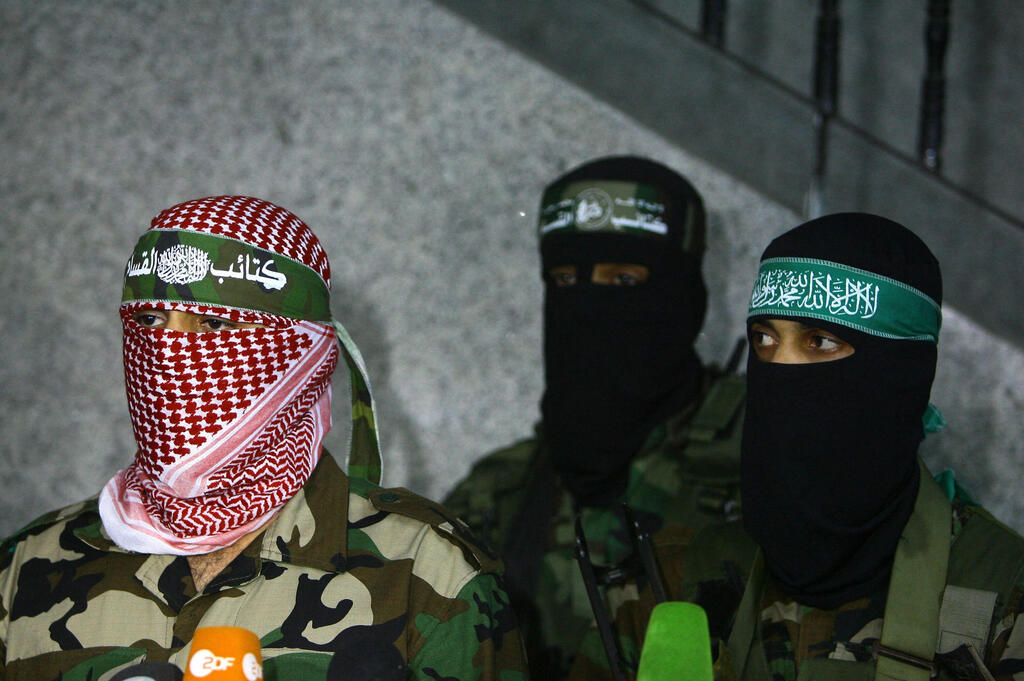
Abu Obaida (left)
(Photo: Mohammed ABED / AFP)
The group highlighted both the kidnapping and its documentation as a dual success—militarily and in the information war. “The importance of kidnapping soldiers and presenting demands via video—as in the abduction of Nachshon Wachsman, when Mohammed Deif and Salah Jadallah appeared in clips featuring the soldier on October 10, 1994.” More than two decades later, Hamas continues to reference the event as a model of “effective resistance,” showcasing it to a new generation of jihadists.
The documents indicate that Hamas does not view such events merely as history, but as a vital part of its ideological identity—intended to teach the next generation how to synchronize military action with strategic propaganda.
They also reference the filming and dissemination of suicide bombers’ “wills,” noting the first example was that of Salah Nazal, who carried out a suicide attack at Tel Aviv’s busy Dizengoff Center mall on October 19, 1994. This practice has since become a lasting tradition, with even lone attackers today often leaving behind written or recorded farewell messages.
Hamas also places great emphasis on the mass presentation of propaganda. The documents describe “televised speeches, press conferences, memorial ceremonies and public declarations” as integral parts of its psychological warfare. These are supplemented by displays of armed fighters, which continue to this day—especially around symbolic events such as the terror-filled hostage release ceremonies.
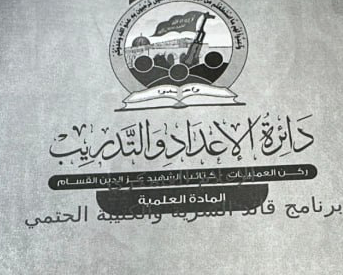
Documents reveal Hamas’s state-level propaganda and media apparatus, planned and organized with strategic precision
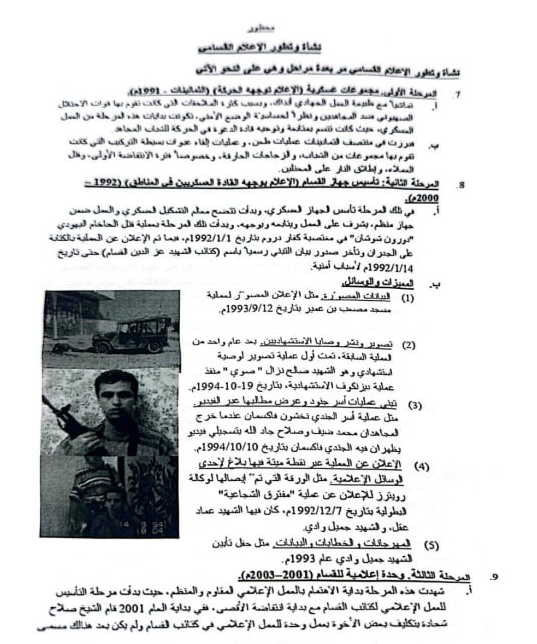
The documents expose Hamas’s worldview: its actions are not random but part of a systematic, well-coordinated strategy in which every military move is wrapped in a carefully crafted media narrative. This narrative aims not only to glorify the organization among its supporters but to project strength, resolve and victory—even when the battlefield reality tells a different story. Hamas sees its media operations not as a supplement to warfare, but as an independent front. As one document states: “The struggle is not only over territory—it’s over consciousness.”
According to the documents, Hamas assigns multiple roles to its military media: boosting morale among civilians and fighters, exposing the “enemy’s lies” and reinforcing a sense of justice in the war.
The group divides its propaganda efforts into two tracks—one for peacetime, the other for wartime. During calm periods, the focus is on fostering national pride, portraying fighters as heroes, maintaining operational secrecy and shaping public discourse in schools and communities. In times of war, the focus shifts to broadcasting videos of rocket fire and infiltrations, boosting public morale and spreading tightly timed messages to “show victory even in the face of military losses.”
The defense establishment has long warned that Hamas’s propaganda machine is far more than mere messaging—it is a central tool in mobilizing operatives and solidifying the group’s power.
IDF unmasks Abu Obaida


Hamas’s primary target audience is not only the population in Gaza, but also the Israeli public. The documents highlight efforts to “spread fear, confusion and erode national morale” in Israel. The group seeks to project continuity and strength, portraying itself as in control and committed to the fight—even when suffering losses on the battlefield.
Ultimately, these documents reveal that Hamas sees its media apparatus as a critical weapon—sometimes as effective as a missile or tank. A video, a poster or a Telegram post can become a weapon in its own right. The propaganda unit is what sustains the psychological war, even after the elimination of senior commanders—and perhaps even after the death of Abu Obaida, the strongest media figure Hamas ever had.