

Thousands of Israelis who sought to leave the country through Ben Gurion Airport on Thursday found themselves stuck for hours in huge lines and amid widespread chaos. After the exhausting day experienced by tens of thousands of passengers, here is a look at the players and the economic and political interests underlying operations at Ben Gurion Airport. We also explain the rights of passengers whose flights were canceled and look ahead to whether the scenes witnessed Thursday could happen again soon. ynet explains:
What actually happened at Ben Gurion Airport on Thursday?
At around noon, severe disruptions began at the airport as check-in counters closed, baggage belts were shut down and Ben Gurion Airport was even closed to incoming flights for about an hour. It was one of the busiest days of the year at the airport, with nearly 100,000 passengers and 600 flights. Passengers arriving at the airport encountered huge lines, numerous canceled or significantly delayed flights and some aircraft en route to Israel were forced to turn around in midair.
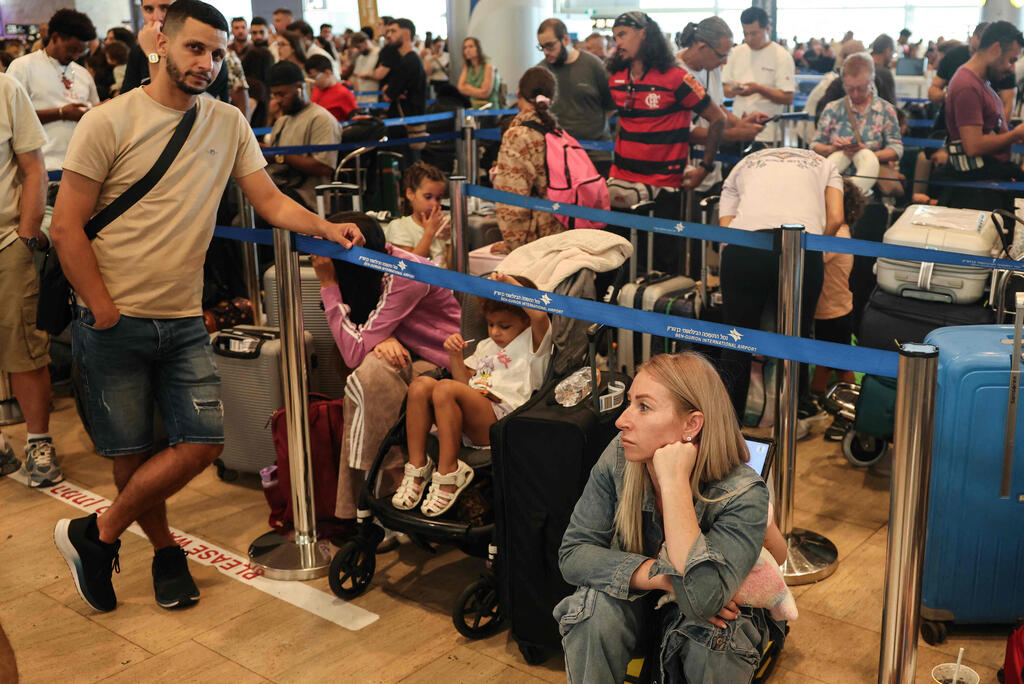
In addition, entrances to the airport parking lots were blocked, causing massive traffic jams in the area. Only three hours later, around 3 p.m., did the airport gradually begin returning to operation. But the chaos continued, with huge lines and flight delays, as well as repercussions at other airports. More than 10 flights, for example, were stranded Thursday at Paphos Airport in Cyprus because of the crisis at Ben Gurion. Sun d'Or, El Al's low-cost subsidiary, Arkia, Israir and TUS were forced to delay their departures because Ben Gurion was unable to receive the flights.
What led to the chaos at the airport?
The management of the Israel Airports Authority, which is responsible for operating the airport, accused the organization's workers' committee of initiating a surprise strike. About an hour after the disruptions began, the authority's management issued a statement saying: "The Israel Airports Authority is currently dealing with work disruptions, under the direction of the workers' committee, which are affecting operations and service to the traveling public. The authority's management calls on employees to immediately stop any action that could disrupt regular work and to restore full normal operations."
The statement added that "the authority views with severity any deliberate action that could harm the traveling public and the proper operation of Ben Gurion Airport, particularly during the summer peak period and amid high levels of activity."
The Airports Authority workers' committee, headed by Likud member Pinchas Idan, gave a different account, saying employees simply collapsed under the workload, caused both by the large number of flights Thursday and a severe shortage of staff. The committee said it had warned management about the shortage for a long time.
Idan said Thursday: "You can't just call it a strike and make up stories because everyone wants to cover themselves. In June I sent a letter saying there was a shortage of staff, and then they said, 'There's no shortage, there are Americans, there is Greece' — nonsense. A porter can't work 13 hours a day in this heat. What do you want, for people to collapse?"
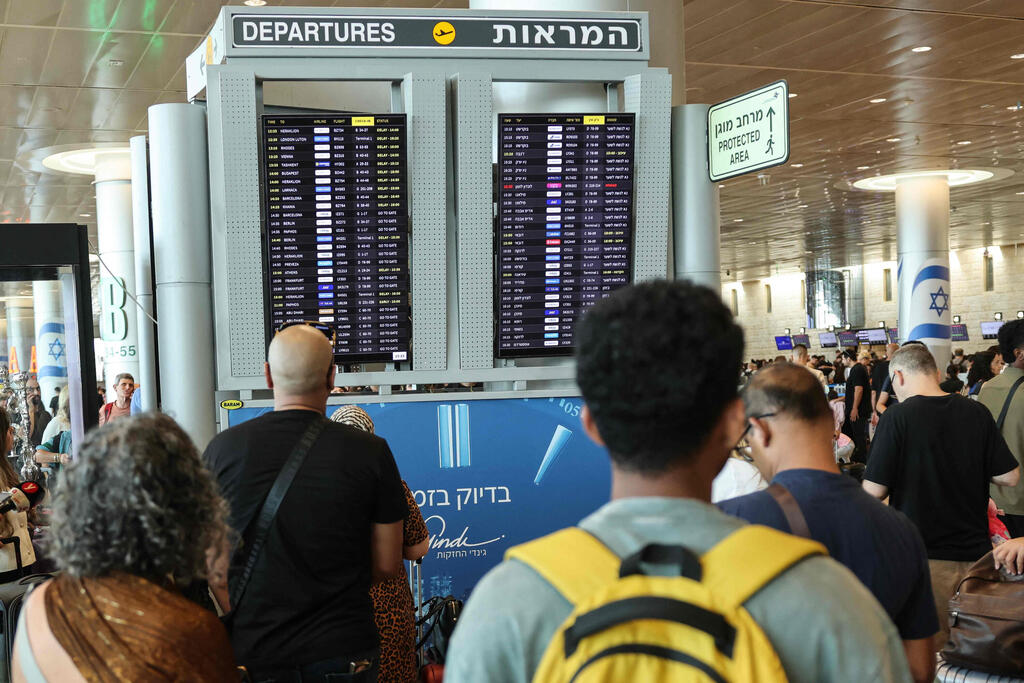
(Photo: Jack GUEZ / AFP)
Employees who abandoned their posts were summoned to disciplinary hearings.
A controversial employment model
According to sources on the workers' committee, one of the reasons for the severe staff shortage is the Airports Authority's employment model. The system is based on a clear operational constraint: work at the airport is seasonal.
The model consists of three groups: permanent employees, temporary employees covered by a collective agreement and workers who sign two-year contracts in advance. The committee argues that because the airport requires a huge workforce during the peak summer season while the number of flights drops significantly in winter, there is no justification or room for all employees to receive permanent status.
The result, according to the workers, is that the authority frequently parts ways with employees regardless of their skills and contribution in order to avoid having too many permanent employees, particularly during periods when workloads decline significantly. This allows the authority to avoid the long-term financial and organizational commitments associated with permanent employees while maintaining managerial, operational and budgetary flexibility.
But the price, according to the workers, is a chronic shortage of employees during peak periods because the authority struggles to recruit new workers to replace those who leave.
What was agreed in talks between management and the workers' committee?
Following talks between the Airports Authority chairman, its director general and the workers' committee chairman, employees returned to full-scale work, at least for the time being.
At the same time, it was agreed that a significant effort would be made to increase staffing levels and address operational needs. The chaos at the airport continued even after the agreement because of the backlog that accumulated during the hours of disruption.
When check-in operations and flights are disrupted, they create a chain reaction affecting the flight schedule, airlines and thousands of passengers. As a result, even after operations resume, it takes time for the airport to return to normal.
What should you do if your flight was canceled?
Passengers whose flights were canceled must deal directly with their airline to receive an alternative ticket or a full refund, which under Israeli law should be provided within 21 days.
As for passengers whose flights departed without their luggage, Airports Authority Director General Sharon Kedmi told Channel 12 News Thursday evening: "Anyone who flew without their baggage — airlines generally put the baggage on subsequent flights. It's very unpleasant, very inconvenient, but you receive your baggage after you fly."
When will Ben Gurion Airport return to full operations?
Airports Authority Chairman Yiftah Ron-Tal told ynet he hoped the crisis would be resolved by Friday morning. However, given the broader staffing shortage, which had already caused disruptions last week, further congestion cannot be ruled out, particularly during the upcoming Jewish holiday season.
"I just came from a tour of the check-in halls. Fortunately, the airport is returning to full capacity and even beyond that. We're increasing the number of departing flights and will actually double them in the coming hours. It's all aimed at closing the gaps. I very much hope that by Friday morning we'll reach a situation in which the airport is back to normal operations," Ron-Tal said.
Kedmi added regarding the Tishrei holiday period that "we'll do everything we can to make sure everything is OK," but noted that it is always a busy period.
Claims of a politically motivated strike
Just Wednesday, Prime Minister Benjamin Netanyahu and Transportation Minister Miri Regev toured Ben Gurion Airport. Regev was even photographed with the Airports Authority workers' committee chairman and Likud member Pinchas Idan. Following the visit, Regev and senior ministry officials traveled to Morocco.

Netanyahu and Regev at Ben Gurion Airport, Wednesdayy
Some in Likud have claimed that those who caused the chaos at Ben Gurion did so deliberately to harm Netanyahu and Regev and that even the timing was not coincidental.
"There was no labor dispute declared," a senior Likud official said. "There were no threats or preliminary steps indicating such a dramatic strike. The extreme measure taken is typical after a labor dispute has been declared or when a severe blow has been dealt through cuts or a reform that is impossible to swallow. None of that happened in this case. So what did happen? A clear attempt to harm Regev and, indirectly, Netanyahu."
Later Thursday, Netanyahu ordered the expulsion of Idan from the Likud party. A statement released by the party said that "following the wild and illegal strike at the airport that harmed the country's citizens and damaged the economy, Netanyahu instructed to expel Pinchas Idan from party membership."
What is the cost to the economy?
The Finance Ministry estimates that the economic damage from Thursday's Ben Gurion strike amounted to approximately 25 million to 30 million shekels ($7.5 million-$9 million).
According to the ministry, the damage includes passengers' lost time, direct and operational costs for airlines, lost revenue for the Airports Authority and airport operators, disruptions to cargo and courier traffic and damage to supply chains, as well as losses to the tourism and hotel industries.
The Finance Ministry points to three structural problems that it says underlie the repeated damage caused by such incidents: Israel's very limited aviation infrastructure capacity, its complete dependence on a single airport and an Airports Authority workers' committee that, according to the ministry, prevents efficiency, flexibility and development.